

Healthcare marketers in India: what the strongest ones do differently
Reviewed on by Gaurav Phogat. Statistics checked against their original sources on the same date.
The best healthcare marketers are the ones who can be trusted with a hospital’s name: they keep claims inside NMC and ASCI rules, earn the trust of doctors, plan demand around real capacity and protect patient trust. There is no credible ranking of individuals, so this sets out the healthcare-specific practices that separate them, how to hire one and how to become one.
This article is part of the leadership from the CXO seat series, best read in order from the pillar.
Last updated: 29 October 2026.
People search for the best healthcare marketers in India expecting a list of names. There is no credible one. What circulates is usually an award shortlist people paid to enter, an agency round-up of its own clients, or a conference speaker line-up. None of them measures the only thing that matters in a hospital, which is whether patients who needed care found it, trusted it and turned up.
I have hired marketing heads, inherited them, worked alongside them across units, and been let down by a few who interviewed brilliantly. Most of the habits that make a good marketer anywhere also matter in a hospital. This piece is about the ones that do not travel: the rules on medical claims, the relationship with doctors, the hard limit of beds, theatres and consultant calendars, and the particular trust a patient extends when they are frightened. That is where generalists stumble and where the strongest healthcare marketers quietly earn their place.
It is written for three readers: the CEO or board about to appoint a head of marketing for a hospital, the marketer who wants to become that person, and the peer checking their own habits against it.
They measure honoured appointments, not leads
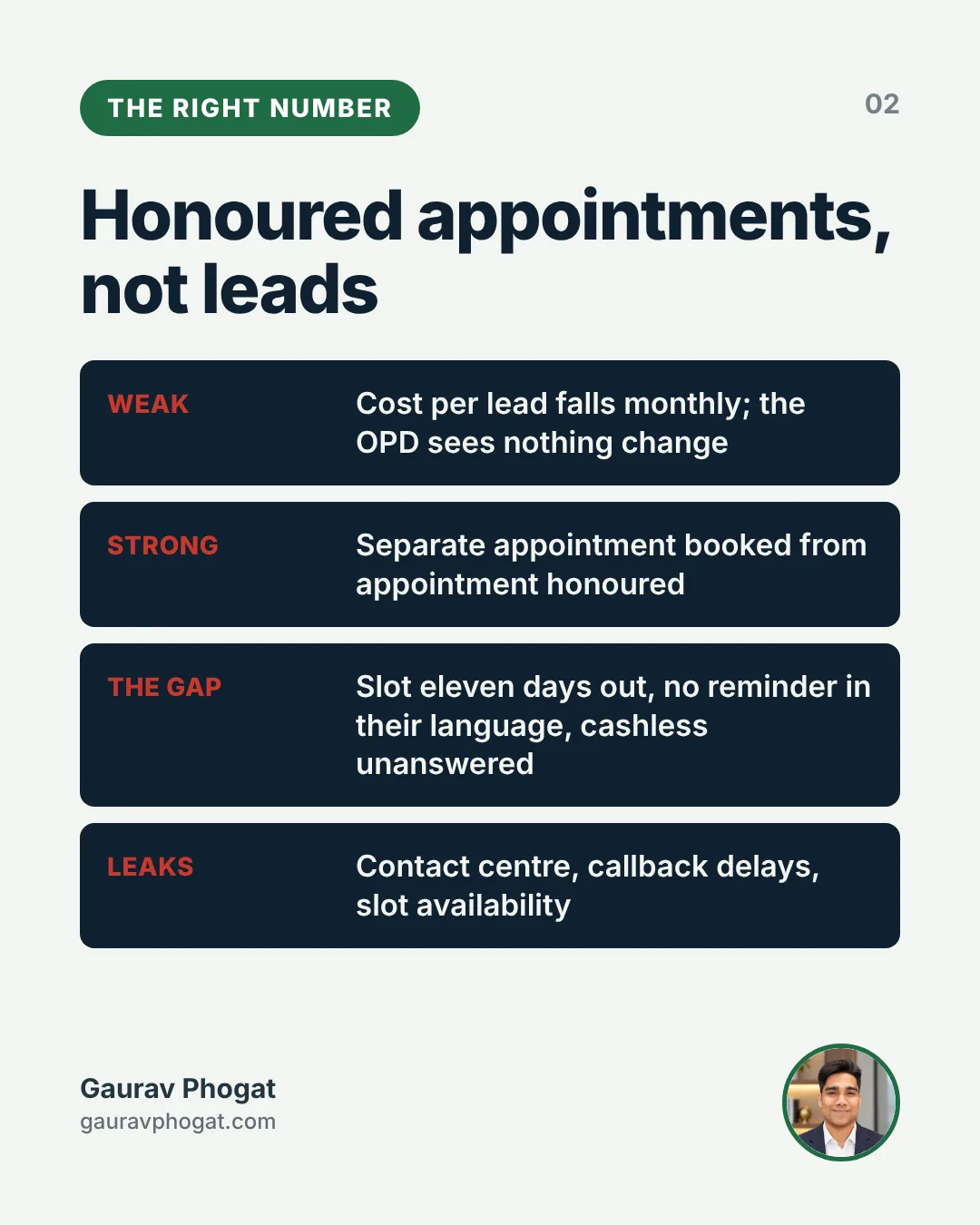
The best healthcare marketers judge their work by booked and then honoured appointments by unit and service line, not by leads. They accept that the first honest number will be lower than the old dashboard and focus on the enquiry-to-appointment rate, because in a hospital that is where most of the money leaks away.
The weakest hospital marketers I have worked with were not lazy. They were measured on the wrong thing and got very good at it. Cost per lead fell every month, the agency review was pleasant, and the units saw nothing change in the OPD.
The strong ones separate two numbers that most dashboards blur: the appointment booked and the appointment honoured. In healthcare the gap between them is large and it has causes you can fix, such as a slot offered eleven days out, a family that never got a reminder in its own language, or a cashless question nobody answered. They know the enquiry-to-appointment rate leaks in the contact centre, in callback delays and in slot availability, and they go to those places rather than waiting for a report about them.
They know the NMC and ASCI rules before legal has to explain them
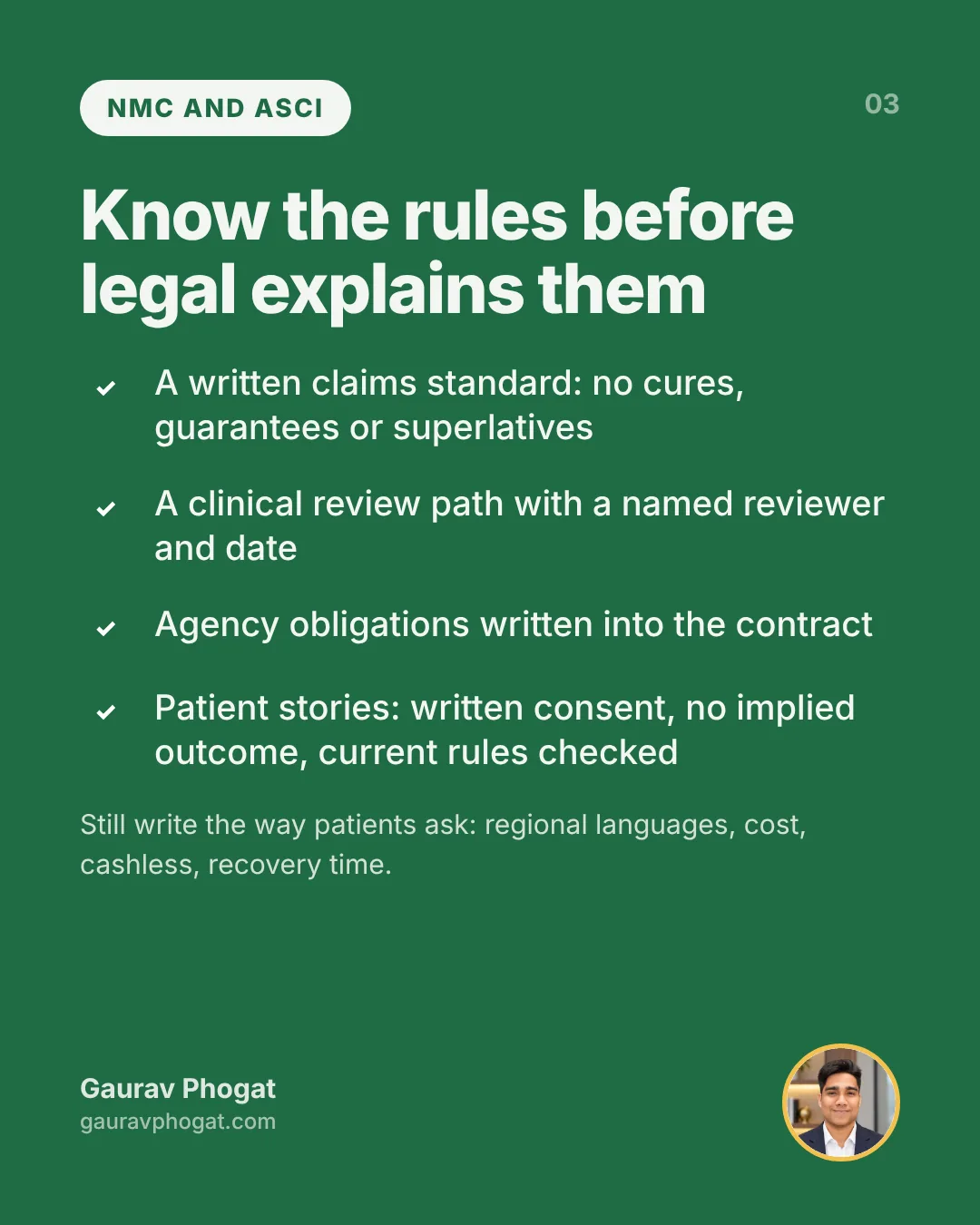
Healthcare is one of the few categories where a marketing line can create a professional misconduct problem for a doctor. The best healthcare marketers know the NMC rules on what doctors may say or allow in their name and the ASCI code on truthful, substantiated claims, and they write a claims standard the medical director signs.
Two sets of rules sit over hospital marketing in India, and a strong marketer keeps both in their head. The National Medical Commission governs the conduct of registered doctors, which includes what appears in a doctor’s name, on their profile and in content they front. ASCI’s code applies to the advertiser, which means the hospital itself: claims have to be truthful and capable of substantiation, and advertising should not exploit fear. I have set out the NMC advertising guidelines clause by clause, and what hospital ads can and cannot say across both, separately.
What I see the best marketers do is turn that into a working system rather than relying on legal to catch problems late.
- A written claims standard. No cure language, no guarantees, no unsourced success rates, no comparative superlatives, and no outcome promise placed beside a doctor’s photograph.
- A clinical review path. Any line that makes a clinical statement is read by a clinician before it goes live, with a named reviewer and a date.
- Agency obligations in the contract. The agency signs up to the standard, so approval is not a negotiation every time.
- Care with patient stories. Written consent, no implied outcome, and a check against current NMC and ASCI rules before a story or image is used.
Within those rules, they still write the way patients actually ask: in regional languages where the catchment needs it, about cost, cashless and recovery time. Accuracy and warmth are not in tension. Carelessness and excessive caution are both just easier.
They earn doctors’ trust before they use doctors’ names
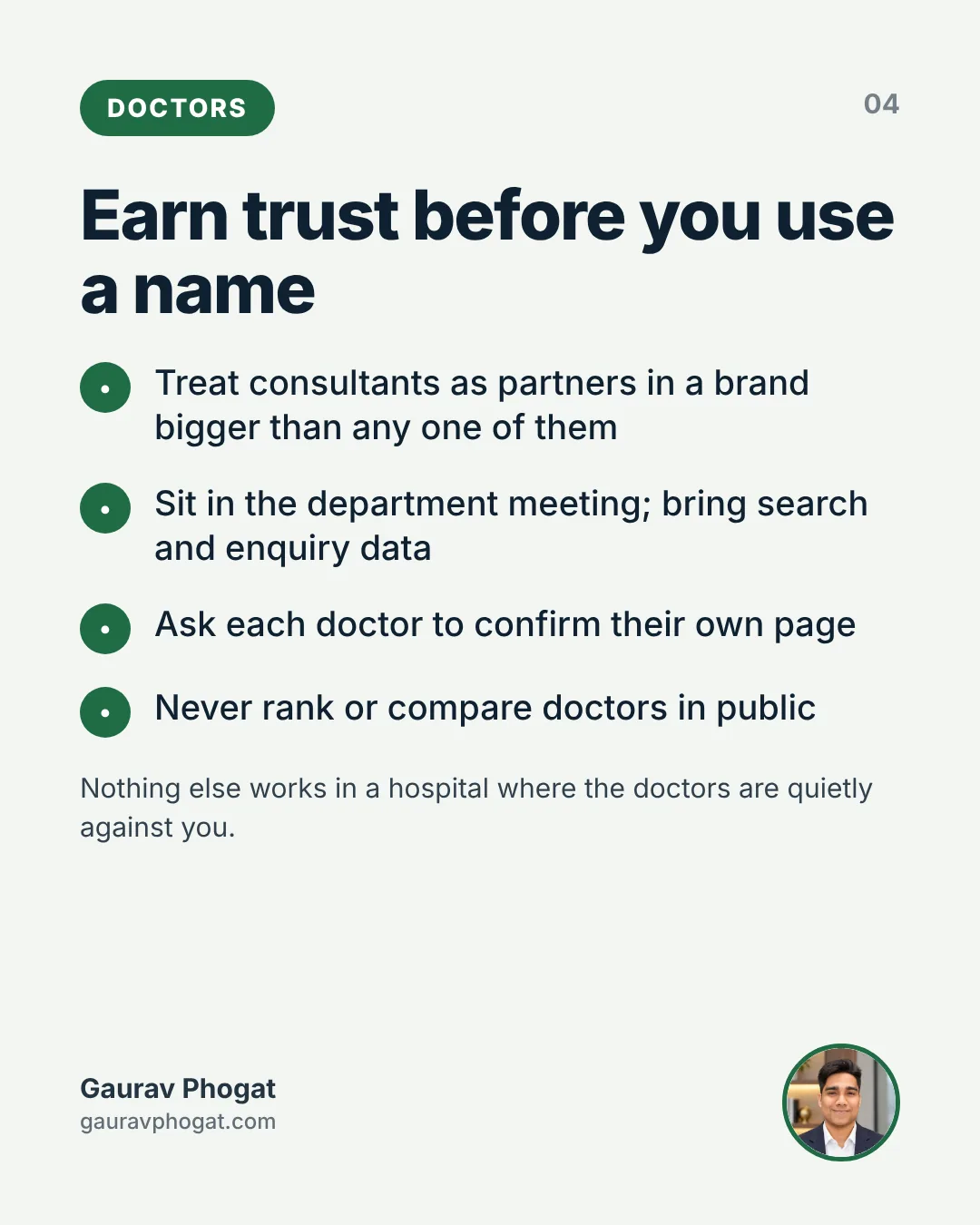
The best healthcare marketers treat consultants as partners in a brand bigger than any individual, because doctors move and a brand built on a few names leaves with them. They bring doctors demand data, ask for help rather than approval, and never place a claim beside a doctor without that doctor reading it first.
Weak hospital marketing treats consultants as inventory: a headshot, a list of degrees, a campaign built around whoever joined most recently. Strong marketing treats them as partners in a brand that has to be bigger than any one of them.
In practice this means the best marketers spend real time with clinicians. They sit in the department meeting. They bring data the doctor has never seen: what patients search for, which questions the contact centre cannot answer, why second-opinion enquiries go elsewhere. They keep each doctor page accurate and ask the doctor to confirm it, rather than discovering an outdated qualification when a patient points it out. And they never rank or compare doctors against each other in public, because that is the fastest way to lose a whole department.
The trade-off is time. Earning a department’s trust is slow, and a marketer under quarterly pressure will skip it. The good ones do it anyway, because nothing else in this piece works in a hospital where the doctors are quietly against you.
They plan demand around capacity, not around the media calendar
A hospital cannot sell what it cannot schedule. Strong healthcare marketers look at consultant calendars, theatre slots and bed occupancy before they spend, pull demand away from services that are full, push it towards those with room, and treat a patient sent to a three-week wait as money lost.
This is the habit that most clearly separates healthcare marketers from good marketers in other sectors. A retailer with more demand than stock can take a backorder. A hospital with more demand than consultant time sends a worried family to a competitor, and the family remembers.
The best marketers I have worked with keep a simple weekly view, built with operations, of next available slots by consultant and service line, theatre availability for the procedures they promote, and occupancy at the units they are sending patients to. When the next slot for a consultant moves beyond a couple of weeks, they reduce spend on that consultant’s service and route enquiries to a colleague with room, with the department’s agreement. When a new consultant has an empty calendar, that is where the money goes.
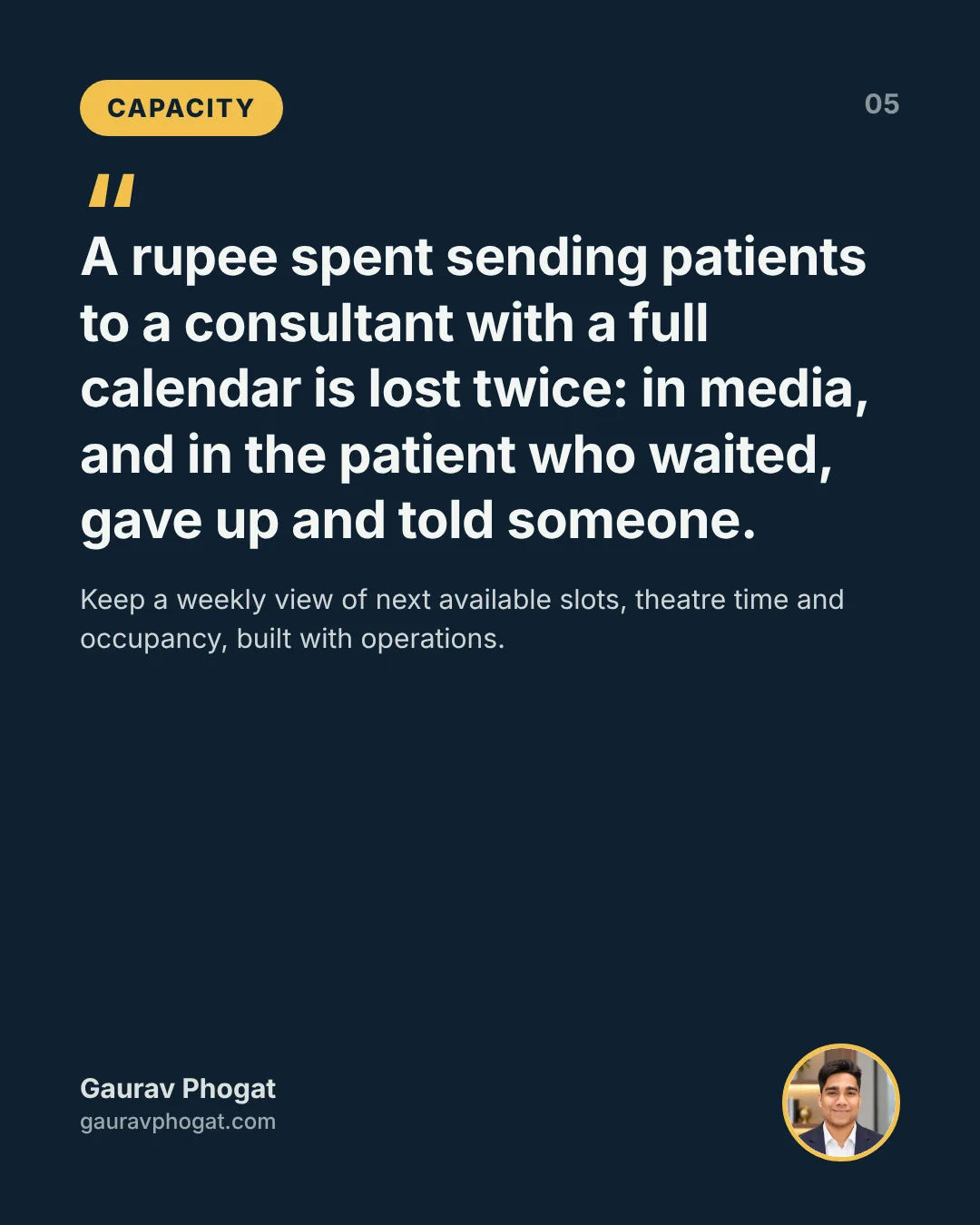
They also understand that a rupee spent sending patients towards a consultant with a full calendar is a rupee lost twice: once in media and again in the patient who waited, gave up and told someone. It is a sentence a CFO and a medical director both respect, and it is usually the first time either of them has heard it from marketing.
They build demand before a launch, not after it
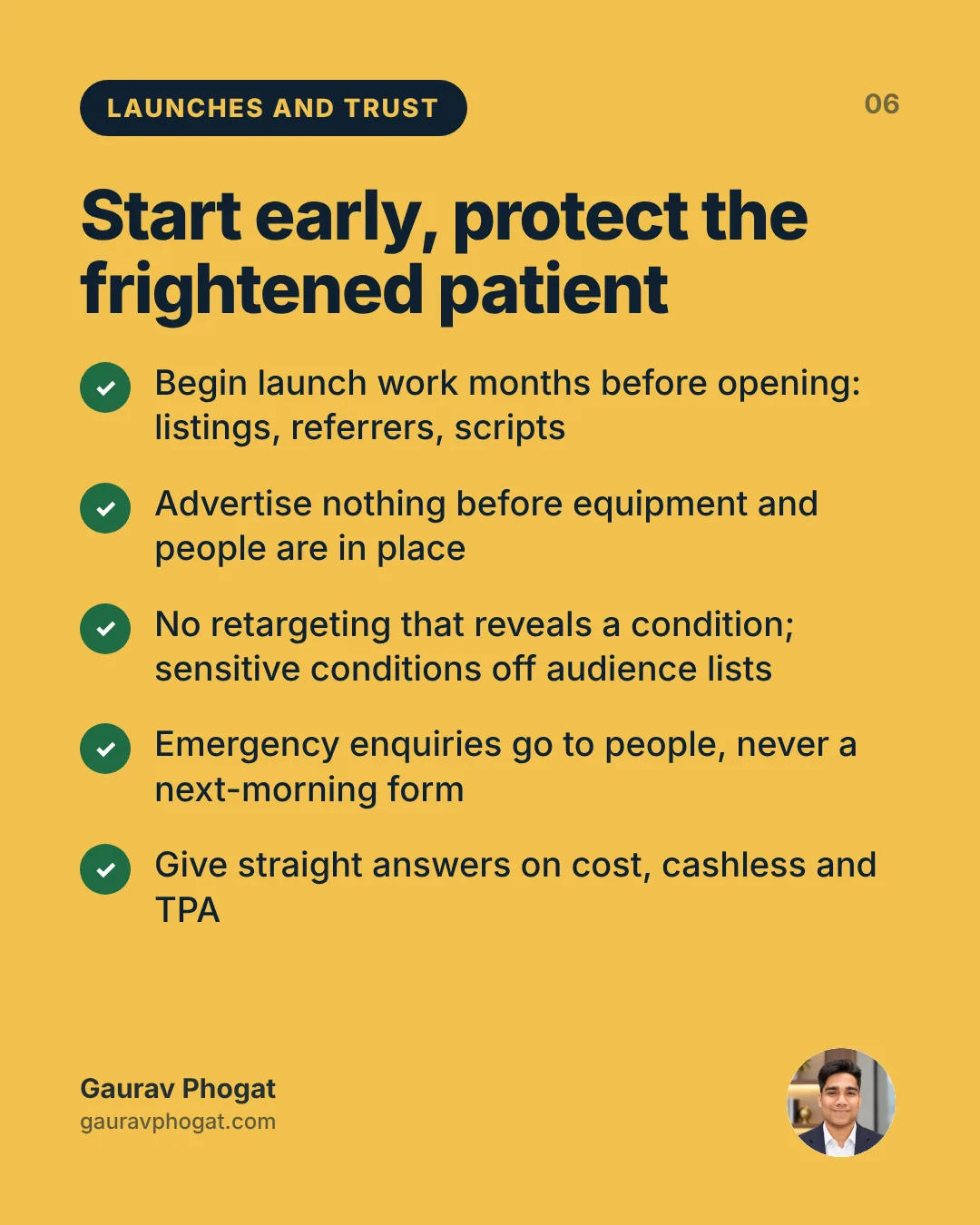
Strong healthcare marketers start launch work many months before a hospital or service opens, often before any consultant can be named. They build search presence, listings, catchment referral relationships, contact-centre scripts and language rosters, and treat the first ninety days as measurement of conversion, locality response and capacity rather than celebration.
One of the easiest ways to spot an average marketer is to watch them at a hospital launch. The campaign starts a few weeks before opening, the ribbon is cut, and everyone waits for the OPD to fill.
The best ones start many months earlier. They build the search presence, the listings, the referral relationships with local practitioners in the catchment, the contact centre scripts and the language roster, and they publish doctor pages the day appointments are confirmed. They agree with the medical team which services will be ready on day one and which will follow, so nothing is advertised before the equipment and the people are in place. They treat the first ninety days as a measurement exercise (which service lines convert, which localities respond, where capacity will bind first) and when a launch stalls, they say so early instead of buying more media to hide it.
They protect patient trust where it is most fragile
Patients share illness, fear and money worries with a hospital before they ever meet a doctor. The best healthcare marketers design for that: no retargeting that reveals a condition, emergency enquiries routed to people rather than forms, honest answers on cost and cashless, and clinically reviewed content signed by a named consultant.
Healthcare data describes someone’s illness, and a marketer who treats it like retail browsing data will eventually embarrass the hospital. The strong ones ask hard questions about retargeting visitors to condition pages before anyone else has to, and they keep sensitive conditions out of audience lists entirely. Consent is captured clearly at every form and messaging channel, and nobody is messaged who did not opt in.
They also design the front door for the frightened version of the patient. An emergency or chest pain enquiry should never land in a form that is answered the next morning. Cost, cashless and TPA questions get a straight answer, because a family that cannot find the price assumes the worst. And content that answers medical questions is clinically reviewed and attributed to a named consultant, which is what both patients and search engines look for when they decide whether to trust a hospital’s explanation.
They keep local referral knowledge alive across units
In multi-unit hospital groups, the best marketers centralise the CRM, data, brand standards and media buying, but leave local relationships, health camps and knowledge of who refers whom with each unit. They make sure a metro flagship and a new Tier 2 unit both get what they need without either feeling neglected.
Hospital demand is more local than most marketers expect. A large share of it moves through relationships: the family physician who refers, the nursing home that transfers, the corporate that sends its employees, the camp that brought in the first screening. None of that sits in an ad account.
The best marketers in multi-unit groups decide carefully what is centralised and what stays with the unit, and they protect the local part from being flattened by a central plan. A flagship in a metro and a new unit in a Tier 2 city need different things: the flagship needs specialty depth and second-opinion demand, the new unit needs to become known to the doctors around it. They write down who the unit’s referrers are, so the knowledge does not walk out of the door with one relationship manager, and they handle the politics of centralisation without making unit heads feel something has been taken from them.
How can a CEO spot a strong hospital marketing head?
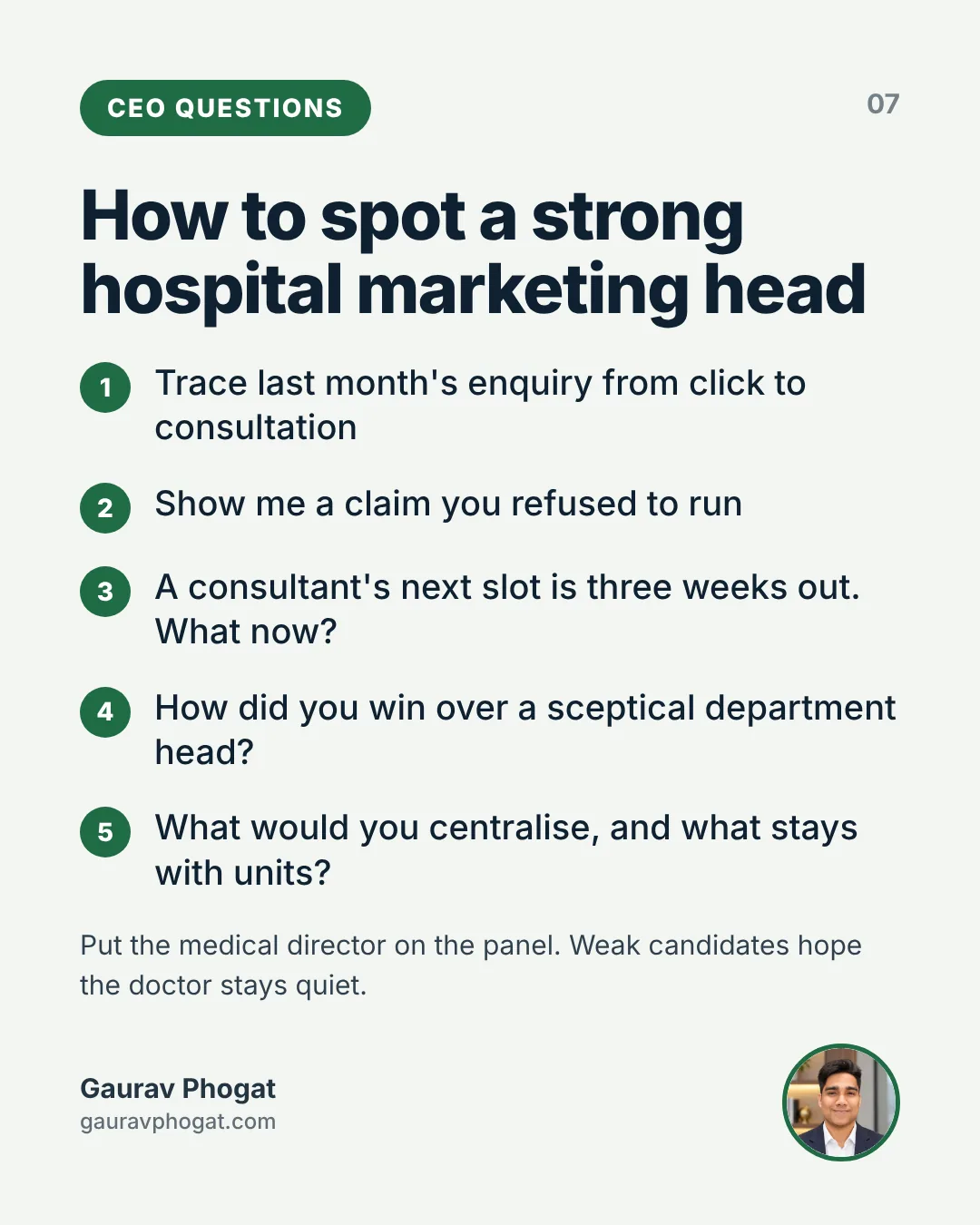
Ask healthcare-specific questions. Have candidates trace an enquiry from click to consultation, show a claim they refused to run, explain what they do when a consultant’s calendar is full, describe winning over a sceptical department head and explain how a cashless enquiry works. Red flags include superlatives in their past ads and promising growth before checking slot availability.
Boards and CEOs usually hire the best presenter on the shortlist. In a hospital that is a poor filter. The strongest healthcare marketer is often the quietest person in the room, and the only one who asks to see the call recordings and the consultant rosters before the final round. These are the questions I ask now.
- “Walk me through what happened to an enquiry last month, from the click to the consultation.” Strong candidates know the stages, the leaks and the owners. Weak ones describe the campaign.
- “Show me a claim you refused to run, or changed, and why.” Anyone who has worked in healthcare for long has one, and the answer tells you whether they understand NMC and ASCI limits or just fear legal.
- “A consultant’s next available slot is three weeks out. What do you do with the campaign?” Listen for a conversation with operations, not more spend.
- “How did you get a sceptical department head to work with you?” Listen for specifics: the meeting, the data, what they conceded.
- “How does a cashless enquiry differ from a self-pay one at the front desk?” A marketer who cannot answer has not followed a patient past the form.
- “What would you centralise here, and what would you leave with the units?” There is no right answer. There is a thoughtful one.
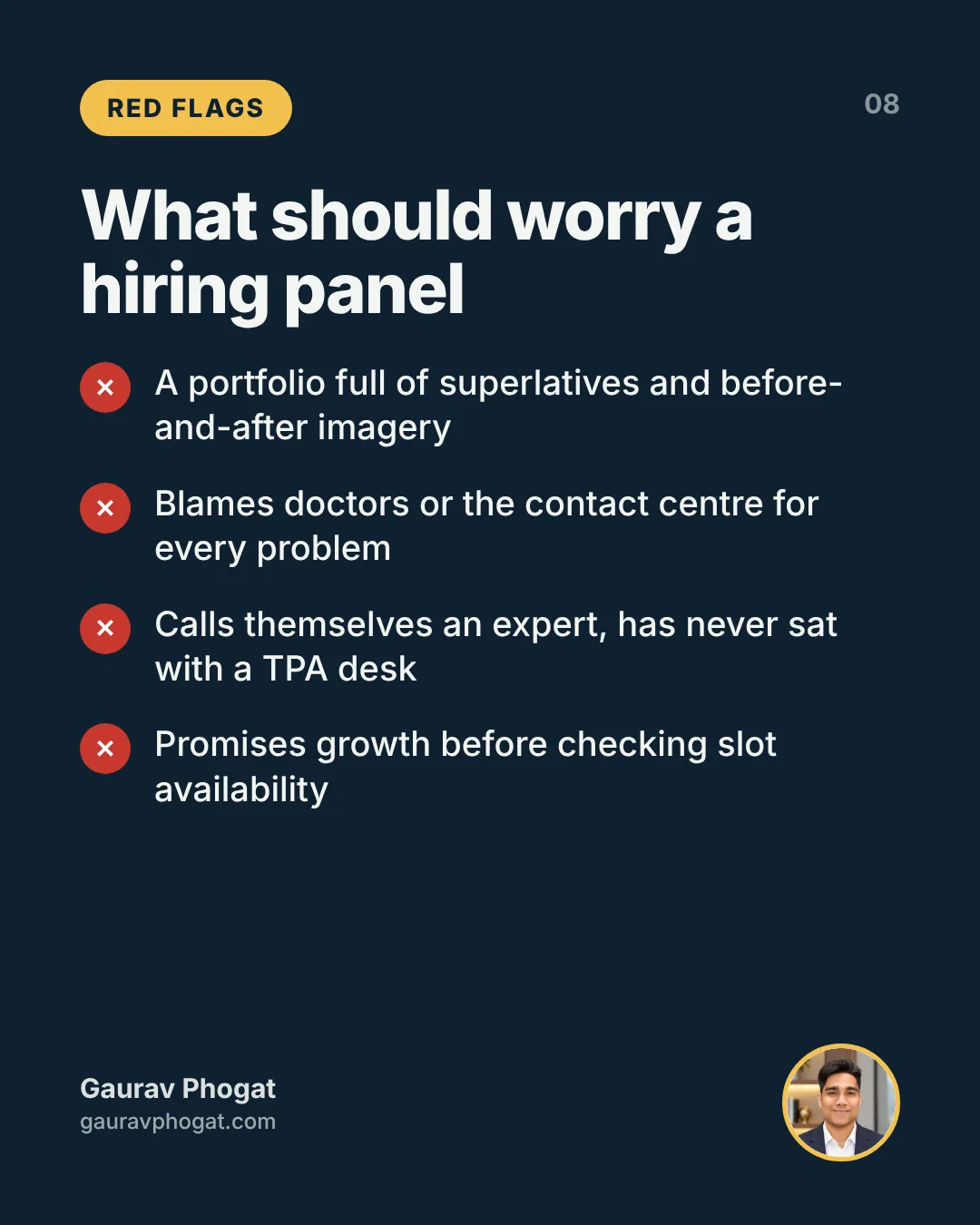
The red flags are consistent. A portfolio full of superlatives and before-and-after imagery. A candidate who blames the doctors or the contact centre for every problem. Someone who calls themselves a healthcare marketing expert and has never sat with a TPA desk. And anyone who promises growth before they have looked at your slot availability.
One note for the panel itself: put the medical director on it. Good candidates welcome the clinical questions. Weak ones perform for the CEO and hope the doctor stays quiet.
How do you become one of the best healthcare marketers?
Spend a week in the contact centre, adopt one department and earn its head’s trust, get a claims standard signed by the medical director, set up a weekly capacity review with operations, audit how patient data from condition pages is used, and learn how cashless and TPA approvals work at the front desk.
If you are a marketer who wants to be the person described above, the route is less glamorous than an award entry and much more reliable. This is the sequence I would follow, starting next quarter.
- Spend a week in the contact centre. Listen to calls, sit through a night shift, and write down every enquiry you watch die.
- Adopt one department. Pick a service line, earn the trust of its head, and make it the proof that working with marketing is worth a clinician’s time.
- Write a claims standard and get the medical director to sign it before anyone asks you to.
- Set up a weekly capacity review with operations, and change spend at least once because of what it shows.
- Audit your patient data. Check which condition pages feed audiences, where consent is captured, and stop anything you would not want to explain to a patient.
- Learn the cashless desk. Spend a morning with the TPA team and follow three insured patients from enquiry to admission.
- Sit in a launch readiness review for a new service, and make sure nothing is advertised before it can be delivered.
None of these steps will get you on a list. All of them will show up in the weekly review, and in the clinicians who now take your calls.
Average versus strong healthcare marketing practice
The difference between average and strong healthcare marketers shows up in the parts of the job that only exist in a hospital. The table compares typical behaviour on claims, doctors, capacity, launches and patient data, which gives hiring managers and marketers a practical way to judge a hospital marketing function.
| Area | Average practice | Strong practice |
|---|---|---|
| Claims | Legal catches problems late | A claims standard the medical director signed |
| Doctors | Headshots as inventory | Partners who read every claim in their name |
| Capacity | Spend follows the media plan | Spend follows slots, theatres and beds |
| Launches | Campaign a few weeks before opening | Demand built months ahead, then measured |
| Patient data | Condition pages feed retargeting | Sensitive conditions kept out of audiences |
Key statistics, with sources
The commercial backdrop raises the stakes for healthcare marketing in India. Households still pay a large share of health spending directly, private hospital revenues are forecast to keep growing quickly, and digital now takes most advertising money, so marketers who can link spend to treated patients are increasingly valuable.
- Out-of-pocket spending by households made up 43.4% of India’s total health expenditure in 2022-23, according to the National Health Accounts Estimates released by the Ministry of Health and Family Welfare. Source: PIB, National Health Accounts Estimates for India 2022-23, May 2026.
- Revenue of private hospitals in India is expected to grow 14 to 15% in fiscal 2027, based on Crisil Ratings’ analysis of 98 private hospitals that account for nearly two-thirds of sector revenue. Source: Crisil Ratings press release, February 2026.
- India’s advertising market reached Rs 1,55,105 crore in 2025, with digital accounting for 60% of it, according to the Pitch Madison Advertising Report 2026. Source: Pitch Madison Advertising Report 2026, reported by Social Samosa, February 2026.
Sources and further reading
- Google Search Central: Creating helpful, reliable, people-first content: Google’s guidance on experience, expertise and trust for health topics.
Questions people ask
Healthcare marketers help patients find, understand and choose a hospital or doctor, and then make sure the enquiry turns into a consultation. In a hospital that means search and listings, doctor pages, content that is clinically reviewed, campaigns that stay inside NMC and ASCI rules, and close work with the contact centre and operations so demand matches the capacity to treat it.
Average healthcare marketers manage campaigns and report leads. The best ones manage the whole journey to the consultation, keep every claim inside medical advertising rules, earn the trust of doctors, and plan spend around consultant calendars, theatres and beds. They also protect patient data from condition pages, which generalist marketers often treat like any other browsing data.
Ignore the portfolio of creative and ask hospital questions. Have candidates trace one enquiry from click to consultation, show a claim they refused to run, and explain what they would do when a consultant has no slots for three weeks. Put your medical director on the panel. The strongest candidate is often the one who asks to see your call data and rosters first.
Enough to stop problems before legal sees them. NMC rules govern what registered doctors may say or allow in their name, and the ASCI code expects advertising claims to be truthful and substantiated. In practice that means no cure language, no guarantees, no unsourced success rates and no superlatives, with a clinician reviewing anything that makes a clinical statement.
Respect for their name and their judgement. Doctors want to see every claim made in their name before it goes live, and they respond well to marketers who bring them demand data they have never seen, such as what patients search for and which questions go unanswered. What they resist is being treated as a headshot in a campaign or compared publicly with colleagues.
Build a weekly view with operations of next available slots by consultant, theatre time for the procedures you promote and occupancy at the units you send patients to. Reduce spend where the wait is long, move it to consultants and services with room, and agree routing with the department. Demand sent to a full calendar costs media money and patient goodwill.
It can work, and some of the strongest people come from retail, telecom or other consumer businesses. The risk is someone who brings consumer instincts such as discounts, superlatives and aggressive claims into a setting governed by medical ethics and clinician trust. Test for humility about clinical boundaries and curiosity about the contact centre and the cashless desk.
Carefully, because it describes illness. Keep sensitive conditions out of retargeting and lookalike audiences, capture clear consent at every form and messaging channel, and message only people who opted in. Ask whether you would be comfortable explaining each use of the data to the patient. If not, stop it before legal or a patient raises it.
Yes, if the role owns something real. Strong healthcare marketers are drawn to scope, meaning the enquiry funnel, the contact centre, the referral relationships and the data, more than to a large media budget. A single hospital that gives its marketing lead authority over conversion and a direct line to the CEO will often attract better people than a larger group offering only agency management.
Spending before diagnosing, launching campaigns before winning over the medical director, and advertising services that do not yet have the consultants or equipment to deliver them. Another common one is blaming the contact centre for losses that are really about slot availability. The quieter mistake is ignoring local referrers, who often matter more to a unit than any campaign.
Start where hospitals are different. Spend a week in the contact centre, adopt one department until its head trusts you, get a claims standard signed by the medical director and set up a weekly capacity review with operations. Learn how the cashless desk works and audit how patient data is used. None of it wins awards; all of it shows up in appointments.
Read my takes first in Google Search