

Top digital marketers in India: the hands-on skills that matter
Reviewed on by Gaurav Phogat. Statistics checked against their original sources on the same date.
The top digital marketers in India are separated not by follower counts or rankings but by hands-on craft: measurement they own, performance media fed the right signals, CRM and automation people want, SEO and GEO that compound, and experiments that prove what worked. No credible ranking of individuals exists, so this sets out ten skills and how to test for them.
See every healthcare digital growth guide in one place.
Search for the top digital marketers in India and you get lists. Ten names, sometimes twenty, each with a headshot, a follower count and a course link somewhere near the bottom. Look at who published them and the pattern is plain: most are written by the people on them, by agencies ranking their own founders, or by course sellers for whom the list is the first step of a sales funnel.
I run digital for a large hospital group, and across hospitals, retail, telecom and media I have hired, managed, replaced and learned from a fair number of digital marketers. This piece is about the craft: the hands-on skills that separated the people I would hire again from the ones I would not. It is deliberately practical. The leadership side of marketing and the parts that only apply in hospitals are covered in their own pieces, linked at the end.
Why no list of the top digital marketers in India holds up
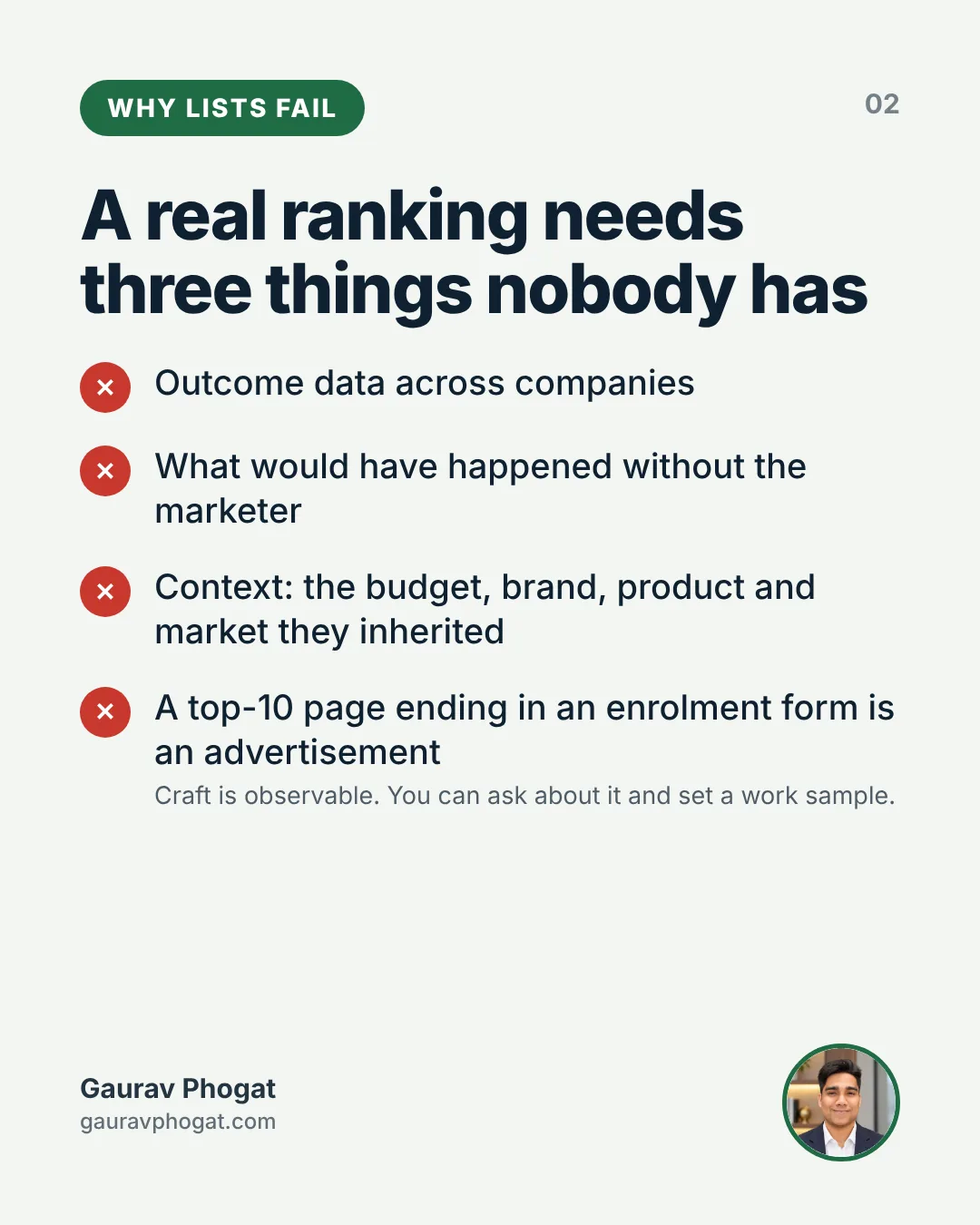
A credible ranking of digital marketers would need outcome data across companies, an estimate of what would have happened without each marketer, and the context of the budget, brand, product and market they inherited. Nobody has all three, so published lists measure visibility and self-promotion rather than the results that actually distinguish strong digital marketers.
A real ranking would need three things nobody has: outcome data across companies, a view of what would have happened without the marketer, and context (the budget, the brand, the product and the market they were handed). A person who grew a category leader with a generous budget and a person who kept a weak brand alive in a Tier 2 market on very little are not comparable on any screenshot.
What the lists measure instead is visibility. The marketers with the largest audiences are, by definition, good at marketing themselves. That is a genuine skill, and it is a different job from building an acquisition engine for someone else’s P&L. When a “top 10 digital marketing experts in India” page ends in an enrolment form, it is not a ranking. It is an advertisement with a table of contents. Judge people on craft instead. Craft is observable: you can ask about it, set a work sample and watch it in the first ninety days.
The ten skills at a glance
The strongest digital marketers own their tracking and first-party data, feed ad platforms the right conversion signals, fix the path after the click, run performance media as a craft, build SEO that compounds, prepare for GEO and AI answers, run CRM and automation with consent built in, manage agencies with scorecards, prove incrementality and kill failed tests fast.
- They own tracking and first-party data rather than renting the truth from platforms.
- They feed ad platforms the right signal.
- They fix the conversion path after the click.
- They run performance media as a craft.
- They build SEO that compounds.
- They prepare for GEO and AI answers.
- They run CRM and automation that people actually want.
- They manage agencies with real scorecards.
- They prove incrementality instead of assuming it.
- They test quickly and kill things without sentiment.
Measurement and media
Strong digital marketers build their own tracking plan, join campaigns to outcomes in the CRM and send those outcomes back to the ad platforms as conversion signals. They know the path after the click as well as the ad, and they treat account structure, bidding, creative testing and budgets as a craft rather than something the platform automates for them.
1. They own tracking and first-party data
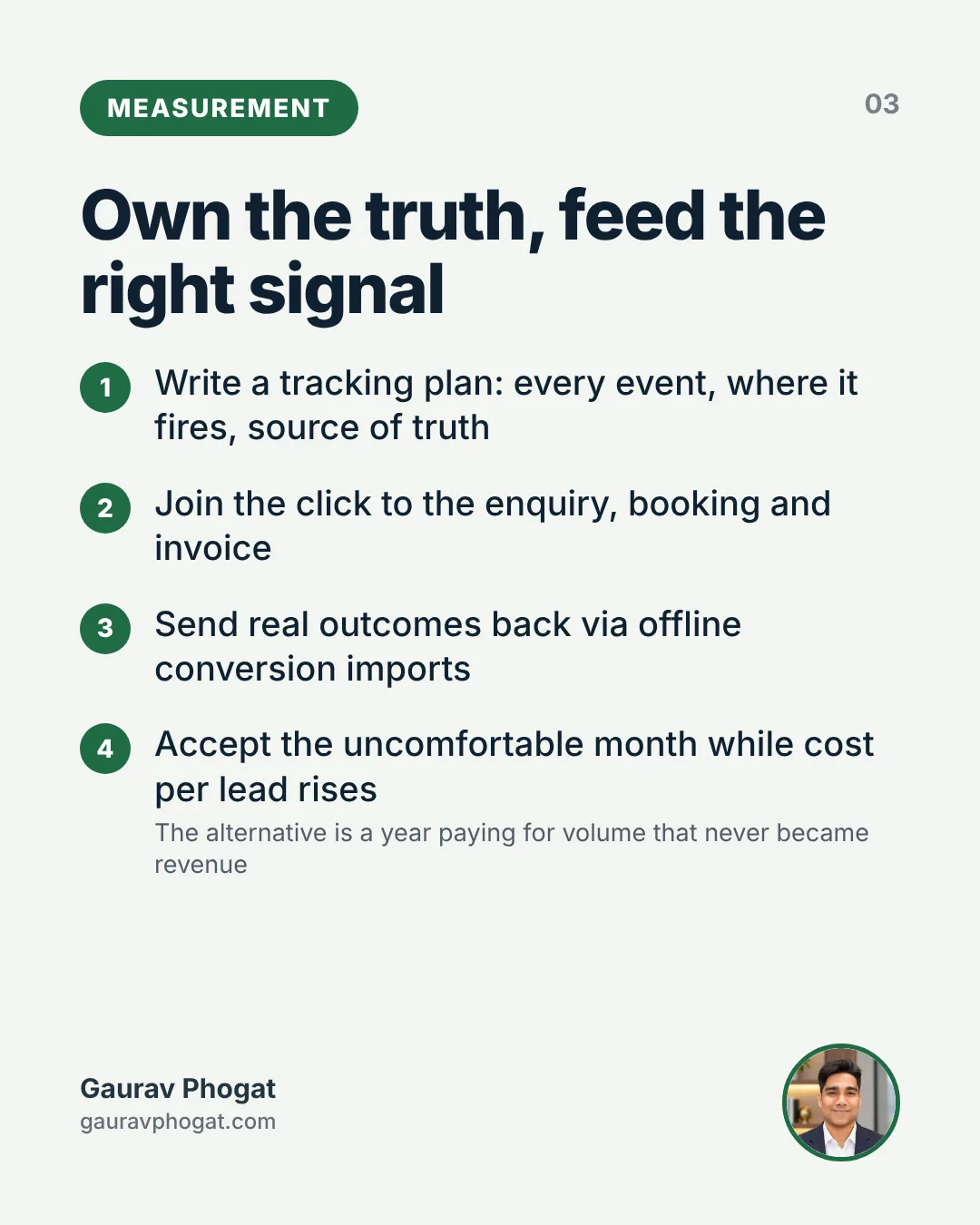
The weaker marketer reports what the platform reports. Every platform claims credit for the same customer, so the sum of the dashboards is always larger than the business. The stronger one writes a tracking plan: every conversion event, where it fires, what it is called and which system is the source of truth. They know where the truth lives (the enquiry record, the CRM, the booking, the invoice) and they have built, or insisted on, the join between a click and a paying customer.
They are honest about the limits. Phone calls, walk-ins, multiple devices and family members who search on someone else’s behalf make perfect credit impossible, and I have written about what attribution can tell you and where it runs out. And they treat consented first-party data (the phone numbers, email addresses and messaging opt-ins your customers gave you directly) as an asset the business owns, not a by-product the agency holds.
2. They feed ad platforms the right signal
Ad platforms optimise towards whatever signal you feed them. Feed them form fills and they will find people who fill forms. The strongest digital marketers decide first what the business actually needs (a booked and honoured appointment, an enrolment rather than an enquiry, revenue net of returns) and then send that outcome back to the platform through offline conversion imports, so the bidding learns from customers rather than clicks. Where outcomes differ in value, they pass the value too.
This costs something in the short term. Cost per lead rises, the volume of conversions the platform sees falls, and the algorithm needs time to relearn. The marketer worth hiring is willing to have that uncomfortable month, because the alternative is a year of paying for volume that never became revenue.
3. They fix the conversion path after the click
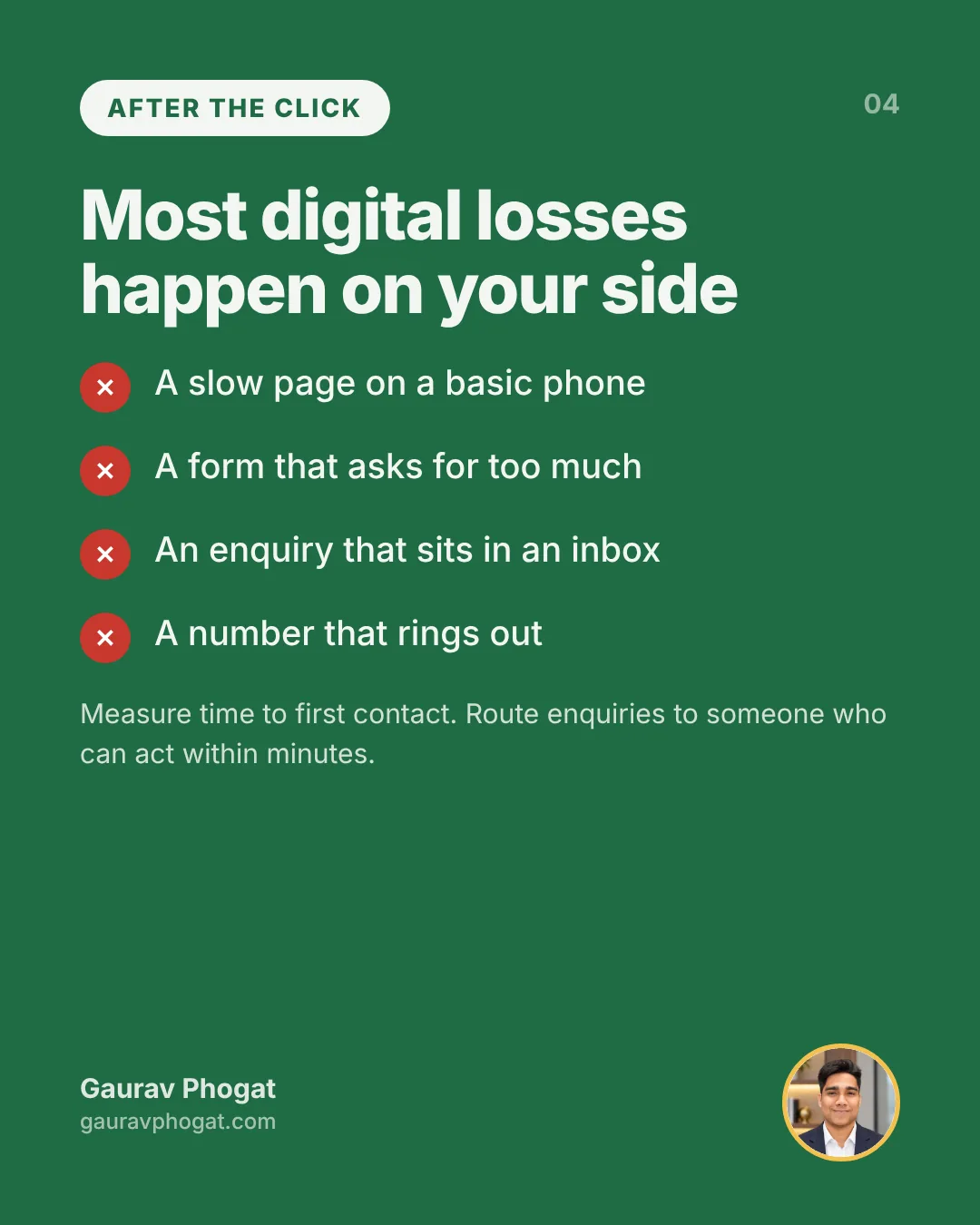
Most digital losses happen after the click: a slow page on a basic phone, a form that asks for too much, an enquiry that sits in an inbox, a number that rings out. The strong digital marketer treats the landing page, the form and the speed to first response as part of their job, not someone else’s. They measure time to first contact, test shorter forms against longer ones that filter better, and set up automatic routing so an enquiry reaches a person who can act on it within minutes.
They also understand the product well enough to say when digital is not the problem. If the price is wrong or the offer is unclear, more spend makes the numbers worse, and they will say that in the room.
4. They run performance media as a craft
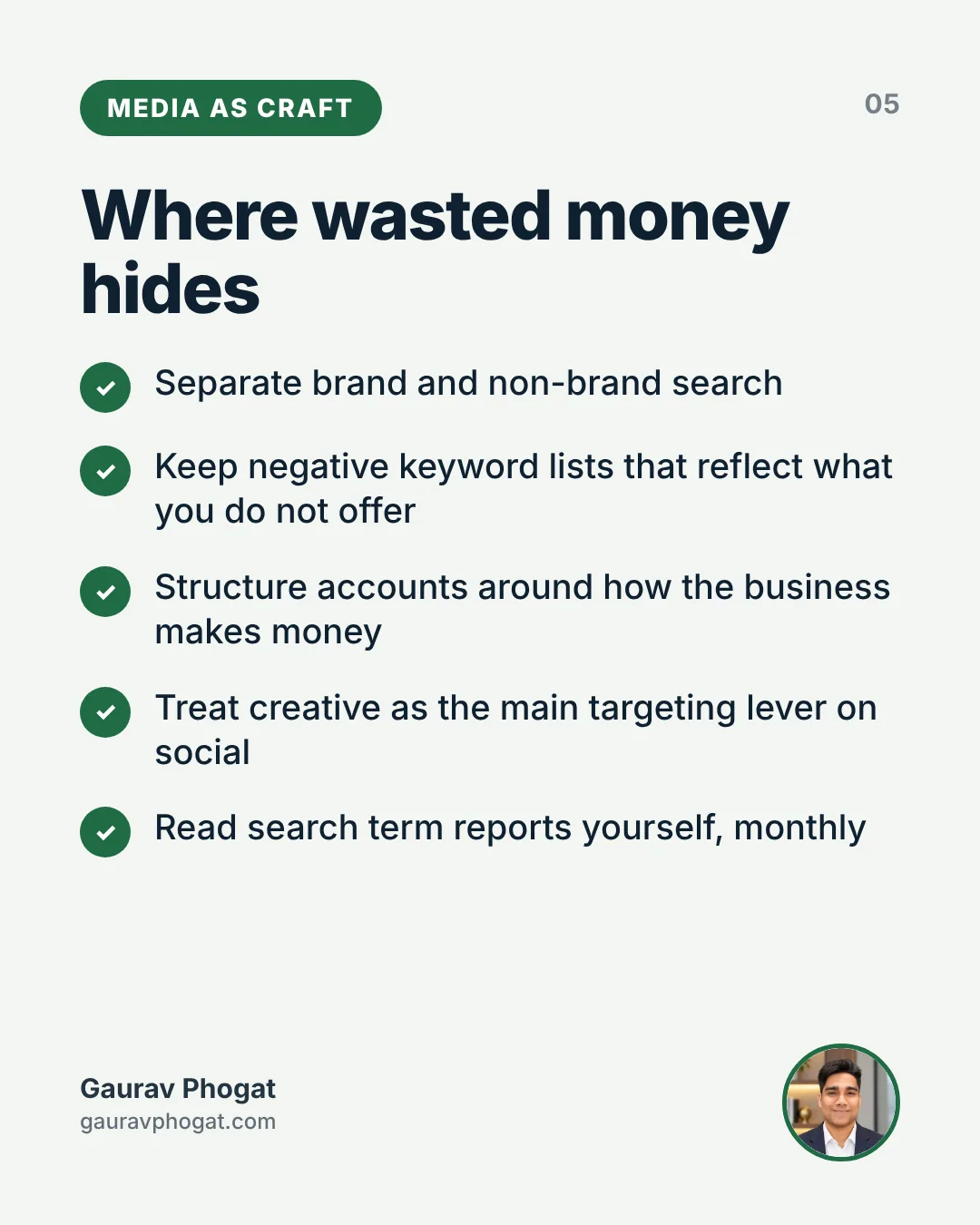
Automation has taken over a lot of what used to be manual, which makes judgement more important, not less. The strong ones separate brand and non-brand search so brand traffic does not flatter blended efficiency, keep negative keyword lists that reflect what the business does not offer, and structure accounts around how the business makes money rather than how the agency bills. On social platforms they treat creative as the main targeting lever, test a few clear variations at a time and retire them when frequency climbs. They read search term reports themselves at least once a month, because that is where wasted money hides.
Search, GEO and CRM
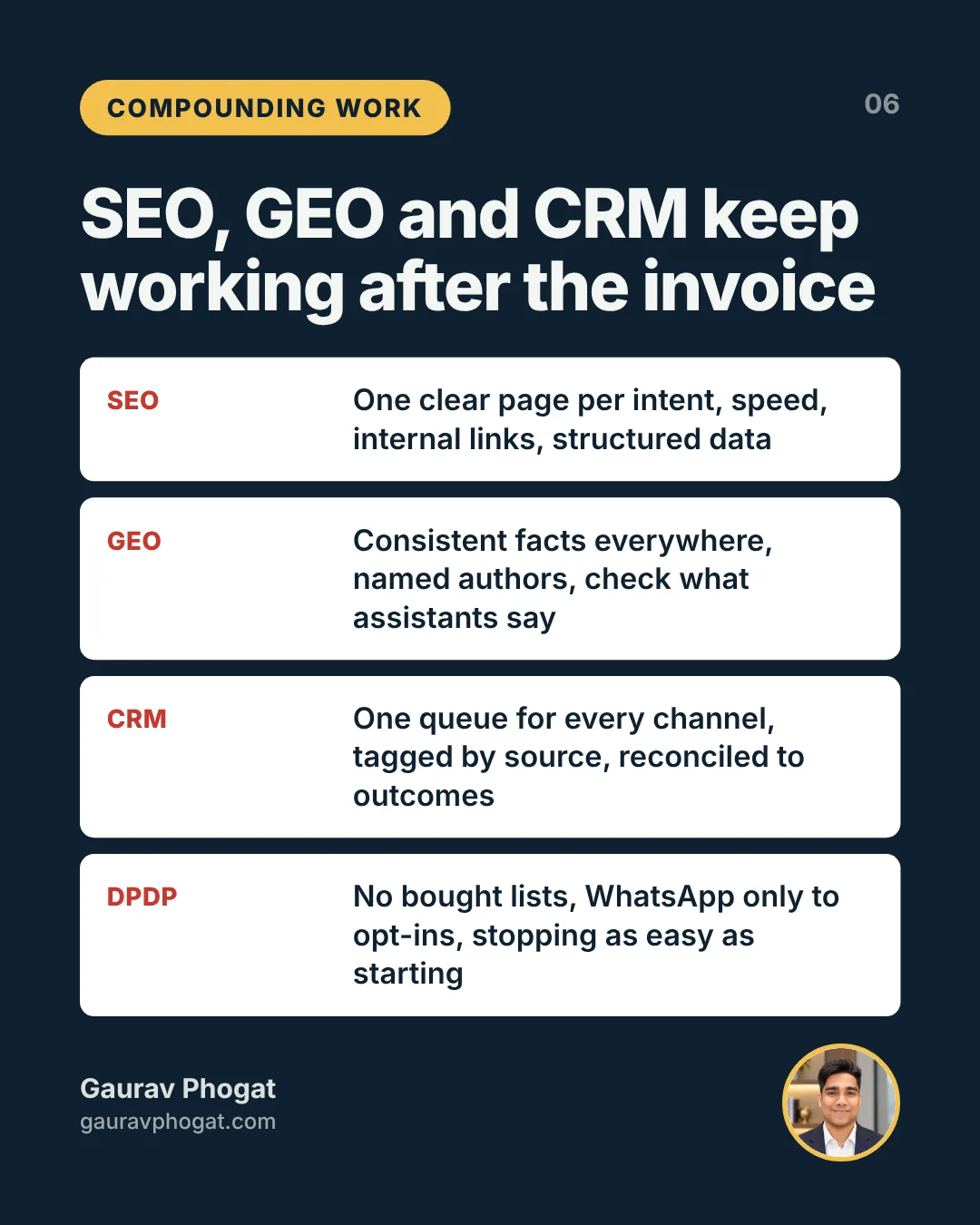
Paid media stops the day the budget stops, while SEO, well-built pages and owned customer relationships keep working. The best digital marketers protect that compounding work, prepare their entity data and content for AI answers, and run CRM and automation that customers opted into and actually value.
5. They build SEO that compounds
Organic search, well-built service pages, locality pages that match how people actually search, and content that answers the real question keep working after the invoice is paid. The strongest marketers run paid and organic together and protect the compounding work from being raided every time a quarter looks thin. They care about the unglamorous parts: site speed, internal linking, structured data, one clear page per intent rather than five overlapping ones, and fixing what Search Console flags before writing anything new.
They also take brand seriously. Byron Sharp’s argument about mental availability (being the brand that comes to mind when the need arises) is why a well-known brand converts search traffic that a lesser-known one has to pay far more to reach. A digital marketer who dismisses brand as unmeasurable usually ends up paying for its absence in the auction.
6. They prepare for GEO and AI answers
Answer engines now summarise before anyone clicks, and the answer names a few brands and ignores the rest. Generative engine optimisation, or GEO, is the work of being one of the sources those answers rely on. The strong marketers adjusted early without declaring search dead. They keep the organisation’s facts consistent everywhere they appear (names, addresses, services, people), because a machine will not reconcile contradictions on your behalf. They write pages that each say one clear, specific thing and attribute expert content to a named person. And they check, regularly and by hand, what the main assistants actually say about the brand, because no dashboard does it for them.
With AI tools they are neither evangelists nor refusers. They use them for drafting, variation, analysis and the first pass of a brief, and they know exactly where the output cannot be trusted. If you are hiring specifically for this, the questions that separate an AI marketing expert from someone who has watched the demos deserve their own list.
7. They run CRM and automation that people actually want
Seth Godin argued years ago that marketing people agree to receive works better than marketing that interrupts them. The strong digital marketers build on that. They own the CRM requirement even when IT owns the system: how enquiries from every channel land in one queue, how duplicates are merged, how each record is tagged with its source, and whether outcomes reconcile with the core business system. Then they build lifecycle journeys on top: reminders before an appointment, follow-ups after it, useful messages at the moments a customer needs them, and nothing in between for the sake of activity.
India’s DPDP framework has turned permission from a good idea into an obligation, and it shapes how consent is collected, what data may be used for and how long it is kept. The strong marketers treat that as a design problem they share with legal. They do not buy lead lists, they message on WhatsApp only people who opted in, and they make stopping as easy as starting.
Partners and proof
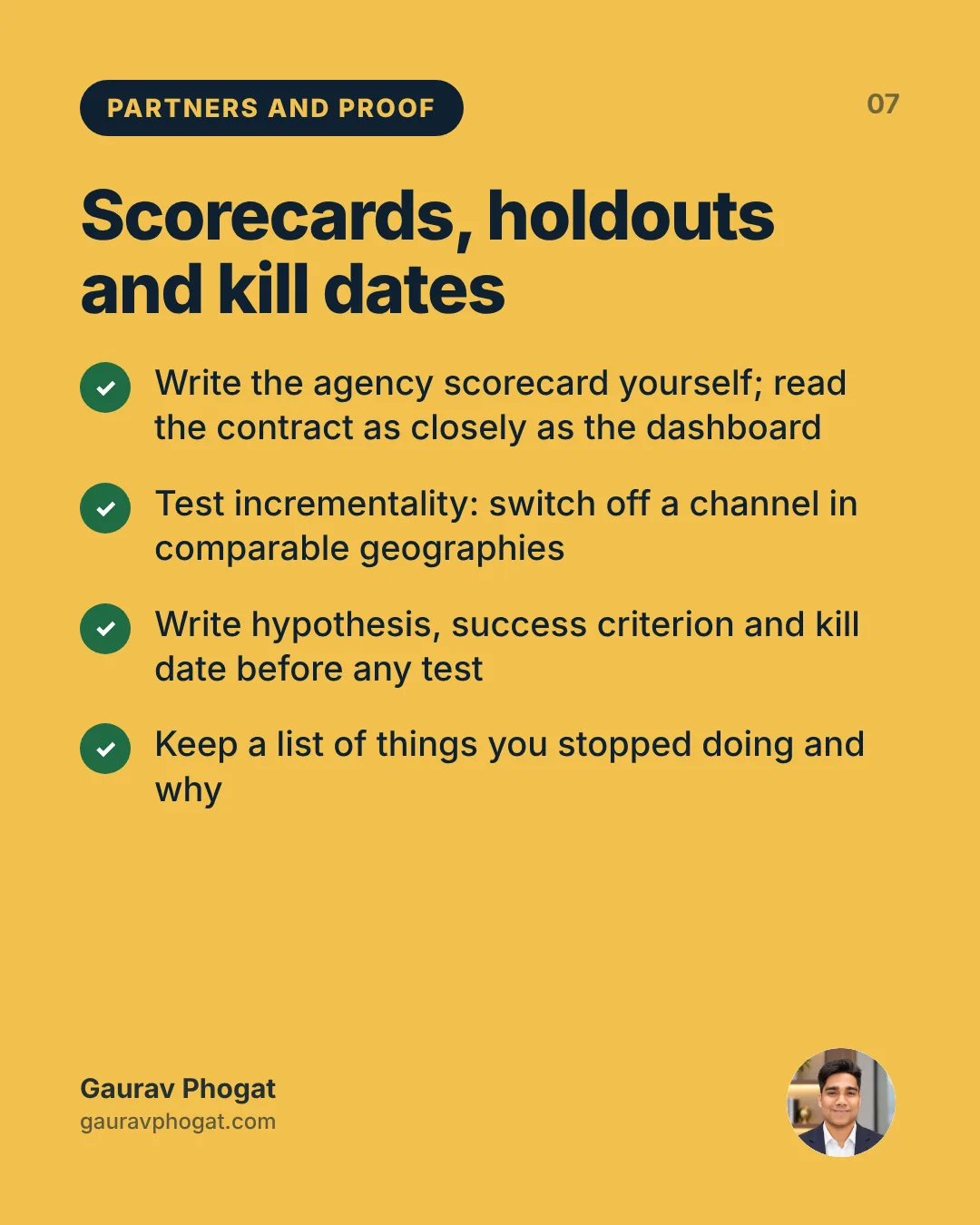
Strong digital marketers write their own agency scorecard and read contracts as closely as dashboards. They prove incrementality with holdout or geography tests rather than trusting platform claims, and they set a success criterion and a kill date before every test starts, so failures end quickly and lessons are kept.
8. They manage agencies with real scorecards
Most agency relationships are judged on the agency’s own report. The stronger marketer writes the scorecard: the outcome metric, contactability, share of spend on non-brand terms, how quickly tests launch, and how often the agency recommended cutting spend rather than adding it. They read the contract as closely as the dashboard, because agency incentives shaped by a percentage of media or a fee per lead quietly steer every recommendation. They know the account well enough to audit it themselves once a quarter, and they set the outcome and the constraints rather than becoming the agency’s project manager.
9. They prove incrementality instead of assuming it
Attribution tells you who touched the customer. Incrementality tells you whether the spend changed anything. The strong marketers know the difference and test for it: switching a channel off in a set of comparable geographies for a few weeks, holding back a share of the audience from a campaign, or pausing brand search where competitors are absent to see how much traffic arrives anyway. The results are rarely clean, and they say so, but an honest estimate from a holdout beats a confident number from a platform marking its own homework.
10. They test and kill things fast
Most tests fail, and that is fine if they fail quickly and cheaply. The strong marketers write down the hypothesis, the success criterion and the kill date before a test starts, so nobody can move the goalposts after it disappoints. They make sure a test has enough volume to tell them something before they call it. They keep a short list of things they stopped doing and why. The weaker ones keep every campaign alive because switching one off feels like admitting it was a mistake.
How to judge a digital marketing expert before you hire one
Judge a digital marketing candidate with a short work sample and questions only real practitioners can answer in detail: how they would set up tracking and offline conversions, which campaign they switched off and why, how they tested incrementality, and what a failed test taught them. Vague answers about creativity or reach are a warning sign.
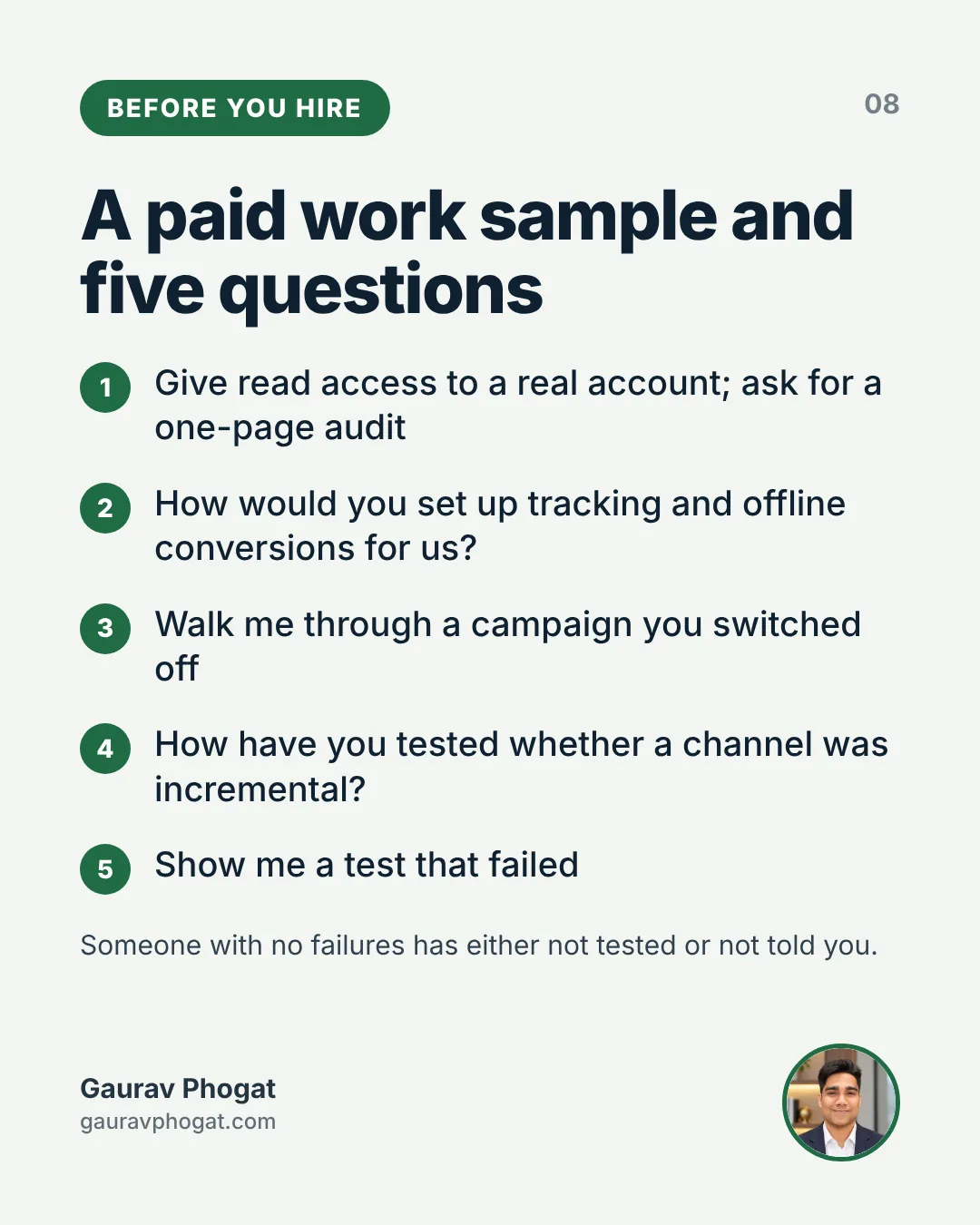
If you are hiring, the lists are no help, and neither are most CVs. The fastest filter I know is a paid work sample: give the shortlisted candidates read access to a real account or an anonymised export and ask for a one-page audit. The good ones find wasted spend, broken tracking and missing negatives within an hour. Then ask questions that only someone who has done the work can answer in detail:
- How would you set up tracking and offline conversions for our business, and what would you send back to the platforms?
- Walk me through a campaign you switched off. What told you, and how long did it take you to act?
- How have you tested whether a channel was incremental? What did you find?
- Show me a test that failed. Someone with no failures has either not tested or not told you.
- How would you find out what AI assistants currently say about us?
The red flags are just as consistent. Follower counts offered as proof of ability. Course certificates presented as experience. Platform screenshots with no link to revenue. Guaranteed results. A conversation that is entirely about tools. And anyone who describes themselves as the best digital marketer in India has told you how they handle claims they cannot substantiate.
Becoming one of the top digital marketers in India: the order of operations
Start by writing a tracking plan for one conversion path from first click to invoice. Then send real outcomes back to the ad platforms, replace platform metrics with business outcomes in your reporting, rebuild the agency scorecard, run a holdout test and invest in SEO, GEO and CRM work that keeps paying after spend stops.
If you want to be the person these skills describe, the sequence matters more than the ambition. This is how I would spend the next two quarters:
- Write a tracking plan for one conversion path, from the first click to the invoice, and fix every gap you find.
- Set up offline conversion imports so the platforms learn from paying customers, not form fills.
- Replace one platform metric in your monthly report with a business outcome, and restate the last quarter on the new basis.
- Read the search term report and the CRM duplicate report yourself every month.
- Pick one compounding asset (service pages, a content series, your listings) and protect its budget for two quarters.
- Check by hand what the main AI assistants say about your brand, and fix the facts they get wrong at source.
- Map where consent is collected across every form and messaging channel, and fix the gaps with legal.
- Write your agency scorecard before the next review, not during it.
- Run one holdout test and present the result, including the uncertainty.
- Start a kill list with a date against every live test.
None of this will get you onto a list. That is roughly the point: the people worth learning from are too busy closing the gap between a click and a paying customer to publish one.
Weaker versus stronger digital marketing craft
The gap between average and excellent digital marketers shows up in the craft rather than in titles or follower counts. The table compares how weaker and stronger digital marketers handle tracking, bidding signals, CRM and automation, SEO and GEO, and experiments, which offers a practical checklist for hiring or for reviewing your own work.
| Skill | Weaker marketer | Stronger marketer |
|---|---|---|
| Tracking | Reports what platforms report | Owns a tracking plan joined to CRM and invoices |
| Bidding signal | Optimises to form fills | Sends paying outcomes back as offline conversions |
| CRM and automation | Bought lists and blast messages | One deduplicated queue and opted-in journeys |
| SEO and GEO | Raids organic work for paid budgets | Protects compounding pages and checks AI answers |
| Experiments | Lets tests run to justify spend | Holdouts, kill dates and a list of what stopped |
Key statistics, with sources
India’s digital marketing field is large and still growing quickly, which makes judging individual marketers by outcomes more important. Digital now takes most of Indian advertising revenue, the online audience is close to a billion people, and almost all of them consume content in Indian languages, raising the bar for genuinely local digital skill.
- Digital advertising revenue in India rose 26% to INR 94,700 crore in 2025 and made up 63% of total advertising revenue, according to FICCI and EY. Source: FICCI-EY Media and Entertainment Report 2026, March 2026.
- India had 886 million active internet users in 2024, an increase of 8% year on year, according to IAMAI and Kantar. Source: IAMAI and Kantar, Internet in India 2024, reported by MxM India, January 2025.
- 98% of Indian internet users accessed content in Indic languages in 2024, according to IAMAI and Kantar. Source: IAMAI and Kantar, Internet in India 2024, reported by MxM India, January 2025.
Further reading from primary sources
- McKinsey: The state of AI: annual survey on AI adoption and business impact.
- Google Ads: About offline conversion imports: how to send booked and treated outcomes back to Google Ads.
Questions people ask
A top digital marketer in India is someone whose work moves a business outcome (revenue, booked appointments, enrolments) and who can prove it from systems the business owns rather than from platform dashboards. The craft is observable: owned tracking, outcome signals fed to ad platforms, a fixed path after the click, compounding SEO and GEO, consented CRM journeys, agency scorecards, incrementality tests and fast decisions on failed tests.
There is no credible answer, and any page that gives one should be read as advertising. Nobody audits marketing outcomes across companies or sees the P and L behind the case studies, and most published lists are written by agencies ranking their own founders or by course sellers using the list to sell enrolments. Judge individuals on craft instead: how they measure, what they switched off and what failed.
The skills that matter most are measurement (a tracking plan joined to real outcomes), performance media judgement, conversion path fixes, SEO and GEO, CRM and marketing automation with consent built in, agency management and experiment design. Tools change every year. The habit of tying every activity to a business outcome, and testing whether it was incremental, does not.
Start from the outcome you need, not a job title. Set a short paid work sample, such as a one-page audit of a real or anonymised ad account, and then ask the candidate how they would set up tracking, which campaign they switched off and what a failed test taught them. Treat follower counts, certificates and screenshots with no link to revenue as noise.
No. A certificate shows someone completed a syllabus, which is useful for a junior hire learning the tools. It says nothing about whether they have moved a business number, handled an agency or killed a failing campaign. For a senior digital role I give a certificate no weight and spend the interview time on what the candidate changed, how they knew it worked and what they would do differently.
It depends far more on scope than on title: whether the role owns tracking, CRM and agency contracts, or only media. The cheaper mistake is under-hiring: a junior who reports platform metrics can waste many times their salary in misdirected spend within a year. Budget for the person who can own measurement and outcomes, and spend less on tools until that person is in the seat.
Clear outcomes, access to the data that shows them and a scorecard agreed in advance. Good agencies want visibility into what happens after the lead so they can optimise for booked business rather than form fills, and they want offline conversions flowing back into the accounts. They also want quick decisions and a contract that rewards results rather than spend.
Data-protection obligations under DPDP make consent, purpose and retention design questions for marketing, not paperwork for legal. In practice that means collecting clear consent at each form and messaging channel, using data only for the purpose it was given, not buying lead lists and honouring requests to stop. CRM journeys and audiences have to be built on that consent from the start.
The common ones are protecting a campaign because they built it, letting brand search flatter blended efficiency, reporting the platform numbers because reconciling them is slow, and raiding the budget for SEO whenever a quarter looks thin. Another is optimising to a cheap conversion event that never becomes revenue. The fix is usually a pre-agreed success criterion and a kill date.
Yes, but the work has shifted. Answer engines summarise before anyone clicks, so being cited depends on clean entity data, consistent facts across every listing and pages that each say one clear thing. That is still search work, and it still compounds. The strongest digital marketers adjusted their content and listings rather than declaring search dead or pretending nothing had changed.
GEO, or generative engine optimisation, is the work of becoming a source that AI assistants and answer engines rely on when they summarise a topic. SEO aims to rank a page; GEO aims to be cited or named in the answer. Much of the groundwork overlaps: consistent facts about the organisation, clear pages, expert attribution and checking by hand what the assistants actually say.
The cost of acquiring a paying customer (or a booked and honoured appointment in a hospital) by business line, reconciled against the organisation’s own systems rather than platform reports, and tracked over several quarters. It shows whether the digital function measures outcomes or activity, and whether its owner understands where money is gained and lost.
Yes, and a small organisation often applies them faster because there are fewer systems and fewer people to align. A tracking plan, offline conversions, a clean CRM queue and one honest test need discipline more than budget. The practices that need scale, such as multiple agencies or a holdout test with statistical weight, can wait until the basics are working.
Read my takes first in Google Search