

Top marketing leaders in India: how the strongest CMOs lead
Reviewed on by Gaurav Phogat. Statistics checked against their original sources on the same date.
The top marketing leaders in India are not the names on award lists but the CMOs who sign for a commercial number at board level, manage the budget as a portfolio, hold a brand position for years, win influence across the business and build teams that outlast them. There is no credible ranking of individuals, so this sets out ten leadership habits seen across four sectors and how to hire for them.
New to the topic? Start here: Leadership from the CXO seat sets out the reading order.
Last updated: 29 October 2026.
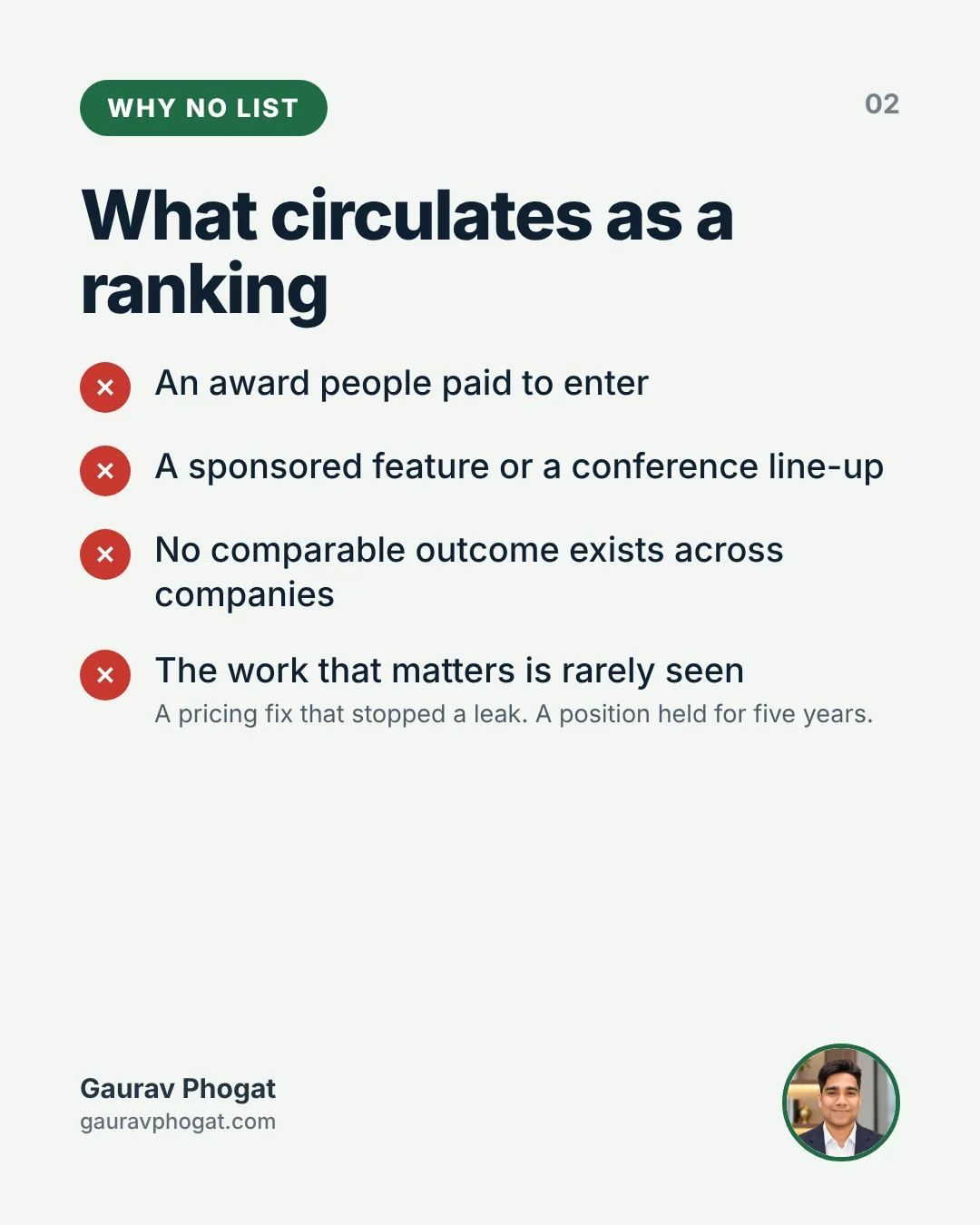
People who search for the top marketing leaders in India usually want names. I cannot give you an honest list of them, and neither can anyone else. Marketing produces no comparable outcome across companies, and the work that matters most is rarely seen: a pricing change that stopped a slow leak, a positioning held for five years while three chairmen wanted to change it. What circulates as a ranking is usually an award people paid to enter, a sponsored feature or a conference line-up.
What I can give you is what I have seen. I have worked in luxury retail, telecom and media before moving into healthcare, and in each of those I reported to marketing heads, hired them, inherited them and sat across the table from them. This piece is about leadership: the CMO’s view of the board, the P&L, the budget, the brand, the team and the rest of the executive table. The hands-on craft and the parts unique to hospitals are covered in their own pieces, linked at the end.
What do the top marketing leaders in India have in common?
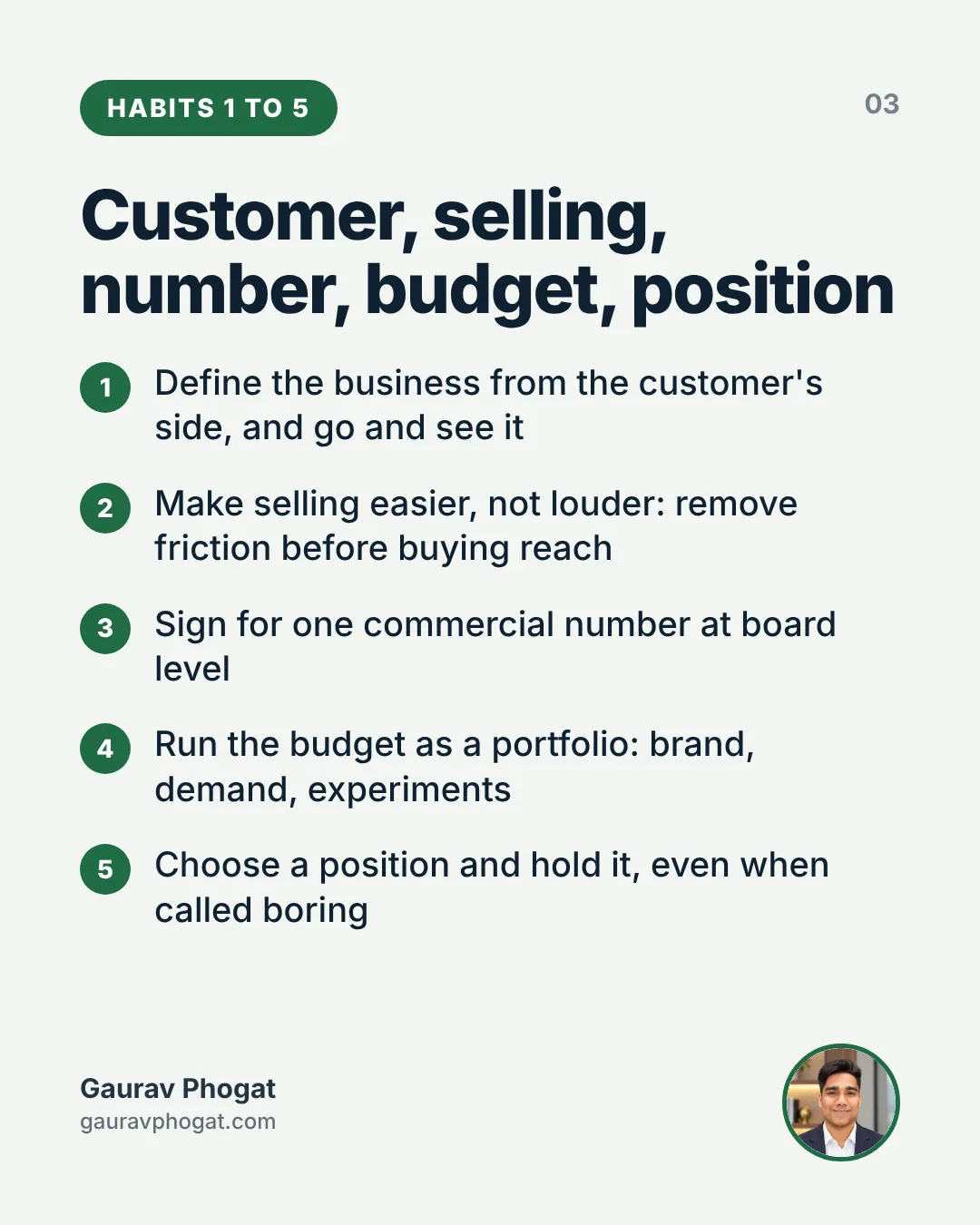
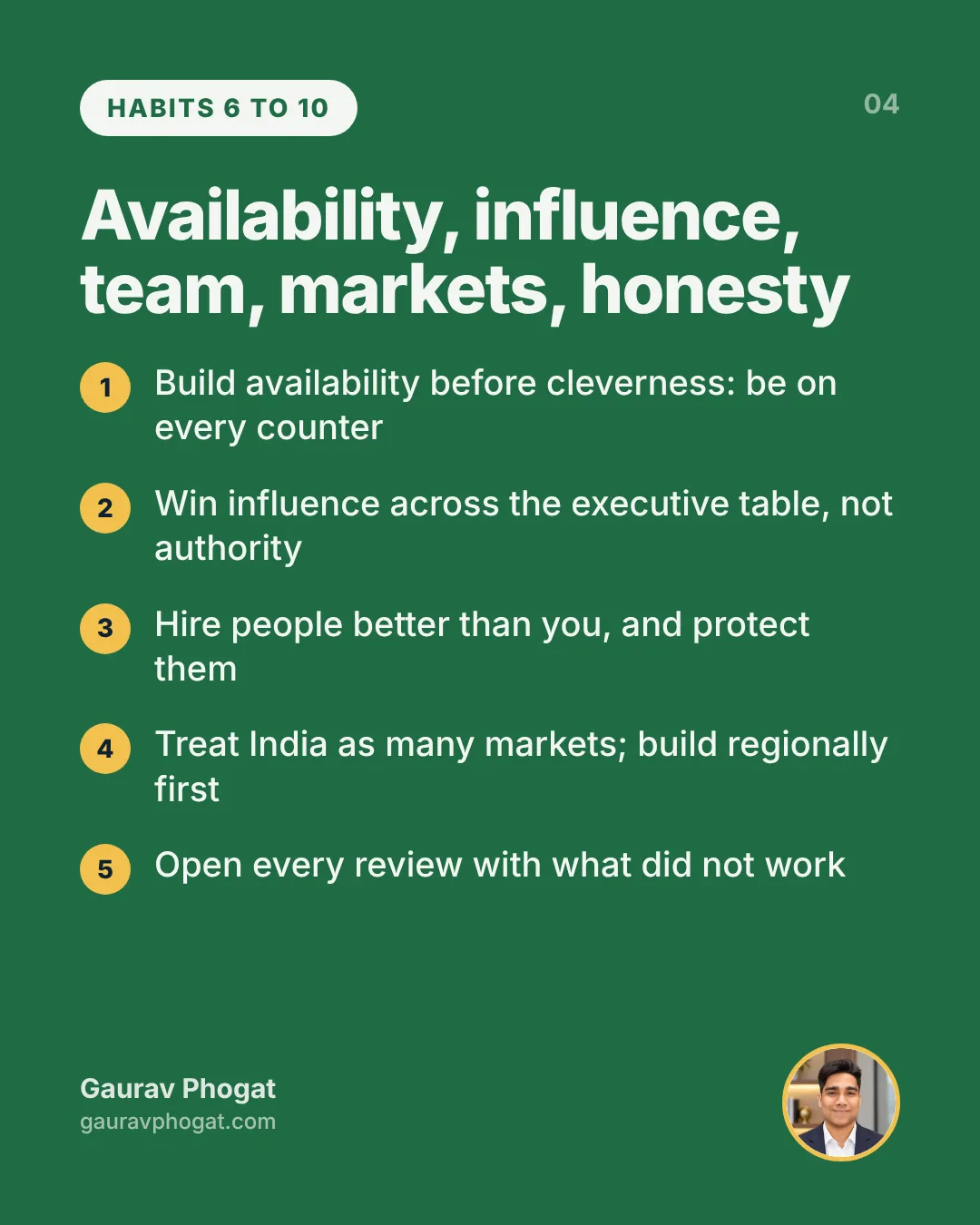
Ten habits recur among marketing leaders who deliver: they define the business from the customer’s side and go and see it, make selling easier rather than louder, sign for a commercial number at board level, run the budget as a portfolio, hold a position, build availability, win influence across functions, build teams better than themselves, treat India as many markets and admit what did not work.
These are the habits I saw repeatedly in the leaders who delivered, across four sectors. Where a well-known thinker gives a useful lens, I have named them. The ideas are old. The discipline of applying them every week is what is rare.
1. They define the business from the customer’s side, and go and see it
Theodore Levitt’s Marketing Myopia argued that companies decline when they define themselves by the product they make rather than the need they serve. In luxury retail the lesson was immediate. Nobody was buying a watch. They were buying reassurance that they had chosen well, and an after-sales promise that would still hold in ten years. The leaders who understood that spent on service and the store experience; the ones who did not spent on another shoot.
The strongest leaders also refused to know the customer only through a research debrief. They stood on the shop floor on a Saturday, sat with a retailer in a small town, and waited in a queue without announcing themselves. They came back with one or two specific things that were wrong and could be fixed that week, and it showed in every brief they wrote.
2. They make selling easier, not louder
Peter Drucker’s line that the aim of marketing is to make selling superfluous is quoted often and practised rarely. In telecom, the strongest people I worked with spent as much time on the recharge journey and the retailer’s commission as on the campaign, because a customer who cannot top up easily leaves quietly. The best leaders go looking for the friction and remove it before they buy more reach.
3. They sign for a commercial number at board level
Philip Kotler spent a career insisting that marketing is a management discipline, not a department that makes advertising. The leaders who took that seriously could walk into a board meeting and talk about margin, mix and payback without switching vocabulary. They chose one commercial number to be judged on, agreed with the CFO how it would be measured, and reported it the same way in good quarters and bad. They knew what a marketing head owes the CFO before the CFO had to ask.
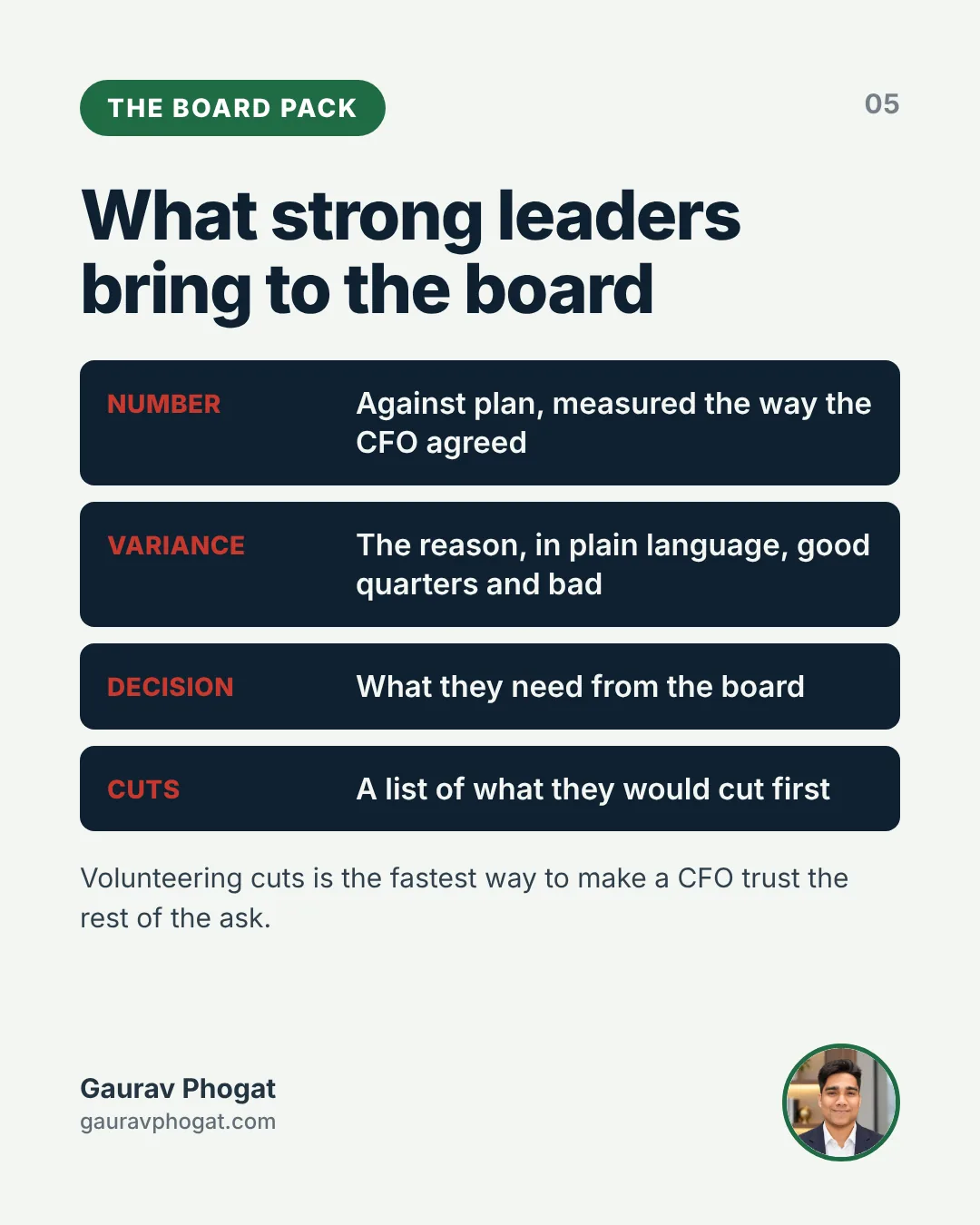
The board pack is where this shows. The weaker leaders brought a reach number and a showreel. The stronger ones brought three things: the number against plan, the reason for the variance in plain language, and the decision they needed from the board. Forecast accuracy earned them more credibility than forecast ambition ever did.
4. They run the budget as a portfolio
Most marketing budgets are last year’s budget plus or minus a negotiation. The best leaders I worked for rebuilt theirs from the objective each year and thought of it as a portfolio with different jobs: long-term brand building that pays back slowly, demand capture that pays back quickly, and a small, ring-fenced share for experiments that might fail. They protected the slow-paying part when a bad quarter arrived, because cutting it is easy and the cost shows up a year later when nobody remembers why.
They also came to every budget review with a list of what they would cut first. Volunteering cuts is the fastest way I know to make a CFO trust the rest of the ask, and it is why their budgets survived downturns that took others’ apart.
5. They choose a position and hold it
Al Ries and Jack Trout made the point that positioning happens in the customer’s mind, not in the brand manual. In media, the familiar failure is a brand that repositions every time a new head arrives and wants a visible mark, until the audience no longer knows what it stands for. The leaders who do better hold one idea for years, cut everything that contradicts it and accept being called boring. Holding a position is mostly about what you refuse, including the campaign that would win a trophy and blur the promise. They also explained the brand to the board as an asset with a value, not a cost centre with a logo.
6. They build availability before cleverness
Byron Sharp’s work on mental and physical availability (being easy to think of and easy to buy) is the most useful corrective I know to the Indian habit of over-investing in the big idea. Telecom made it concrete: the brand that was on every retailer’s counter in a Tier 2 town beat the brand with the better commercial. Clever work on top of a broken front door is money spent on reminding people you are hard to reach.
7. They win influence across the executive table
Very little of what decides a customer’s experience sits inside the marketing function. Pricing sits with finance, the product with another team, service with operations, hiring with HR. The marketing leaders who achieved most had no more authority than the others; they had more influence. They sat in the operations and sales reviews, not just their own. They agreed shared targets with sales instead of arguing about lead quality. They brought other functions customer evidence they could use, and they gave credit away freely when something worked.
The test I use is simple: when the marketing leader is not in the room, do other executives still argue from the customer’s side? If they do, the leader has done the job.
8. They build teams that are better than they are
Every good marketing head I have known hired people who knew more than they did about data, search, content or CRM, and then protected them. They were comfortable being the least technical person in the room on a given topic. They thought about the organisation design before the hires: which capabilities to build in-house, which to buy from partners, and in what order. The principles behind building a digital team in a hospital group are the same ones I saw in retail and telecom: hire for judgement, give people a number they own, and name a successor early so the function survives your departure. They also let good people leave for bigger roles, which made the next hire easier.
9. They treat India as many markets
Telecom taught this faster than anything else. Each circle had its own language, its own competitor and its own idea of value, and a national plan written in one city and translated at the end failed in most of them. The leaders who did well built for the regional market first, gave regional teams real budget authority, and let the national story emerge from what worked.
10. They say what did not work
The last habit is the one that separates people you trust from people you tolerate. The best leaders I worked with opened reviews with what had failed, why, and what they had stopped paying for. They killed their own campaigns. They admitted when a positioning was wrong. It made the rest of what they said believable to the board, and it is the reason their budgets survived bad quarters.
What they do not have in common
Background, personality and public profile turn out not to matter. Effective marketing leaders come from sales, engineering, agencies and brand management; some are introverted and avoid stages; some had never run a large media budget before the job; very few have a public profile. Consistent habits matter far more than pedigree.
It is as useful to know which traits turned out not to matter. The strongest leaders I have seen came from sales, from engineering, from agencies and from brand management. Some were introverted and hated stages. Some had never run a large media budget before they got the job. Very few had a public profile, and those who did treated it as a side effect rather than a goal.
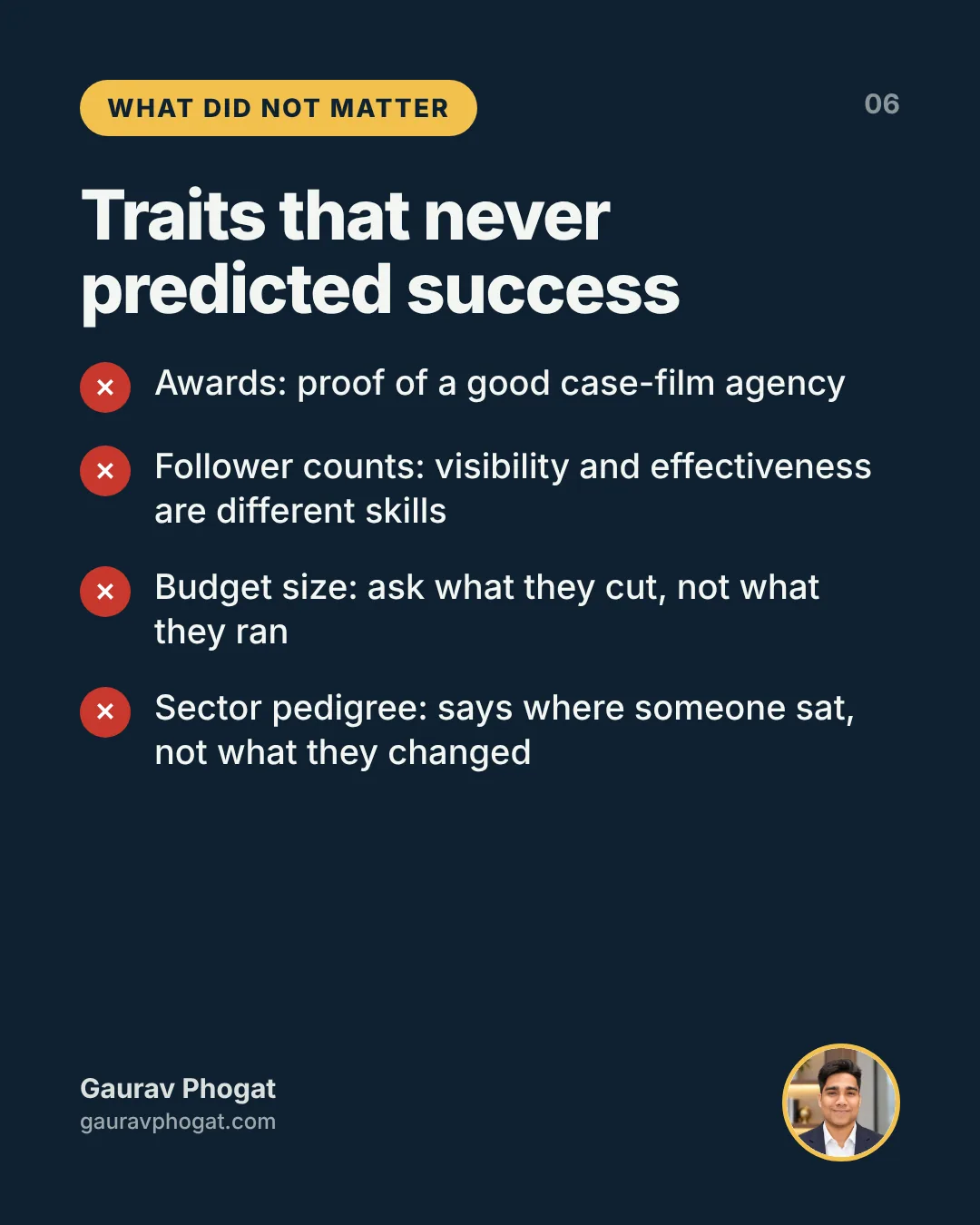
What did not predict success:
- Awards. A shelf of trophies tells you someone is good at entering awards and has an agency that is good at case films.
- Follower counts. Visibility and effectiveness are different skills, and one often crowds out the other.
- Budget size. Running a large budget is not the same as running it well. Ask what they cut.
- Sector pedigree. A famous consumer brand on the CV says where someone sat, not what they changed.
Why the sector matters less than people think
Leadership habits transfer across sectors even though each sector has rules to learn. Customer focus, commercial ownership, budget discipline, positioning and team building applied in media, retail, telecom and healthcare alike. What changes is where the friction sits and who has to agree before a marketing leader can remove it.
When I moved from media to healthcare, several people told me the habits would not transfer. Some did not, and I made mistakes learning the new rules. Creative instincts from retail, in particular, needed unlearning: what reads as aspiration in a store reads as a guarantee somewhere else.
But the leadership habits above transferred almost intact. Owning a number, running the budget as a portfolio, holding a position, building influence and building a team are not sector-specific. What changes is who sits at the table and who has to agree before you can act. Every sector has its version of the colleague who did not ask for marketing’s help, and winning that person over is most of the job.
How do you spot a top marketing leader when hiring?
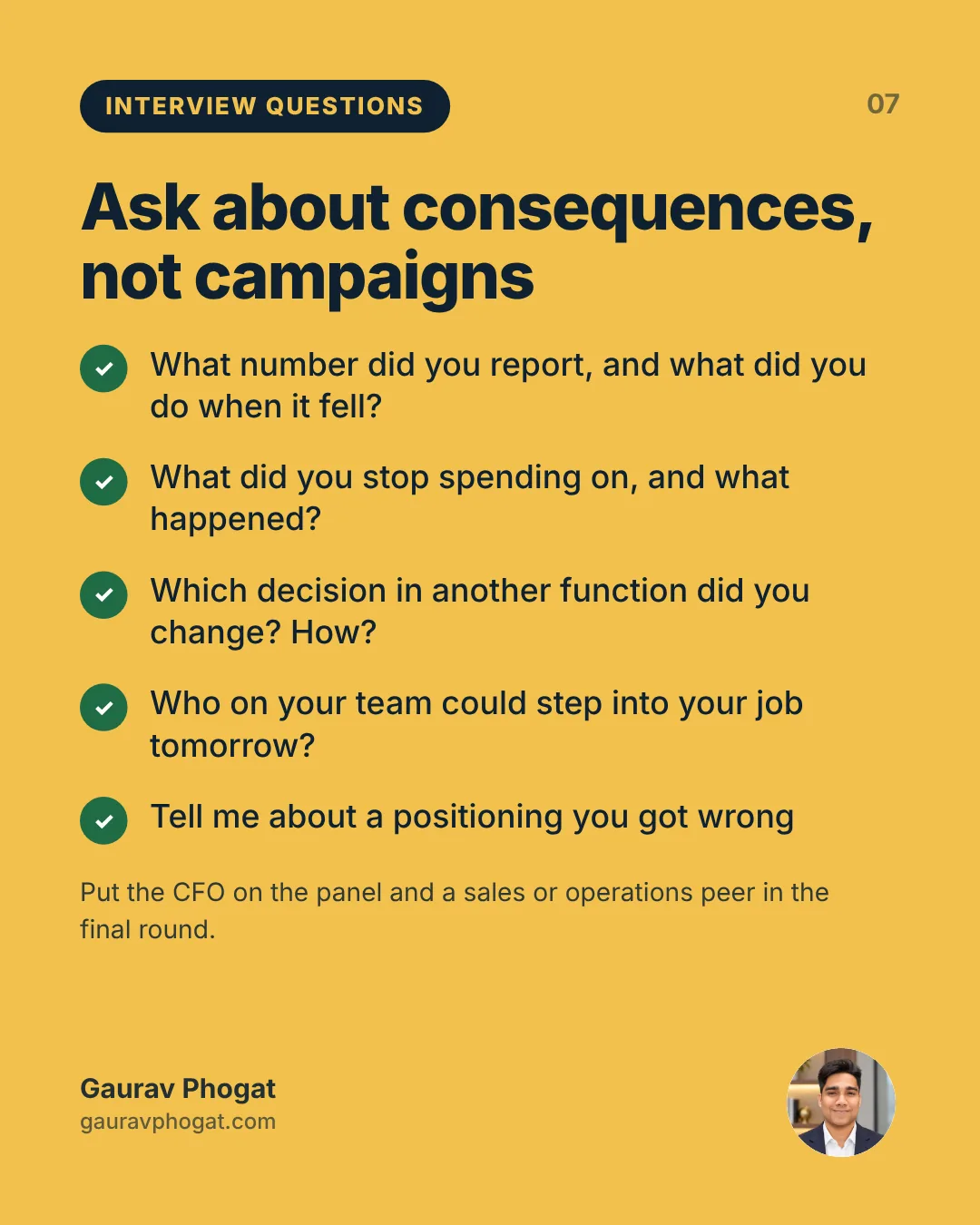
In CMO interviews, ask about consequences and influence rather than campaigns. Ask which number the candidate reported to the board and what they did when it moved the wrong way, what they cut, how they changed a decision in a function they did not run, who on their team could replace them and which positioning they got wrong.
The interview is where most of this gets tested, and it is where most boards and CEOs ask the wrong questions. Ask about campaigns and you will hear about campaigns. Ask about consequences instead.
- What number did you report to your board or CEO last quarter, and what did you do when it moved the wrong way?
- What did you stop spending on in your last role, and what happened?
- Tell me about a decision in another function (pricing, product, service) that you changed. How?
- Who on your last team could step into your job tomorrow, and what did you do to get them there?
- Tell me about a positioning or a campaign you got wrong.
The answers separate operators from presenters quickly. Put the CFO on the panel, and ask a peer from sales or operations to join the final round. How a candidate treats them tells you how they will work at the executive table.
Where is the marketing leader role going?
The marketing leader role is widening toward the commercial centre of the business. It increasingly owns demand, pricing inputs, digital platforms and customer data rather than only the brand, and the CMO title is often combined with or replaced by growth, commercial or customer officer roles that carry revenue accountability.
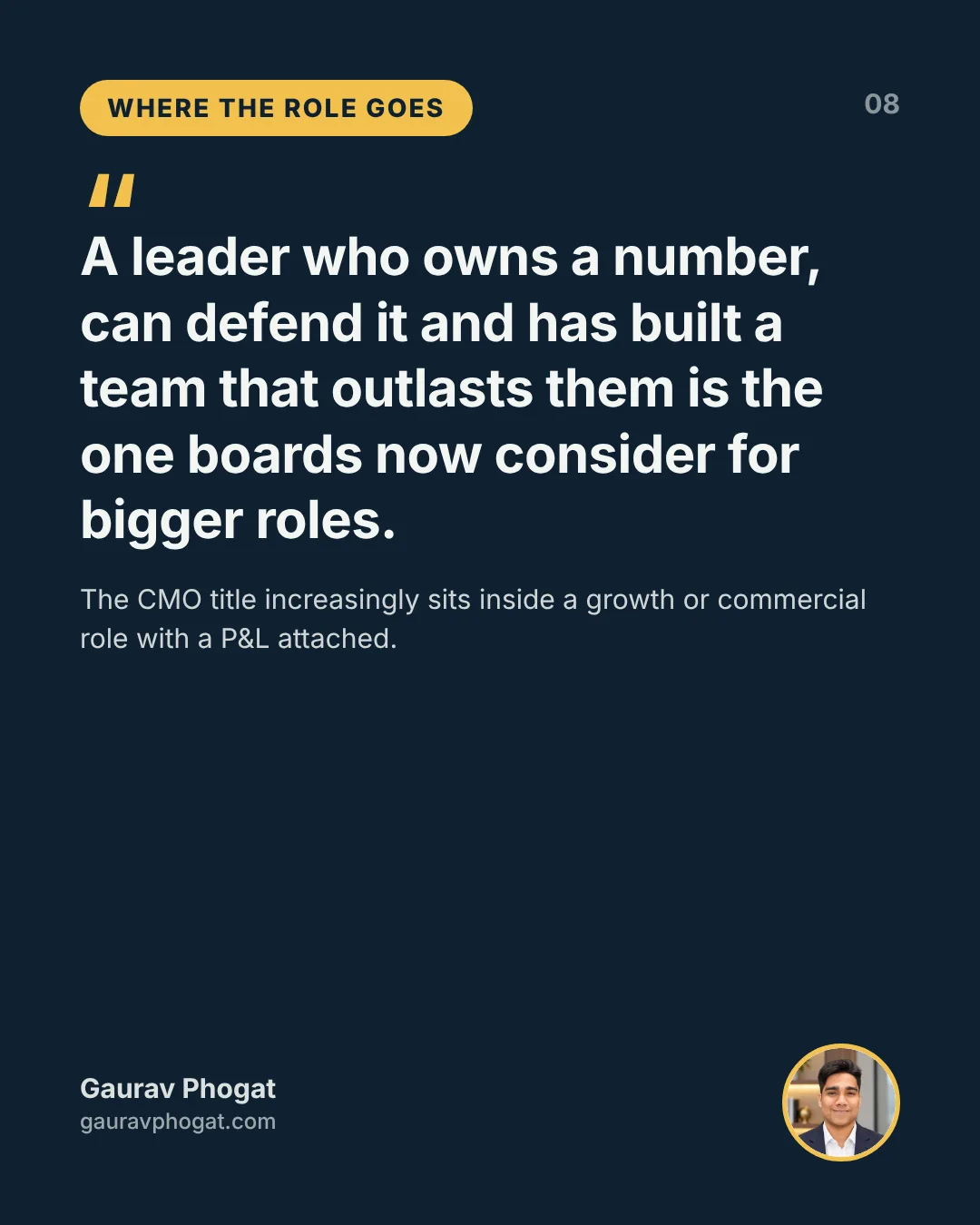
The role is widening. In most sectors I have worked in, the strongest marketing leadership has drifted towards the commercial centre of the business. It owns demand, pricing inputs, digital platforms and the customer data, not just the brand. The title CMO increasingly sits alongside, or gets absorbed into, a growth or commercial role with a P&L attached.
That shift rewards exactly the habits above and punishes the ones that the lists celebrate. A leader who owns a number, can defend it and has built a team that outlasts them is the one boards now consider for bigger roles, and it is why the path to chief executive runs more often through the commercial function than it used to. A leader whose value is a showreel finds the room getting smaller.
If you are building these habits next quarter
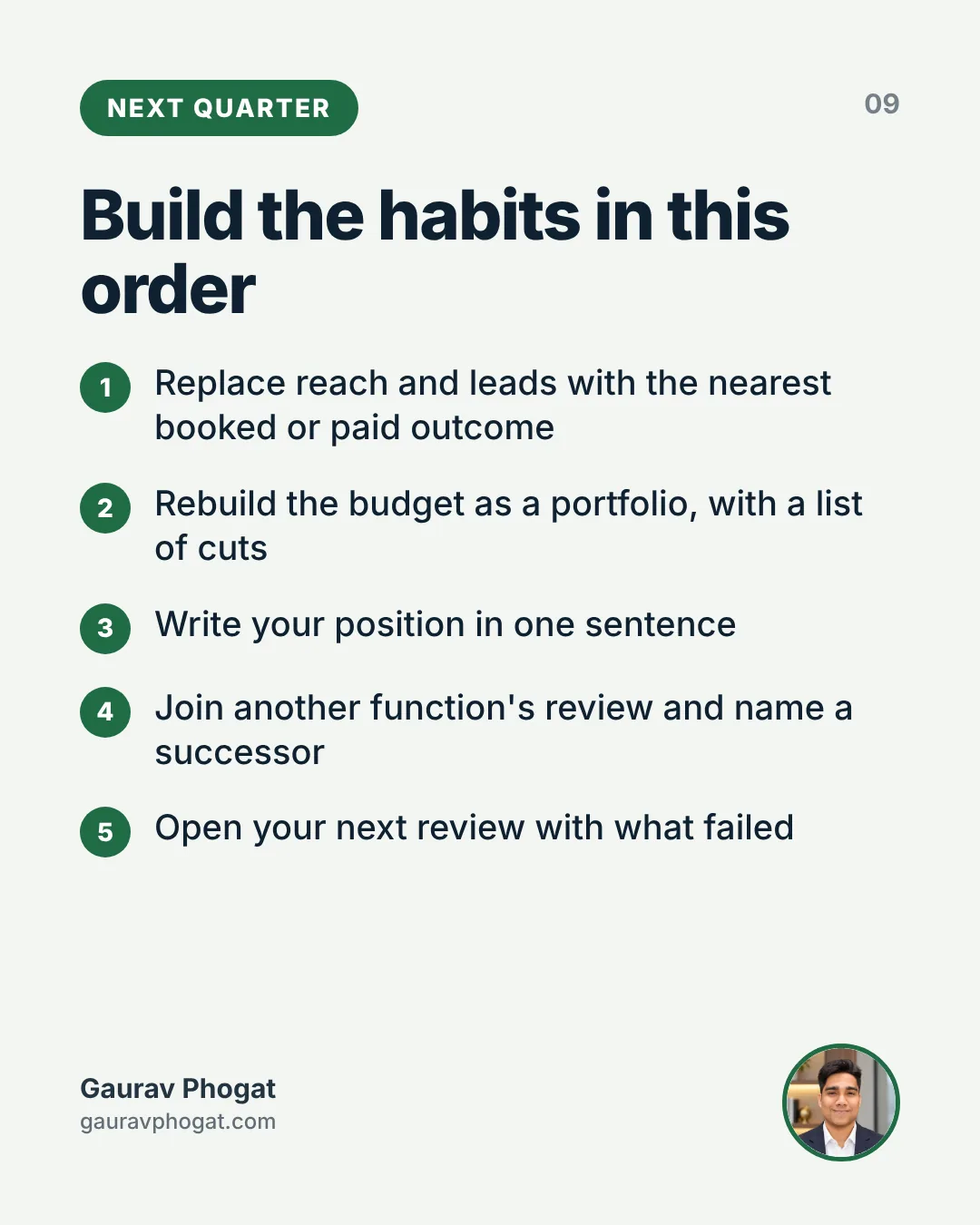
Start by changing the number you report to the board: replace reach and leads with the closest measure of booked or paid outcomes, even a rough one. Then rebuild the budget as a portfolio with a list of cuts, write your position in one sentence, join another function’s review, name a successor and open your next review with what failed.
If you run marketing today and want to work like the top marketing leaders in India rather than be listed as one, the order matters.
- Change the number you report. Replace reach and leads with the nearest thing you have to a booked or paid outcome, agree it with the CFO and restate the last two quarters on that basis.
- Rebuild next year’s budget from the objective, split it into brand, demand and experiments, and write down what you would cut first.
- Write your position in one sentence and list the current activity that contradicts it. Stop the worst two.
- Ask to sit in one other function’s monthly review, and bring them something useful each time.
- Walk three customer journeys yourself in the first month and fix one thing from each.
- Name one person on your team who should be able to do your job, and give them a number to own.
- Open your next board or executive review with what failed. Then keep doing it.
The lists will keep coming, and some good people will be on them. The ones worth learning from are usually too busy fixing the business to enter.
What award lists measure versus what effective marketing leaders deliver
Public lists and real leadership reward different things. The table contrasts what marketing award lists and rankings usually notice with what the most effective marketing leaders deliver at board level, on budgets, brand, influence and team, which explains why the people who move a business are often absent from rankings of top marketers in India.
| Dimension | What lists tend to notice | What effective leaders deliver |
|---|---|---|
| Board | Campaigns and creative awards | A commercial number the board and CFO accept |
| Budget | Size of the media spend | A portfolio with protected brand and a list of cuts |
| Brand | This year’s launch | A position held for years |
| Influence | Conference talks and media profile | Decisions changed in pricing, product and service |
| Team | Agency rosters | Capable in-house teams and a named successor |
Key statistics, with sources
Data on marketing leadership shows a demanding and changing role. Large-company CMOs serve shorter tenures than the rest of the C-suite, most are in their first CMO job, and marketing budgets have stayed flat as a share of revenue, which raises the premium on leaders who can prove commercial impact with the money they have.
- Average CMO tenure at Fortune 500 companies was 4.3 years in 2024, against a C-suite average of 4.9 years, according to Spencer Stuart. Source: Spencer Stuart, CMO Tenure Study 2025, March 2025.
- 68% of marketing leaders at Fortune 500 companies are serving in their first CMO role, according to Spencer Stuart. Source: Spencer Stuart, CMO Tenure Study 2025, March 2025.
- Marketing budgets averaged 7.7% of company revenue for a second consecutive year in 2025, with half of CMOs reporting budgets of 6% or less, according to Gartner’s CMO Spend Survey. Source: Gartner 2025 CMO Spend Survey, reported by Campaign, June 2025.
Sources and further reading
- Spencer Stuart: CMO Tenure Study 2025: how tenure and the scope of the marketing leadership role are changing at large companies.
Questions people ask
A top marketing leader is someone who signs for a commercial number at board level, runs the budget as a portfolio, holds a brand position for years, wins influence across the business and builds a team that outlasts them. That is judged by consequences over years, not by visibility. Most published lists measure who entered an award or paid for a feature, which is why I describe habits rather than rank people.
There is no credible ranking of individual Indian marketers, and I would distrust anyone who offers one. Most lists of top marketing experts in India are award shortlists people paid to enter, sponsored features or speaker line-ups. They rank visibility. The people worth learning from are usually known inside their sector for what they changed, and are often on none of those lists.
Ask what the candidate reported to their board or CEO and what they did when it moved the wrong way. Ask what they cut in their last role, how they changed a decision in a function they did not run, who could replace them tomorrow and which positioning they got wrong. Operators answer with specifics. Presenters answer with campaigns and awards.
A CFO wants one number that connects spend to booked or paid outcomes, measured the way finance agrees, a clear view of what was cut and why, and a marketer who talks about margin, mix and payback without switching vocabulary. Reach and lead counts do not survive that room. The strongest marketing leaders arrive with the list of cuts before the CFO asks for it.
They tell you something narrow: that the person or their agency is good at entering awards and making case films. That is not nothing, but it is not the same as running a marketing function well. Much of the most valuable leadership work, such as a pricing fix, a budget rebuilt from the objective or a position held for years, never gets entered because it does not photograph well.
The first ninety days should produce a truer number, not a better one. Expect a new head to change what is reported to the board, rebuild the budget logic and fix obvious friction in the first quarter. Commercial movement usually shows in two or three quarters, and a positioning takes years to settle. Be wary of anyone who promises a visible turnaround in the first month.
Briefly and in the board’s language. Bring one commercial number against plan, the reason for any variance in plain words, the risks you see coming and the decision you need from the board. Leave campaign detail for the appendix. Boards trust marketing leaders whose forecasts turn out accurate and who raise bad news early, in the same format as good news.
By being useful before asking for anything. Strong leaders sit in other functions’ reviews, bring customer evidence those teams can use, agree shared targets with sales instead of arguing about lead quality, and give credit away when something works. Influence shows when other executives start arguing from the customer’s side even when marketing is not in the room.
There is no universal ratio, so build it from the objective rather than from last year. Most strong leaders separate long-term brand building, demand capture that pays back quickly and a small ring-fenced share for experiments, then protect the brand share in bad quarters because its cost shows up later. Bring a list of what you would cut first to every budget review.
Ask who on their last team was better than them at something and what they did to keep that person. Ask who could step into their role tomorrow and how the team was designed: what was built in-house and what was bought from partners. Strong marketing heads give each person a number to own and build a function that survives their departure. Weak ones hire for loyalty.
Watch whether the reported number moved from reach and leads towards booked or paid outcomes, whether spend was cut anywhere, whether other functions started asking marketing into their decisions, and whether the leader opens reviews with what failed. A board should worry about a first year full of launches and awards but with no change in how marketing is measured.
Read my takes first in Google Search