
NMC advertising guidelines 2026: the compliance hub
Everything doctors, hospitals and their agencies need on the NMC Guidelines on Ethical Advertising and Public Communication, in force since 6 October 2026: what is allowed, what is barred, a free copy checker, penalties, a 30-day action plan, templates and every guide on this site, in one place.
The rules in four lines
Source document
Everything on this hub is checked against the NMC’s own notice. Clause numbers on this page refer to that PDF.
| Item | Detail |
|---|---|
| Title | Guidelines on Ethical Advertising and Public Communication by Hospitals/Medical Institutions and Registered Medical Practitioners |
| Notice reference | Public notice No. R-13014/01/2024-Ethics |
| Dated | 6 October 2026 |
| Issued by | National Medical Commission, Ethics and Medical Registration Board (EMRB) |
| Signed by | Dr Raghav Langer, Secretary, National Medical Commission |
| In force | Immediately. The covering notice says the guidelines come into force with immediate effect, and clause 1.2 says they apply from the date of publication by the NMC. |
| Why it exists | Framed in view of Writ Petition (Civil) No. 1160/2023 in the Supreme Court and the IMC (Professional Conduct, Etiquette and Ethics) Regulations, 2002. |
| Which law wins in a conflict | For doctors, the NMC Act and the 2002 Regulations (clause 4.2). For hospitals, the Clinical Establishments Act or the state law (clause 4.3). |
| Length | 13 pages, five chapters, 12 clauses |
The PDF copy is hosted by Medical Dialogues. Check the public notices on nmc.org.in for any later clarification issued under clause 12.
At a glance: allowed and off limits
The short version of what changed. Each line links back to the detailed guides below.
✓Still allowed
- Factual, verifiable information: name, location, contact details, departments, facilities, equipment, emergency services, accreditation and charges.
- A doctor directory with names, recognised qualifications, specialties, registration details and availability.
- Health awareness and educational content that does not promote a practice or solicit patients.
- Factual announcements: a new practice, change of address, temporary absence, resumption and consultation charges.
- Public health talks in the doctor's own name, and case studies in reputed medical journals.
- A best, top or leading claim only when it is objectively verifiable, with the award or ranking’s issuer, date and methodology disclosed (clause 8.1(ix)). “Best doctor” or “No.1 Specialist” style self-praise stays barred (clause 8.1(iii)).
- AI-assisted content that follows the guidelines, labelled as AI-generated or AI-assisted.
✕Now off limits
- Requesting or sharing patient testimonials, recommendations or reviews for promotion, even with consent.
- Before-and-after photos, promotional case studies, celebrity patients and success stories.
- Fake, paid or manipulated reviews, ratings, followers or search rankings.
- “Guaranteed cures”, “Best doctors”, “No.1 Specialist”, “100% success” and “painless treatment” (clause 8.1(iii)), and any best, top or leading claim you cannot verify (clause 8.1(ix)).
- Discounts, limited-period offers, contests, coupons, gifts and cashbacks used as inducements.
- Fear-based marketing and content that creates demand for unnecessary tests or procedures.
- Endorsing drugs, devices or products, paid or unpaid.
- Commissions or agency and influencer fees linked to patients or leads procured.
- AI-generated promotional campaigns, and AI that fakes a patient's image, voice, testimonial or outcome.
- Identifiable patient details such as names and faces in public content.
The guidelines, clause by clause
Every operative clause in plain English, with what it means for a marketing team. Read the exact wording in the official PDF before acting on a specific case.
| Clause | Plain-English rule | What it means for marketing |
|---|---|---|
| 1.2 and cover note | The guidelines apply from the date the NMC published them: 6 October 2026. | There is no grace period. Content live today is judged by these rules. |
| 3.2 | “Advertisement” covers any communication that directly or indirectly promotes a doctor or hospital. Digital, sponsored, targeted, influencer-led, search, platform and AI-made content counts when it is promotional. | Boosted posts, SEO pages, listings and creator videos are all in scope, not just paid ads. |
| 3.2 Expl. I and II | Non-promotional public information is exempt. Equipment and facilities can be described as facts, without superiority, guaranteed accuracy or comparisons. | “3 Tesla MRI available” is fine. “The most accurate MRI in the city” is not. |
| 3.2 Expl. III and IV | A doctor’s electronic media posts show name, qualifications, registration status and SMR/NMR number. A hospital’s posts name the doctor with the same details. | Add a registration line to every doctor post, reel cover and creative. |
| 3.2 Expl. V | No fake, paid or manipulated reviews or testimonials. A doctor shall not request or share patient testimonials or reviews for promotion on social media. | Stop review-request drives, QR cards and testimonial reposts. |
| 4.4 | Publishing through an agency, influencer, platform or intermediary does not remove responsibility for content you authorised, commissioned or knowingly permitted. | Agency contracts need approval rights and takedown duties. |
| 5.1 | Doctors may take part in awareness and educational content that does not promote their practice, solicit patients or get monetised through promotional marketing. | Education is the safe lane. A hard “book now” turns it into promotion. |
| 5.2 | Hoardings and billboards carry only factual information on infrastructure and facilities. Unverifiable claims are treated as commercial and prohibited. | Outdoor creative: facilities, address, helpline. No slogans that claim superiority. |
| 6.1 to 6.4 | Patient images and details need lawful, specific, documented consent. Consent does not make a testimonial or before-and-after depiction acceptable. Identifiers must be cropped, blurred or blacked out. | Consent is necessary, never sufficient. Audit galleries and stories. |
| 7.2 | AI-generated promotional campaigns for commercial interest are prohibited. Compliant AI content must carry a source mark saying it is AI. No AI patient images, voices, testimonials or outcomes. | Label AI content and never create synthetic patients or results. |
| 7.3 Expl. | Government of India and state government campaigns in the larger public interest are exempt. | Public health scheme communication is outside these limits. |
| 7.4 | No patient data, such as names, faces or anomalies, that can identify a patient publicly. | No identifiable patients in any public content. |
| 7.5 | Nothing permits live broadcast or commercial dissemination of surgery outside the NMC’s live surgery framework. | Live surgery streams for marketing are off the table. |
| 7.6 | Advertising that uses personal data must follow the IT Act, 2000 and the DPDP Act, 2023 with its 2025 Rules. | Lead forms, retargeting and WhatsApp follow-up need consent. |
| 8.1(i) and (vi) | No fear-based marketing, no demand for unnecessary tests or procedures, no unrealistic expectations or hidden risks, no unproven therapies. | Drop “silent killer” hooks and package pushes built on fear. |
| 8.1(ii) | No direct or indirect solicitation, self-promotion, third-party marketing of services, or use of a doctor’s name, image or voice for promotion. | Doctor-fronted sales content is the core risk for doctors. |
| 8.1(iii) | No advertising of achievements, success rates or number of patients treated with claims like “Guaranteed cures”, “Best doctors”, “No.1 Specialist”, “100% success”, “painless treatment”, “Miracle treatment” or “Exclusive cure”. | These phrases are named in the text. Remove them outright. |
| 8.1(iv) | No approval or endorsement of any drug, device, health product or commercial product, paid or unpaid. | No brand collaborations on professional channels. |
| 8.1(v) | No promotional case publication, surgical results, before-and-after photos, celebrity patients or success stories, unless strictly scientific or educational with anonymised patient consent. | Before-and-after galleries come down. |
| 8.1(vii) and (viii) | No commission, referral fee or lead-generation fee tied to patients. Agency, influencer and platform payments cannot be linked to procuring individual patients. | Move off cost-per-lead and per-booking contracts. |
| 8.1(ix) | No “best”, “No.1”, “leading”, “most trusted”, “top” or similar claims unless objectively verifiable through a transparent, independent methodology. Any award or ranking used must disclose its conditions, methodology, date and issuer. | A verified award can be cited with full disclosure. Generic superlatives cannot. |
| 8.1(x) | No discounts, limited-period offers, contests, coupons, gifts, cashbacks, referral benefits or free procedures that encourage unnecessary care. Factual fees and packages are allowed. | Publish prices. Delete offers and deadlines. |
| 8.1(xi) | No celebrity, influencer, patient, employee or third-party testimonials, and no using an intermediary to do what you cannot do directly. Commercial relationships in lawful communication must be disclosed. | Influencer “experience” posts for a hospital are out. |
| 8.1(xii) | No buying or manipulating followers, likes, reviews, ratings, comments, views, search rankings or algorithms. | Engagement pods, bought views and review farms are barred. |
| 8.2 | Exceptions: journal case studies; formal announcements (new practice, change of practice type or address, absence, resumption, succession, fees); public health talks in own name without promoting the employer; patient pamphlets; greetings on days of national importance without advertising. | Greetings posts and media talks are allowed, kept free of promotion. |
| 8.3 | Hospitals may share factual, objective, verifiable information on name, location, departments, facilities, equipment, emergency services, accreditation and charges. No solicitation, inducement, superiority claims, guarantees or promotional portrayal of an individual doctor. | Hospital ads stay factual, and frequency cannot turn facts into solicitation. |
| 9.1 | Clinical establishments advertise only factual particulars. A website doctor directory with names, qualifications, specialties, registration and availability is treated as patient information, not an advertisement. | Keep doctor pages directory-style. |
| 9.2 | Using a doctor’s photograph is not permitted where it amounts to self-advertisement, solicitation or promotional publicity. Photos on letterheads and signboards follow Regulations 6.1.1 and 6.1.2 of 2002. | Doctor-face hoardings and promo creatives are high risk. |
| 9.3 | Formal announcements stay factual, non-promotional and limited in scope. | Announce, do not advertise. |
| 9.4 | Healthcare platforms hosting doctors must follow NMC norms, may not sell paid rankings of doctors and must keep listings transparent. | Do not pay listing apps for “top doctor” placement. |
| 10.1 to 10.3 | State Medical Councils impose graded penalties on doctors, only after a show-cause notice, through a reasoned and speaking order. | Keep approval records to answer a show-cause notice. |
| 11.1 to 11.5 | Appeal to the EMRB within 60 days, then a second appeal within 60 days. Hospitals face the Clinical Establishments Act or state law. | See the appeals section below. |
Five rules most summaries skip
These clauses rarely appear in news coverage, but each one changes a common marketing practice.
- Doctor photos in promotion (9.2). A doctor’s photograph cannot be used where it works as self-advertisement or solicitation. Hoardings and ads built around a doctor’s face need a rethink.
- No paid rankings on listing platforms (9.4). Platforms hosting doctors must not sell paid rankings and must keep listings transparent. Paying for a “top doctor” slot puts both sides at risk.
- Live surgery broadcasts (7.5). Nothing in the guidelines permits live or commercial broadcast of procedures outside the NMC’s live surgery framework.
- Greetings and talks are allowed (8.2(iii) and (v)). Doctors may give public health talks on TV, radio and electronic media in their own name and designation, without promoting their employer, and may post greetings on days of national importance, with no advertising in them.
- Doctor details on hospital posts (3.2, Explanation IV). When a hospital publishes electronic media posts, it must name the doctor with qualifications, registration status and SMR/NMR number.
Check your copy against the 2026 rules
Paste an ad, caption, landing page section, WhatsApp message or video script. The checker flags phrases that commonly break the NMC guidelines and the ASCI code, and links to the guide that explains each one. It runs in your browser; nothing is stored or sent.
Checking ad images or creatives? Use the NMC ad compliance checker. It reads the text inside images and gives three compliant rewrites.
A screening aid, not legal advice. It catches common patterns, not every risk, and cannot judge context. Have final copy reviewed by a clinician and your legal or compliance team. Want the detailed version? Use the full ad copy checker.
Worked example: one ad, rewritten
A fictional hospital social ad, the clauses it breaks, and a version that stays within the guidelines. The doctor and hospital are invented.
✕Before
Dr Rakesh Mehta (example), Pune’s No.1 knee surgeon. 100% success, painless robotic knee replacement. 5,000+ happy patients. Watch Mrs K walk again in our before-and-after video! Flat 20% off this month only. Book now.
✓After
Knee replacement at Example Hospital, Pune. Robotic-assisted knee replacement is available in our Department of Orthopaedics. Consultant: Dr Rakesh Mehta (example), MS (Orthopaedics), Maharashtra Medical Council Reg. No. 00000. OPD Monday to Saturday, 9 am to 1 pm. Consultation fee: Rs 1,000. Read what the surgery involves, who it suits and what recovery looks like on our knee replacement page.
| Phrase in the original | What it breaks |
|---|---|
| “Pune’s No.1 knee surgeon” | 8.1(iii) names “No.1 Specialist” style claims; 8.1(ix) bars unverifiable superiority; 8.3(ii) bars promotional portrayal of an individual doctor in hospital ads |
| “100% success, painless” | 8.1(iii) names both |
| “5,000+ happy patients” | 8.1(iii): advertising the number of patients treated |
| “Watch Mrs K walk again”, before-and-after video | 8.1(v) before-and-after and success stories; 3.2 Explanation V and 8.1(xi) testimonials; 6.2 consent does not fix it; 7.4 identifiable patient |
| “Flat 20% off this month only” | 8.1(x) discounts and limited-period offers |
| No qualifications or registration number | 3.2 Explanation IV: hospital posts must name the doctor with qualifications, registration status and SMR/NMR number |
Why the rewrite works: “robotic-assisted” is stated as an available facility, not a superiority claim (3.2 Explanation II); the fee is a factual charge (8.1(x)); the doctor appears as directory information (9.1) with the disclosure line (3.2 Explanation IV). Keep the creative free of a promotional doctor portrait (9.2) and use a real registration number.
Penalties
State Medical Councils enforce the guidelines for doctors, after a show-cause notice and a reasoned order (clauses 10.1 to 10.3). Appeals go to the NMC Ethics and Medical Registration Board within 60 days (clause 11.1). Hospitals face action under the Clinical Establishments Act or the relevant state law (clause 11.5).
| Violation | Penalty for the doctor |
|---|---|
| First | Warning and mandatory ethics training |
| Second | Censure and a monetary penalty |
| Third | Registration suspended for 3 to 6 months |
| Serious, such as misleading cure claims, patient inducement or digital mass solicitation | Registration suspended for 6 to 12 months |
| Repeated | Removal from the medical register for 1 to 3 years |
How enforcement and appeals work
The steps below follow Chapter V of the notice.
- Show-cause notice (10.2)No penalty without a show-cause notice and a chance for the doctor to explain or clarify.
- Reasoned and speaking order (10.3)The SMC’s order must set out the specific violation, the doctor’s arguments and why they were accepted or rejected, and the reasons for the penalty.
- First appeal (11.1 to 11.3)To the Appellate Authority, the EMRB of the NMC, within 60 days under Section 30(3) of the NMC Act, 2019. The EMRB examines it independently, can call for records or order a fresh assessment, and passes a reasoned order.
- Second appeal (11.4)Under Section 30(4) of the NMC Act, 2019, within sixty days of the first appeal decision. Since 23 July 2026 the NMC takes ethics appeals through its online appeal portal, with the second appeal going to the NMC.
- Hospitals (10.1 Explanation and 11.5)Penalties and appeals follow the Clinical Establishments Act, 2010 or the state Act. A doctor who authorised or took part in the communication can be examined separately by the SMC, EMRB or NMC.
- Step 1Complaint or violation reaches the State Medical Council (SMC)
- Step 2 · clause 10.2Show-cause notice to the doctor, with a chance to explain
- Step 3 · clauses 10.1 and 10.3Reasoned order with a graded penalty, from warning to removal from the register
- Step 4 · clause 11.1First appeal to the EMRB, NMC, within 60 days
- Step 5 · clause 11.4Second appeal under Section 30(4), within 60 days
Your 30-day action plan
What hospital marketing teams should work through first.
- Audit live content and remove testimonial videos, review screenshots, before-and-after posts and success stories.
- Stop review-request messages, QR codes and counter cards that ask patients to post reviews.
- Pull every discount, offer, cashback and limited-period package promotion; keep factual price lists.
- Rewrite superlatives: replace best, No. 1 and painless with specific, verifiable facts.
- Show the doctor's name, qualifications and registration number on every doctor post and page.
- Label AI-generated or AI-assisted content and stop any AI-led promotional campaign.
- Review agency and influencer contracts so no fee is tied to patients or leads.
- Update the approval checklist and phrase library, and train the team and agencies.
Guides by topic
Every guide on this site has been updated for the 6 October 2026 guidelines.
Visual summaries
Swipeable carousels for each topic. Open the slides in the guide or download the PDF to share with your team and agencies.
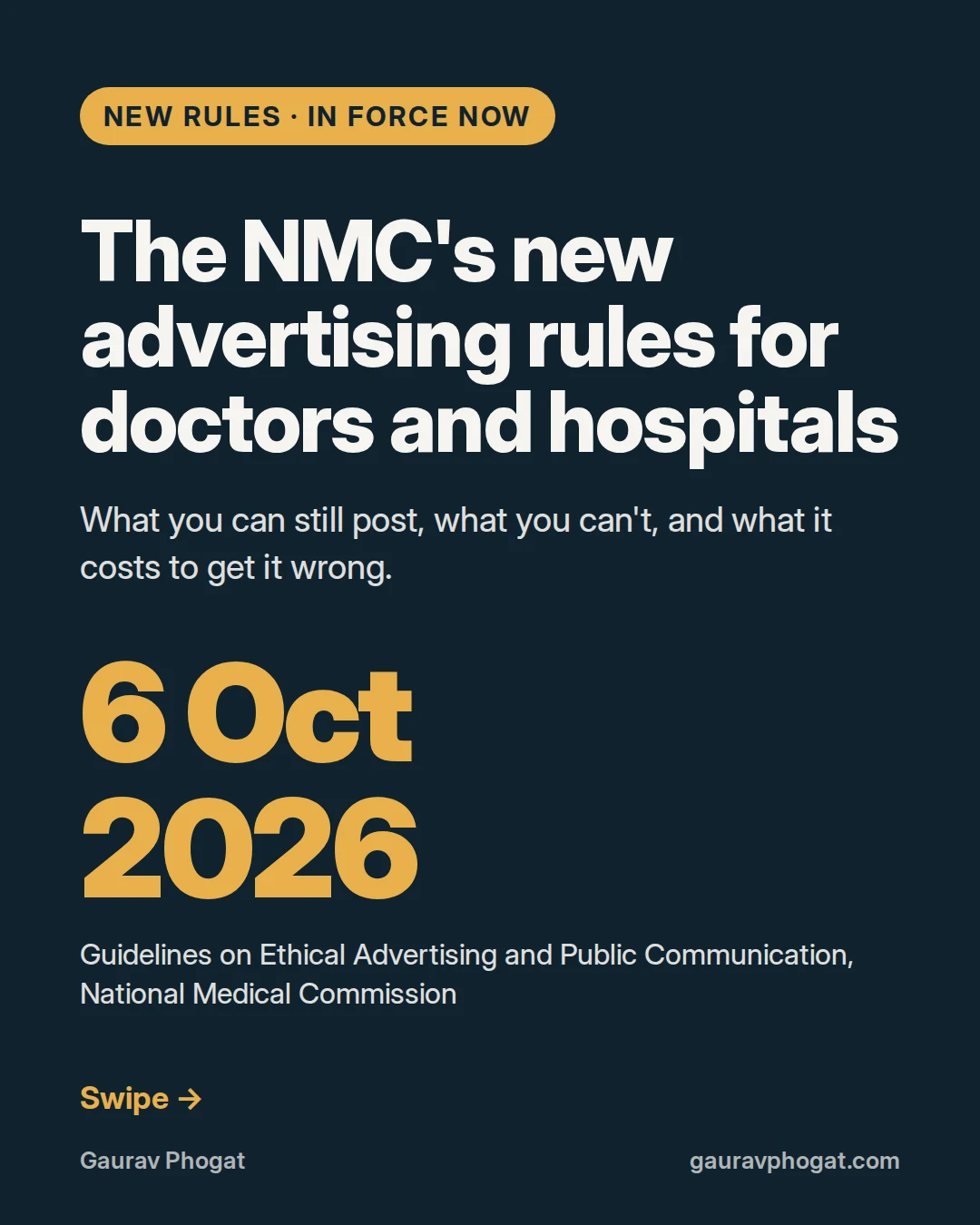 NMC advertising rules 2026: what doctors and hospitals can and can’t post11 slides · PDF
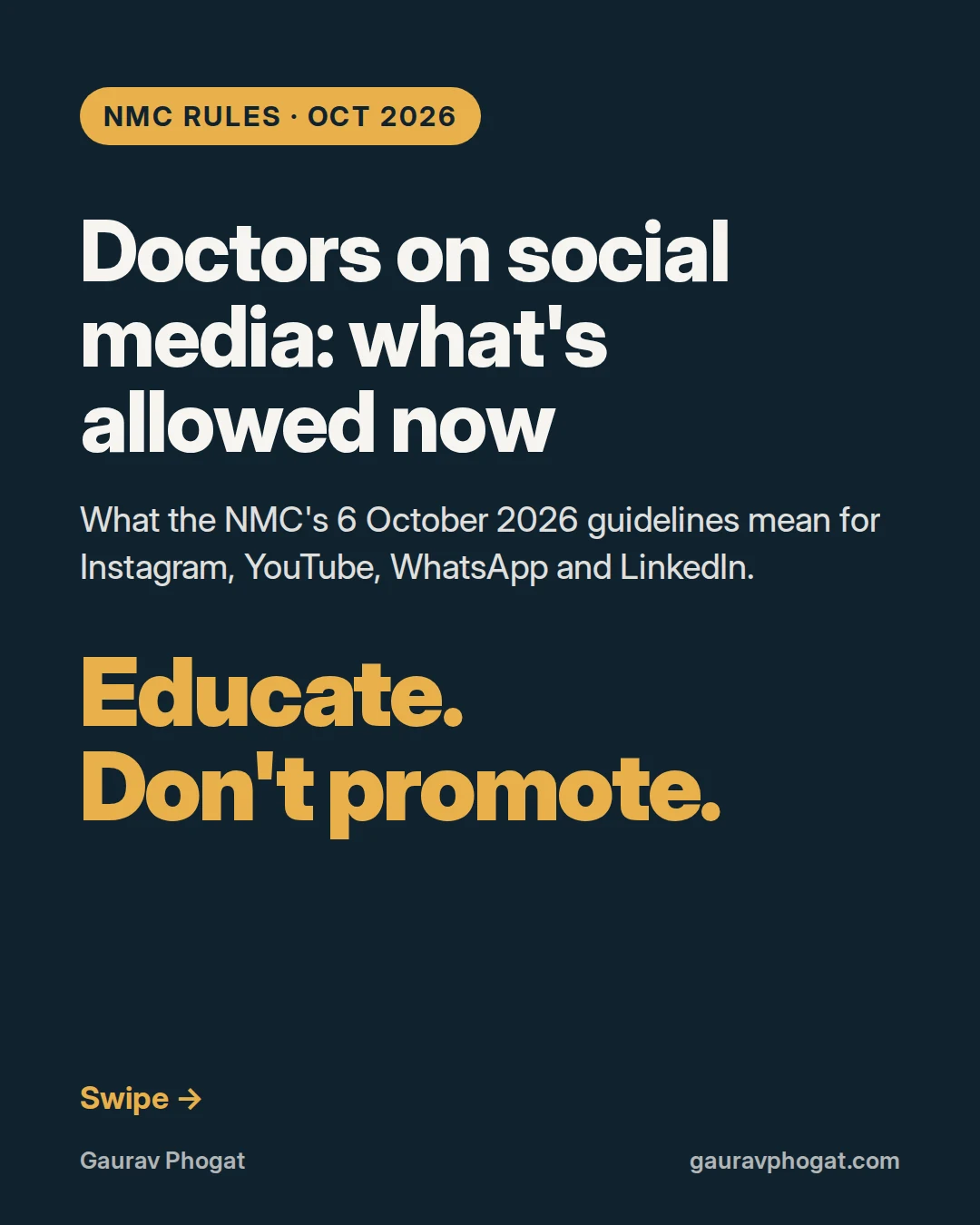 NMC rules for doctors on social media (2026): what you can and can’t post8 slides · PDF
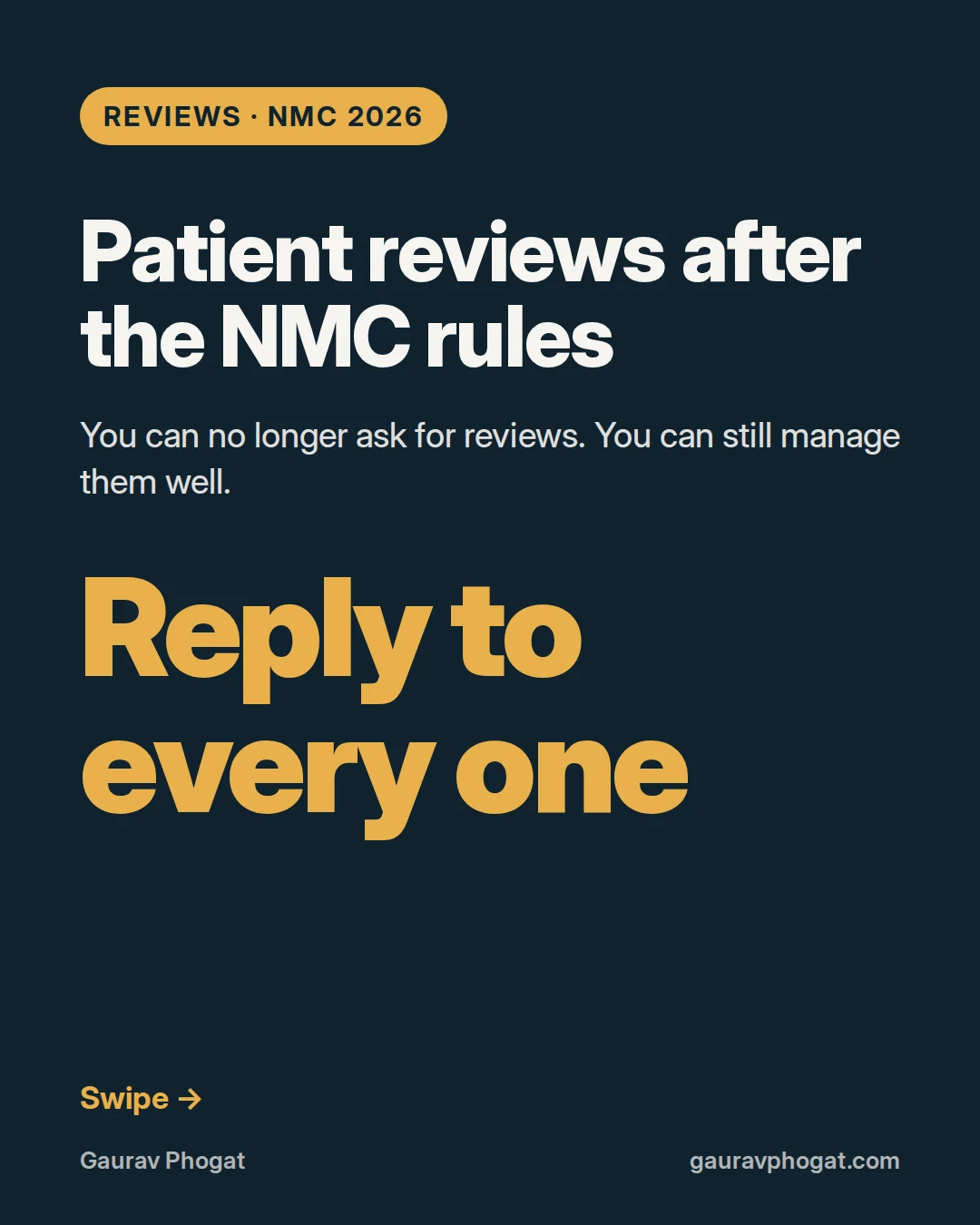 Patient reviews after the NMC rules: what hospitals can still do6 slides · PDF
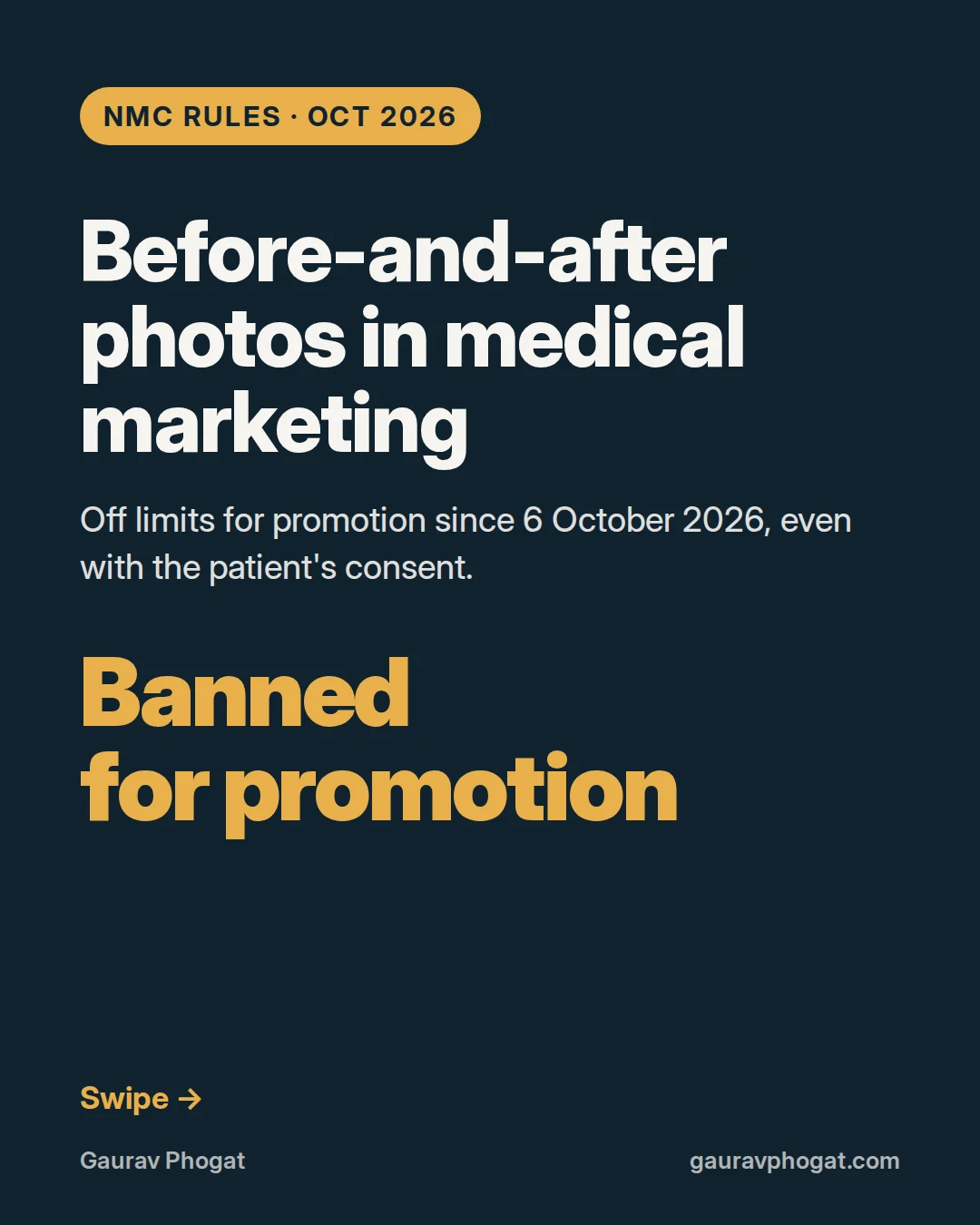 Before-and-after photos in medical marketing: the 2026 rules in India6 slides · PDF
 Ad copy for doctors: compliant rewrites under the 2026 NMC rules7 slides · PDF
 Google Ads healthcare policy: why hospital ads get disapproved7 slides · PDF
 Healthcare influencer marketing in India: the 2026 rules7 slides · PDF
 DPDP Act and hospital marketing: consent, ads, WhatsApp and CRM6 slides · PDF
 International patient stories after the NMC rules6 slides · PDF
 The compliance line in international patient marketing6 slides · PDF
 Ayurveda and homeopathy clinic marketing: what the rules allow6 slides · PDF
Templates that fit the new rules
Copy-ready drafts written for the 2026 guidelines.
Update log
Rules and guidance change. This log records what changed and when this hub was updated.
- 24 October 2026Checked against the official PDF: added the source document box, a clause-by-clause table, five rules most summaries skip, a worked example, the appeals process and an enforcement flow. Clarified that “best doctor” and “No.1 Specialist” claims are barred, while best, top or leading claims are allowed only when objectively verifiable.
- 12 October 2026Compliance hub and template library published.
- 11 October 2026Guides on reviews, doctor social media, before-and-after images, influencers, ad copy and international patient marketing updated for the new guidelines. Visual summaries added.
- 6 October 2026The NMC issues the Guidelines on Ethical Advertising and Public Communication, in force immediately.
Questions people ask
What are the NMC advertising guidelines of October 2026?
The National Medical Commission's Guidelines on Ethical Advertising and Public Communication by Hospitals/Medical Institutions and Registered Medical Practitioners, issued by its Ethics and Medical Registration Board on 6 October 2026 and in force immediately. They operate under the 2002 medical ethics regulations.
Who do the NMC guidelines apply to?
Registered medical practitioners and hospitals or medical institutions. Using an agency or an influencer does not move responsibility away from the doctor or hospital.
Which media do they cover?
All public communication: TV, radio, print, hoardings, websites, social media, WhatsApp and other messaging apps, podcasts, influencer and sponsored posts, online healthcare platforms and AI-generated content.
Can hospitals still advertise?
Yes, with factual and verifiable information: services, doctors, facilities, accreditation, timings and charges. What is barred is promotion through testimonials, reviews, before-and-after images, offers, superlatives and AI promotional campaigns.
Can hospitals ask patients for Google reviews?
No, not for promotion. The guidelines bar requesting or sharing patient reviews for promotion, and patient consent does not make it permissible. Hospitals can still reply to reviews and keep profiles accurate.
Can hospitals show prices?
Yes. Factual disclosure of charges is allowed. Discounts, limited-period offers, coupons, gifts and cashbacks used as inducements are not.
What are the penalties for doctors?
A warning and ethics training for a first violation, censure and a monetary penalty for a second, suspension for 3 to 6 months for a third, 6 to 12 months for serious violations, and removal from the register for 1 to 3 years for repeated ones. Hospitals face action under the Clinical Establishments Act or state law.
Is AI-generated content allowed?
AI-assisted content that follows the guidelines is allowed if labelled. AI-generated promotional campaigns for commercial interest, and AI that fakes a patient's image, voice, testimonial or outcome, are not.
Where can I read the official NMC advertising guidelines?
The public notice is No. R-13014/01/2024-Ethics, dated 6 October 2026, issued by the NMC Ethics and Medical Registration Board and signed by Dr Raghav Langer, Secretary. The 13-page PDF is linked in the Source document box on this page. Check nmc.org.in for later clarifications.
Can a doctor or hospital say best or No.1?
Clause 8.1(iii) bars claims such as 'Best doctors', 'No.1 Specialist', 'Guaranteed cures' and '100% success'. Clause 8.1(ix) allows best, top or leading only when the claim is objectively verifiable through a transparent, independent methodology, with the award's conditions, methodology, date and issuer disclosed. If you cannot show the proof, leave the word out.
How do appeals work under the NMC advertising guidelines?
The State Medical Council must issue a show-cause notice and a reasoned order (clauses 10.2 and 10.3). The first appeal goes to the NMC Ethics and Medical Registration Board within 60 days under Section 30(3) of the NMC Act (clause 11.1). A second appeal lies under Section 30(4) within 60 days of that decision (clause 11.4). Hospitals follow the Clinical Establishments Act or state law (clause 11.5).
Is this page legal advice?
No. It is a marketer's summary of the guidelines, checked against the official notice. Read the exact wording in the PDF and take legal advice on specific cases.
This hub is a marketer’s summary of the NMC guidelines of 6 October 2026, checked clause by clause against the official public notice (PDF), read with the ASCI code and Indian consumer and data protection law. It is not legal advice. Check the public notice on nmc.org.in for exact wording before acting on a specific case.