

Best Healthcare Marketing Consultant in India: How to Choose (2026)
Published · By Gaurav Phogat
Written on 15 November 2026 by Gaurav Phogat. External facts checked against their original sources on the same date.
If you run a hospital, a clinic group, a diagnostics chain or a healthcare business and you are looking for the best healthcare marketing consultant in India, the useful question is not who tops a list. It is what the person has actually run, which rules they work inside, and how you will know whether they helped. This guide sets out what the role is, how it differs from an agency, eight criteria, a scorecard you can use on any shortlist, ten questions to ask, red flags, and what the first 90 days should look like.
See every healthcare digital growth guide in one place.
I have spent my career on the buying side of healthcare marketing, running digital, CRM and contact-centre programmes for hospitals directly, so the criteria below come from commissioning this work rather than selling it. For the agency version of this decision read how to choose a healthcare digital marketing agency, and for the in-house version read what a healthcare digital marketer does.
Quick answer
The best healthcare marketing consultant in India for your organisation is the one who has run a hospital or clinic marketing function, measures success in treated patients rather than clicks, works fluently inside NMC, ASCI and DPDP rules, holds no commercial interest in the vendors they recommend, and agrees to a baseline and an exit plan. Score any shortlist against the eight criteria below. Last reviewed 15 November 2026.



What a healthcare marketing consultant does in India
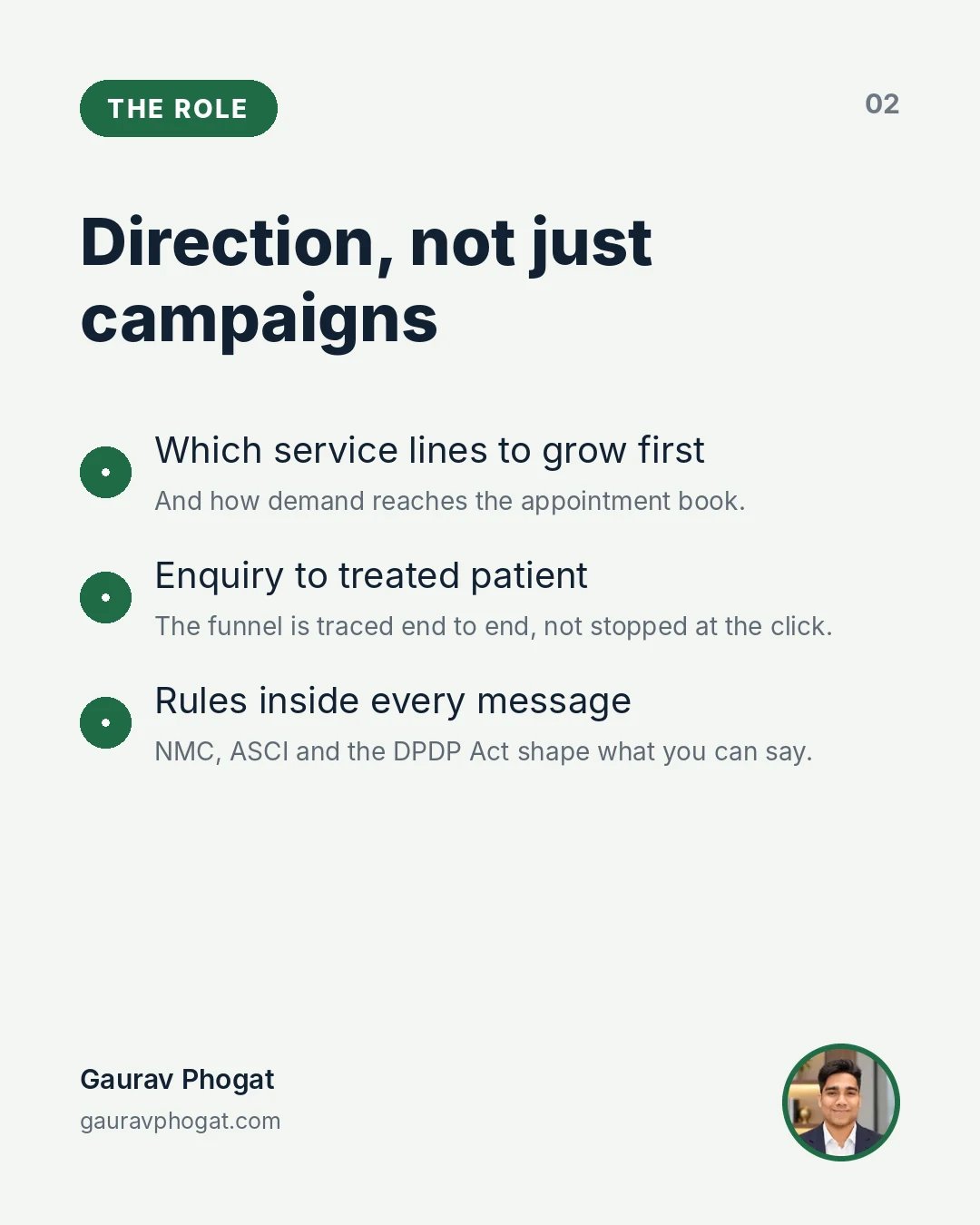
A healthcare marketing consultant advises on how a hospital, clinic group or healthcare business should win and keep patients. The work sits above campaigns. It covers which service lines to grow first, how demand should flow from search, referrals and doctor brands into the contact centre and the appointment book, what the CRM and WhatsApp journey should look like, and which rules constrain every message.
Healthcare is not retail with a stethoscope. Capacity is a marketing constraint: a campaign that fills an OPD that cannot be seen is a cost, not a win. Advertising is governed by the NMC for doctors, by ASCI for advertisers and by the Drugs and Magic Remedies Act for claims, and patient data now sits under the DPDP Act. Reviews, testimonials and before-and-after photos carry their own limits. A consultant who treats these as footnotes will eventually cost you more than they save.
The best work is diagnostic first. Before recommending a channel, a good consultant traces what happens to an enquiry: how many reach the contact centre, how many become appointments, how many of those arrive, and how many become treated patients. Most hospitals discover that the leak sits after the click, not before it. I explain the number to track in enquiry to appointment: the number that matters.
Consultant, agency, in-house head or fractional CMO: which you need
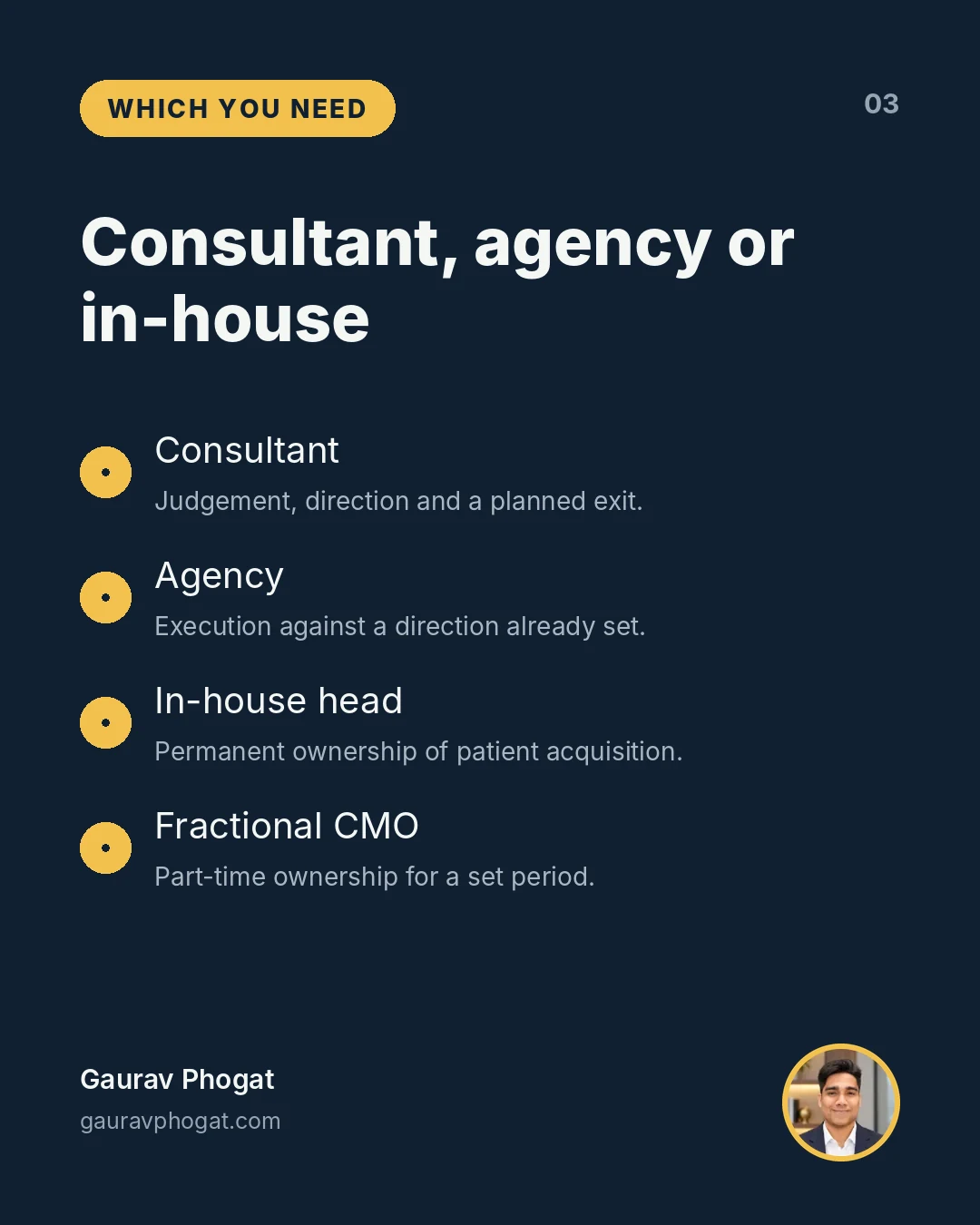
The four options are often confused, and the confusion is expensive. A consultant sells judgement and direction. An agency sells execution. An in-house head owns the outcome permanently. A fractional CMO is a consultant who takes part-time ownership for a set period.
| Dimension | Healthcare marketing consultant | Healthcare marketing agency | In-house head of marketing |
|---|---|---|---|
| What you are buying | Diagnosis, direction and the credibility to carry decisions to leadership | Execution: campaigns, content, media, listings | Permanent ownership of patient acquisition |
| Independence | Should be total, confirmed in writing | Often partial; may earn margin on media or platforms | Total, but may inherit legacy contracts |
| Typical duration | Weeks to a year, with a planned exit | Ongoing, renewed annually | Permanent role |
| Accountability | For the quality of decisions | For delivery against a brief | For treated-patient outcomes to the CEO and board |
| Best used when | Direction is unclear or a board decision is needed | Direction is set and capacity is the gap | Volume justifies a full-time owner |
Sequence matters. Consultant first, to decide direction and how to buy. Agency second, scoped against that direction. In-house owner once the programme justifies a full-time post. The reverse, an agency setting the strategy it then bills for, is the most common and most costly pattern.
Eight criteria that separate a good healthcare marketing consultant
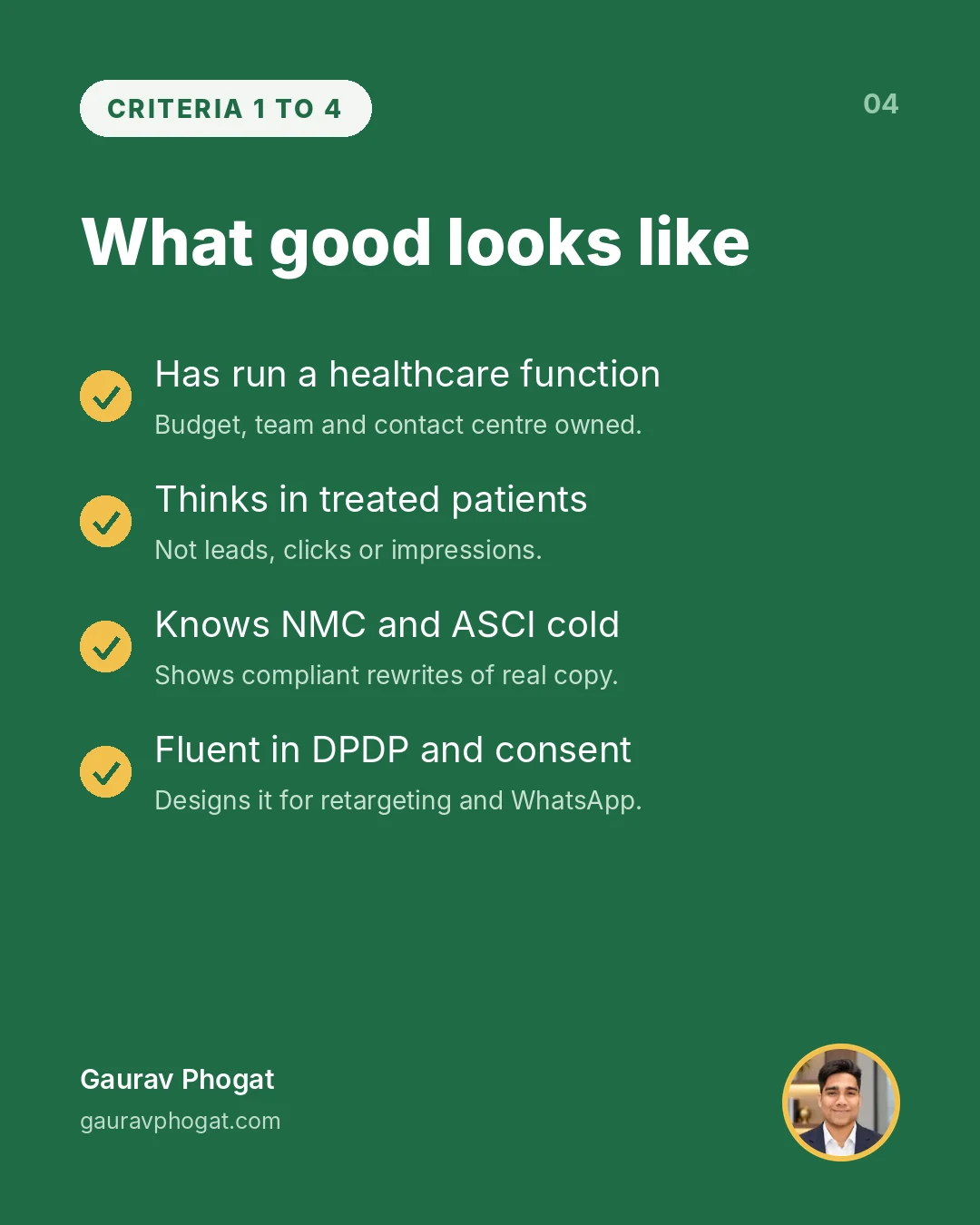
1. Has run a healthcare marketing function. Ask for the budget, the team, the contact centre and the doctors they were accountable for. Operators ask who answers the phone and what the OPD can absorb before they ask about the stack.
2. Thinks in treated patients, not clicks. Cost per lead is easy to lower and easy to game. A good consultant reports enquiry to appointment, appointment to arrival and cost per treated patient, and says where the funnel breaks. See cost per treated patient.
3. Knows NMC and ASCI rules cold. Doctor advertising, endorsements, testimonials, before-and-after photos and AI-generated content all have rules. They should be able to tell you what a doctor can post and why. Start with the NMC advertising guidelines 2026 hub and test any copy in the free NMC ad compliance checker.
4. Is fluent in DPDP and consent. Retargeting, WhatsApp opt-ins and CRM records of health enquiries all need a consent design. Read the DPDP Act for hospital marketers before you interview anyone.
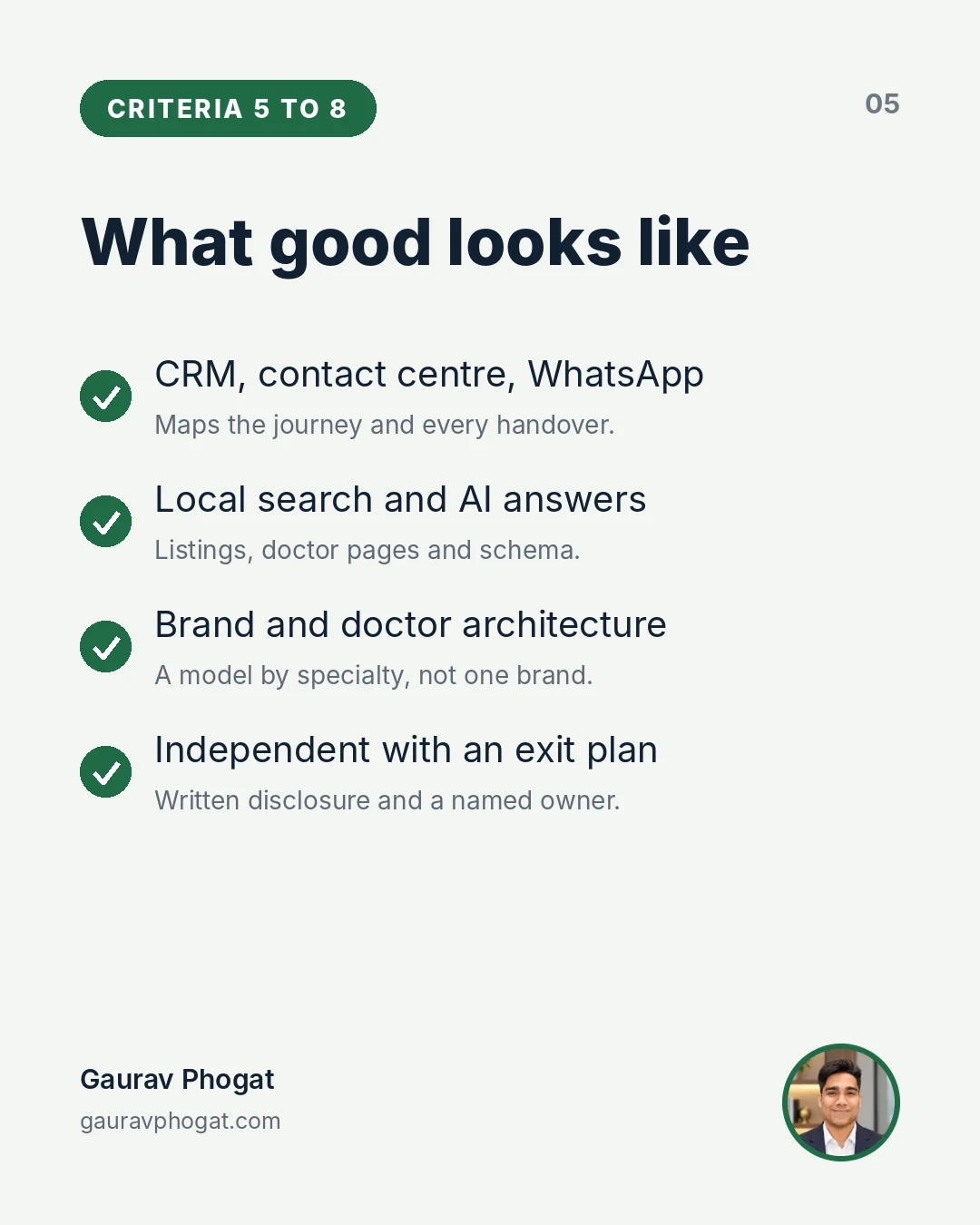
5. Understands CRM, the contact centre and WhatsApp. Most patient acquisition is won or lost between the enquiry and the appointment. See what a hospital CRM is actually for and WhatsApp Business API for hospitals.
6. Handles local search and AI answers. Google Business Profile, doctor pages, structured data and the way AI assistants describe your hospital now decide who gets the call. See local SEO for hospitals in India and how hospitals get cited by AI search.
7. Can design brand and doctor architecture. The hospital brand and individual doctor brands compete for the same patient trust, and the right balance differs by specialty. See hospital brand vs doctor brand: building both.
8. Is independent and plans their own exit. No commission on platforms, no media margin, a written scope, and a named internal owner who takes over when the engagement ends.
Scorecard: compare any shortlist in ten minutes
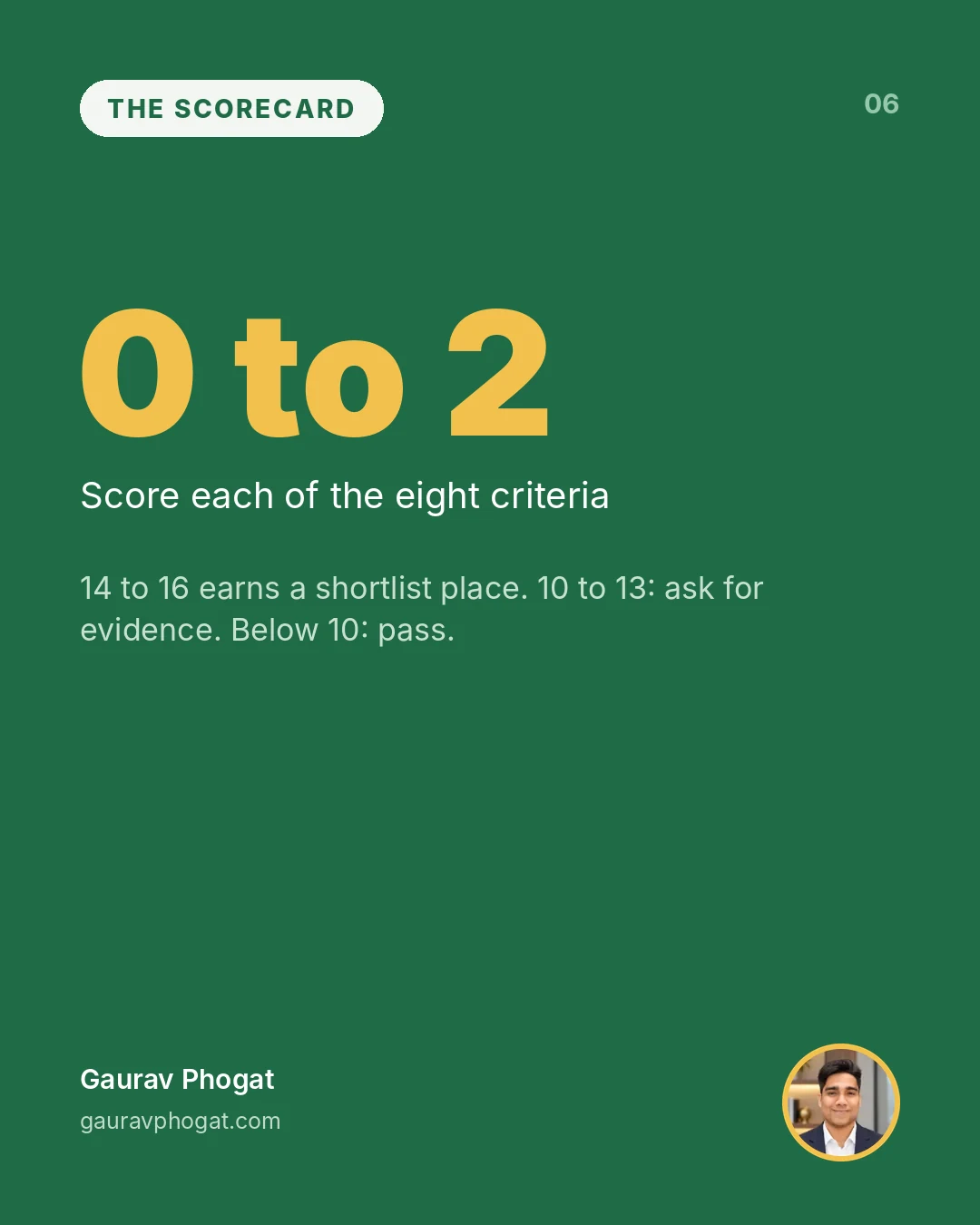
Score each consultant 0 (no evidence), 1 (claims only) or 2 (shown with specifics). Ask for specifics, not slides.
| Criterion | 0: no evidence | 1: claims only | 2: shown with specifics |
|---|---|---|---|
| Has run a healthcare marketing function | Advisory background only | Says so, cannot give scope | Names budget, team and contact centre owned |
| Treated-patient thinking | Reports leads and impressions | Mentions appointments | Reports cost per treated patient and the leak point |
| NMC and ASCI fluency | Not mentioned | Lists the rules | Shows compliant rewrites of real copy |
| DPDP and consent | Not mentioned | Aware of the Act | Designs consent for retargeting and WhatsApp |
| CRM, contact centre, WhatsApp | Media only | Recommends a tool | Maps the journey and the handover points |
| Local search and AI answers | Generic SEO | Mentions GEO | Shows listing, doctor page and schema work |
| Brand and doctor architecture | One brand, no model | Talks about doctor branding | Shows a model by specialty |
| Independence and exit plan | Undisclosed relationships | Verbal assurance | Written disclosure and a named handover owner |
A total of 14 to 16 earns a shortlist place. A total of 10 to 13 means asking for evidence on the weak rows before a second meeting. Below 10, pass, however good the pitch.
Ten questions to ask before you engage a healthcare marketing consultant
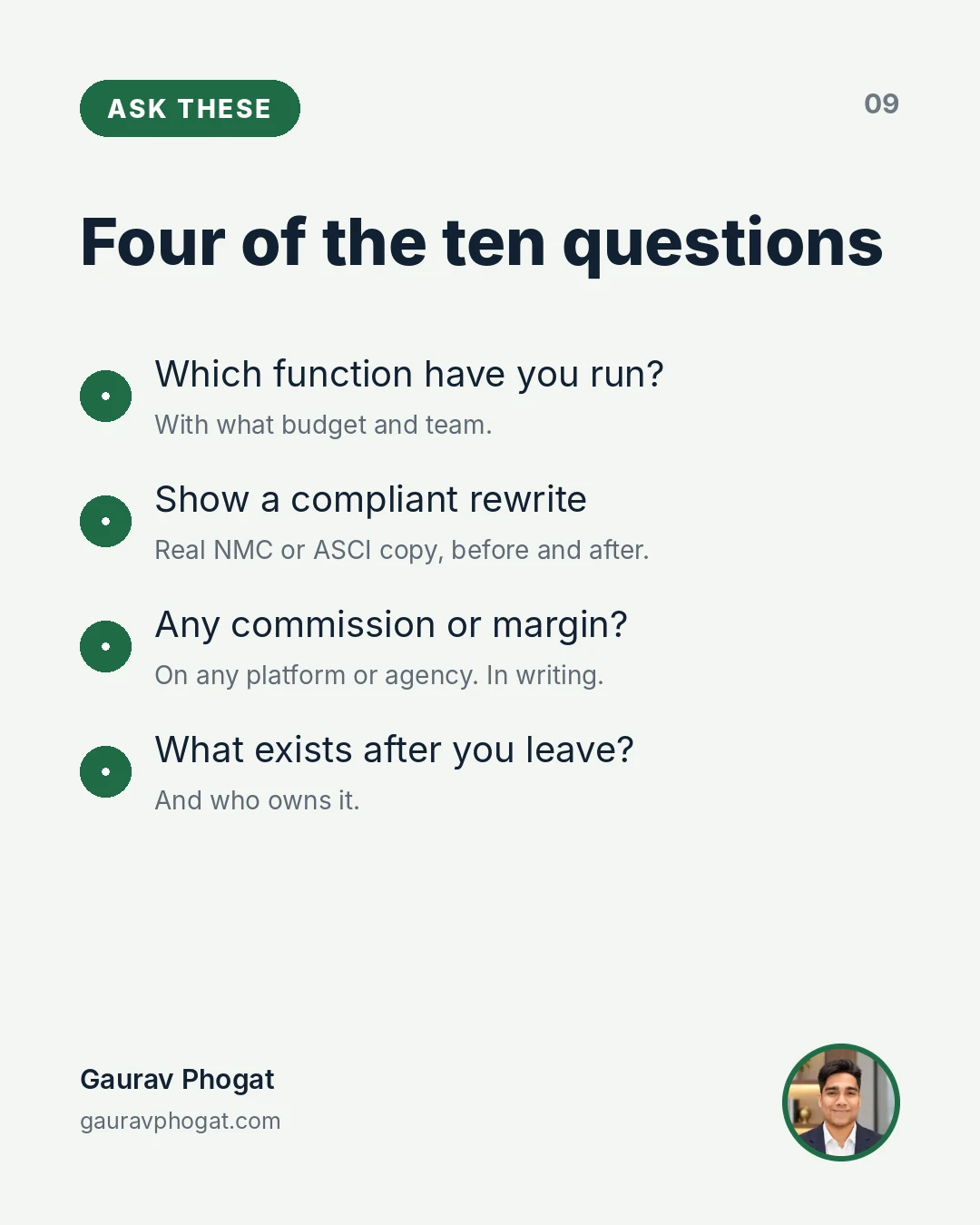
- Which healthcare marketing function have you run, and with what budget and team?
- What single measure would you use to judge your own work in the first 90 days, and what is its baseline here?
- Where does your funnel analysis usually find the leak after the click?
- Show me a piece of ad copy or doctor content you rewrote to comply with NMC or ASCI rules, before and after.
- How would you design consent for retargeting and WhatsApp under the DPDP Act?
- Do you, or anyone connected to you, earn commission or margin on any platform or agency you might recommend? Please answer in writing.
- What would you ask us to stop doing in month one?
- How do you handle the gap between marketing demand and OPD capacity?
- What will exist after you leave that does not exist today, and who will own it?
- Describe an engagement where your advice was wrong. What changed?
A consultant who answers these with specifics, including the uncomfortable ones, deserves a second conversation. One who answers with other organisations’ case studies and a list of tools does not.
Engagement formats and how they work
Diagnostic sprint. Four to eight weeks that trace the funnel from enquiry to treated patient, review consent and advertising compliance, and end in a ranked plan with owners. It suits organisations that do not yet know where the leak is.
Advisory retainer. A fixed number of sessions each month with the CEO, CMO or unit head, acting as a second opinion on agencies, vendors and board papers. It works when an internal owner already exists, and fails when it replaces one.
Launch support. Focused advice for a new hospital, unit or specialty centre, from naming and pre-launch demand to the first ninety days. See the hospital launch marketing plan.
Programme leadership. Interim ownership of delivery for six to eighteen months, with a written exit plan from day one. This is where operator experience matters most.
Red flags that should end the conversation
- Promises of guaranteed patient numbers or rankings. Healthcare outcomes depend on capacity and trust, and such claims often breach advertising rules.
- A proposal that starts with channels before tracing the funnel.
- Review or testimonial tactics that ignore NMC rules, such as scripted reviews or before-and-after photos.
- No questions about consent or patient data.
- Undisclosed relationships with platforms or agencies.
- Case studies drawn only from retail or e-commerce.
- Reports that show leads and impressions but never treated patients.
What the first 90 days should look like
Days one to thirty: listen and trace. Interview the CEO, unit heads, doctors, contact centre and compliance. Trace a sample of enquiries from first touch to treated patient. Establish the baseline, including where the contact centre loses people.
Days thirty to sixty: decide and fix the leak. Bring a few options to leadership, each with a cost, an owner, a compliance position and a measure. Fix the largest leak first, which is usually speed to first reply, appointment confirmation or follow-up after OPD.
Days sixty to ninety: prove and hand over. Report what moved against the baseline, including what did not. Leave a named internal owner, an agency scope written against the plan, and a board paper a non-specialist director can read in ten minutes.
Evidence: published work you can check
Most pages on this topic ask you to trust a ranking the author wrote about themselves. This site publishes the underlying work instead, each study with its method and a downloadable dataset.
- Indian hospital website benchmark: 100 hospital sites scored on speed, booking, doctor pages, schema and privacy
- Hospital Google Business Profile study: 216 listings across 12 cities
- Doctor profile pages study: 287 doctor pages across 31 hospital websites
- Hospital OPD booking flow study: 56 hospital websites across 7 cities
- Healthcare Google Ads teardown: 47 advertisers and their ad copy
- Doctor Instagram NMC compliance study: 112 accounts and 1,329 posts
For applied work, read selected work and the consulting page. Related guides: best healthcare marketers in India: what to look for, AI marketing consultant in India and digital marketing consultant in India.
Read next
Questions people ask
Expect decisions within the first quarter, a fixed leak in the funnel within two quarters, and movement in cost per treated patient within two to four quarters. If the consultant cannot name a baseline and a measure in the first month, the return will be hard to evidence later.
Often yes, for a defined period. An outside view helps with agency decisions, capacity-versus-demand questions and board framing. The consultant should sharpen your team’s decisions rather than replace them, and the engagement should have an end date.
Buying more traffic before fixing what happens to an enquiry. Slow first replies, unconfirmed appointments and no follow-up waste much of the budget in many hospitals. Trace the funnel before you scale spend.
Lightly, but at the right moments: reviewing medical accuracy, agreeing what you are comfortable saying publicly, and checking that content follows NMC rules. A good consultant protects your time by preparing everything for a short review.
Access to the CRM, call and WhatsApp data, website analytics and consent records. They should ask in the first fortnight and respect your access controls.
Role clarity more than headcount. Contact centre scripts, doctor engagement and content approval gain owners and service levels. Expect to need one internal programme owner and some training.
Be transparent about pricing, data handling and what you will and will not measure. A consultant often writes the selection criteria, so routing around them rarely helps you.
A decision, not a maturity score: what it costs, who owns it, the risk position under NMC, ASCI and DPDP rules, and how success will be measured against a baseline.
A named executive sponsor, access to enquiry and appointment data, and a willingness to decide within the engagement period. Mature systems are not required; a diagnostic sprint exists for the opposite case.
It scales down. A single hospital usually needs a diagnostic sprint and a short advisory period. A group needs more on lead routing between units and brand architecture. The criteria stay the same; the format changes.
Ask whether they earn margin on media or platforms, and whether the proposal starts with a diagnosis or a channel plan. Independence and sequencing show the difference quickly.
In three layers: decisions made, capability left behind, and outcomes moved. The first two are visible within a quarter. Outcomes such as cost per treated patient move over two to four quarters and depend on more than the consultant.
Fees vary widely with format and seniority, so a range would mislead. Judge the fee against the value of the decisions it improves, such as a mis-scoped agency contract or a compliance notice, which usually outweigh the fee.
Read my takes first in Google Search