

AI Tools for Marketing: How to Choose by Job, Not Hype
Written on by Gaurav Phogat. External facts checked against their original sources on the same date.
Choosing AI tools for marketing works best when you start from the job, not the tool. Define the job, the input data, the review step, the failure impact and the exit route before any trial begins. Then test one tool for a week against a baseline, using a scorecard with a pass mark set in advance. Tool categories differ in what they do well and badly, so match each to a job and begin with repeatable, low-risk work. Protect personal data under the DPDP Act with a never-paste list, make human review specific rather than assumed, and prevent tool sprawl with one approved tool per job and a simple register.
New to the topic? Start here: Hospital growth strategy sets out the reading order.
Why AI tools for marketing should be chosen by job
Most teams choose AI tools for marketing the way they choose conference speakers: by who is loudest this month. A colleague shares a demo, a tool gets adopted, and three months later nobody can say what it improved. I have seen this pattern in teams of every size, and the fix is not better taste in tools. The fix is a better order of questions.
The order I use starts with the work, not the tool. What job needs doing, with which data, checked by whom, and what happens if the output is wrong? Only after those four answers does a tool category enter the conversation. Teams that skip this order end up with a pile of impressive demos and no change in how the work gets done.
Search for the best AI tools for digital marketing and you will find ranked lists that go stale within weeks. A list cannot know your data, your approval chain or your tolerance for error. A method can. This article sets out that method, walks through a one week trial with a scorecard, and covers the data protection rules I would not bend on.
What this article leaves out
I name no products here, only categories, because categories stay stable while products change every quarter. Judge any AI marketing tools you meet against the same criteria. For prompting systems and review loops for a general-purpose chat assistant, read the guide to prompting systems and review loops for marketers, which I have deliberately not repeated here. For the wider strategic picture, see AI in marketing.
A selection method: five questions before any tool is tried
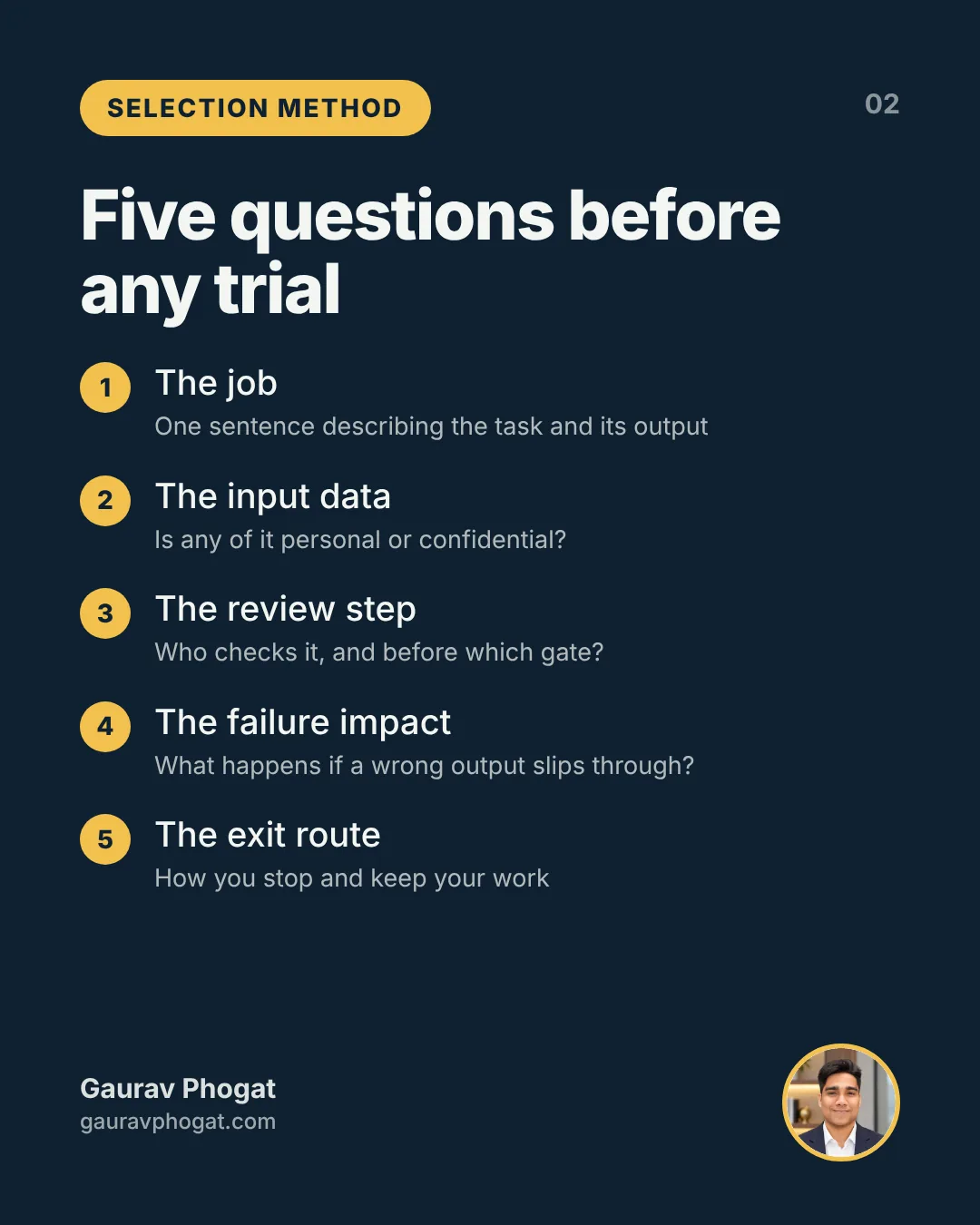
Before a trial of any of the AI tools for marketing begins, the team writes five short answers on one page. If any answer is vague, the trial does not start. This sounds bureaucratic, but it takes under an hour and it prevents most of the disappointment I see later.
- The job. One sentence describing the task and its output, for example: turn an approved product brief into three draft email variants.
- The input data. Exactly what the tool will be given, and whether any of it is personal, confidential or regulated.
- The review step. Who checks the output, against what standard, and before which gate: publish, send or present.
- The failure impact. What happens if a wrong output slips through: a typo, a misleading claim, a leaked list, a regulatory complaint.
- The exit route. How you would stop using the tool and keep your work: exportable outputs, templates stored in your own documents, and a manual fallback that still works.
Why failure impact decides how much oversight a job needs
Jobs differ enormously in what a mistake does. A rough internal summary of a meeting has a small failure impact. An email to a hundred thousand people has a large one. A claim in a regulated advertisement has the largest. Match the review step to the failure impact. Low-impact jobs can use a quick skim. High-impact jobs need a named checker and a written standard.
Why the exit route matters before you start
Teams rarely think about leaving a tool while they are excited about adopting it. Ask the exit question first. If your templates, briefs and approved examples live only inside one tool, you have created a dependency. Keep them in documents you control and treat the tool as replaceable. A tool you can leave is a tool you can evaluate honestly, because nobody is trapped into defending it.
Tool categories and what each is good and bad at
The table after this section summarises six working areas: what AI does well, what still needs a human, and a review check you can apply the same day. The paragraphs here add the failure patterns I see most often when teams adopt AI tools for marketing in each category.
General-purpose chat assistants
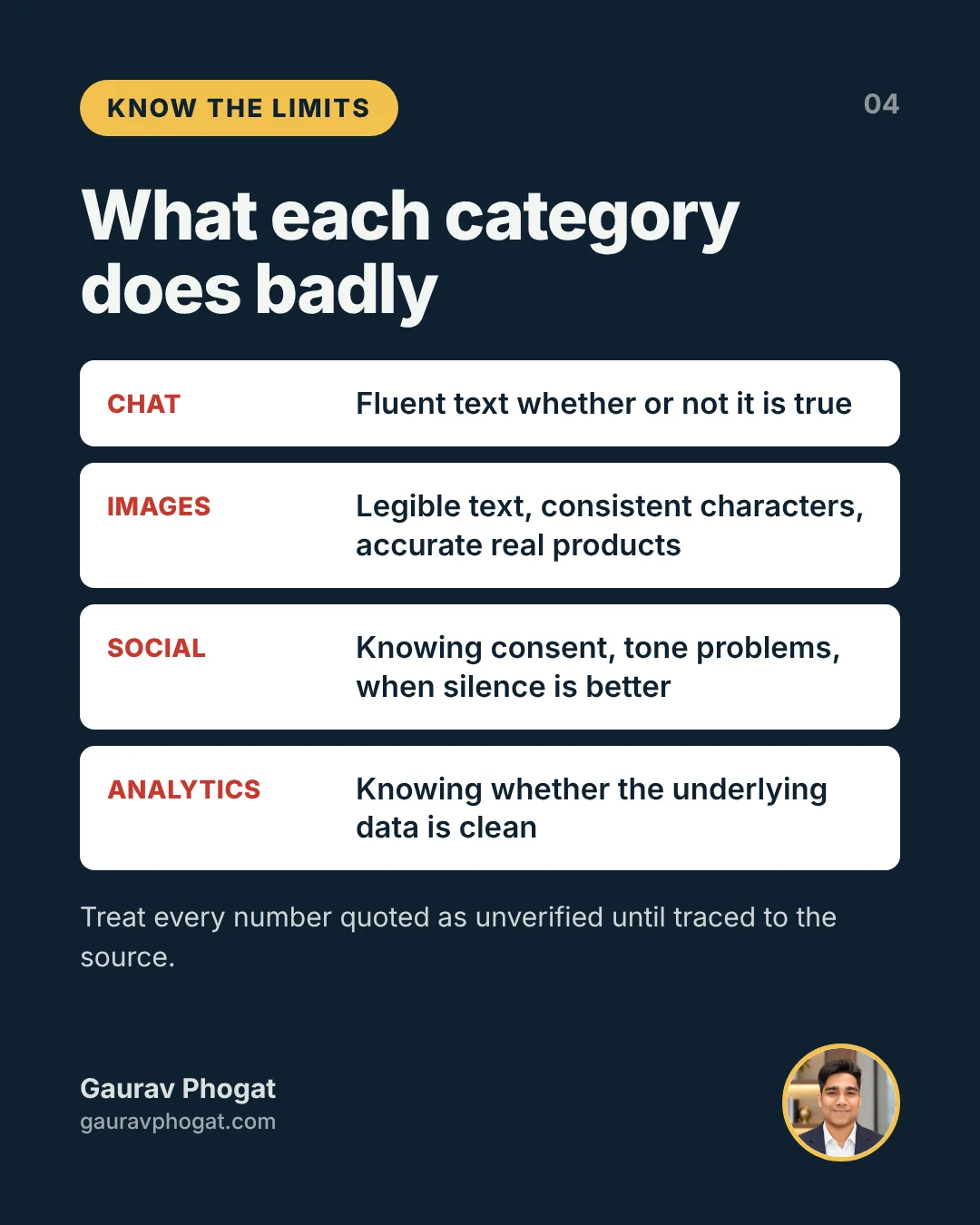
These are good at first drafts, summarising long documents, restructuring text, brainstorming angles and explaining unfamiliar topics. They are bad at knowing your facts, citing sources reliably and holding a brand voice without examples. They produce fluent text whether or not it is true, so fluency is never evidence of accuracy.
Image and video generators
These are good at concept exploration, mood boards, background variations, rough storyboards, resizing and format adaptation. They are bad at legible text inside images, consistent characters across a series, accurate depictions of real products, and anything clinical or technical. Rights and consent questions also stay with you, not the tool.
Email, social and scheduling assistants
These are good at subject line variants, segmentation suggestions, repurposing a long piece into short formats and timing recommendations drawn from past engagement. They are bad at knowing what your audience agreed to receive, spotting tone problems in a sensitive moment, and judging when silence is better than a post. AI tools for social media marketing are especially prone to producing generic posts that sound like everyone else’s.
Search visibility and content tools
These are good at clustering keywords, auditing pages for gaps, drafting meta descriptions and checking structure. They are bad at original insight, first-hand evidence and verified facts, which are exactly what search engines and answer engines increasingly reward. Output that merely restates what already ranks adds nothing new.
Analytics, reporting and workflow assistants
These are good at explaining a dashboard in plain language, flagging anomalies, drafting report commentary, transcribing meetings and listing action items. They are bad at knowing whether the underlying data is clean, separating correlation from cause, and assigning actions to the right owner when the conversation was messy. Treat every number they quote as unverified until it is traced to the source.
| Job | What AI does well | What still needs a human | Review check |
|---|---|---|---|
| Research and planning | Summarising sources, clustering themes, drafting briefs and outlines | Choosing what matters, verifying facts, setting strategy | Trace every claim to a source you have opened yourself |
| Copy and email | Draft variants, subject lines, tone adjustments, repurposing long pieces | Claims, brand voice, consent, timing and final approval | Check each claim and each promise against an approved source before sending |
| Design, image and video | Concepts, variations, resizing, rough storyboards | Accuracy of products and people, rights, taste, anything clinical | Inspect text, hands, products and implied endorsements frame by frame |
| Social and search visibility | Post variants, keyword clusters, page audits, meta descriptions | Original insight, evidence, community response, sensitive moments | Compare against your own facts and read each item as a stranger would |
| Analytics and reporting | Plain-language commentary, anomaly flags, draft summaries | Data quality, cause versus correlation, decisions | Recompute one number by hand and trace each figure to its source |
| Meeting and workflow assistants | Transcripts, summaries, action lists, reminders | Ownership of actions, confidential topics, judgement of tone | Compare the summary with your own notes for what was left out |
Matching AI tools for marketing to jobs, in the right order
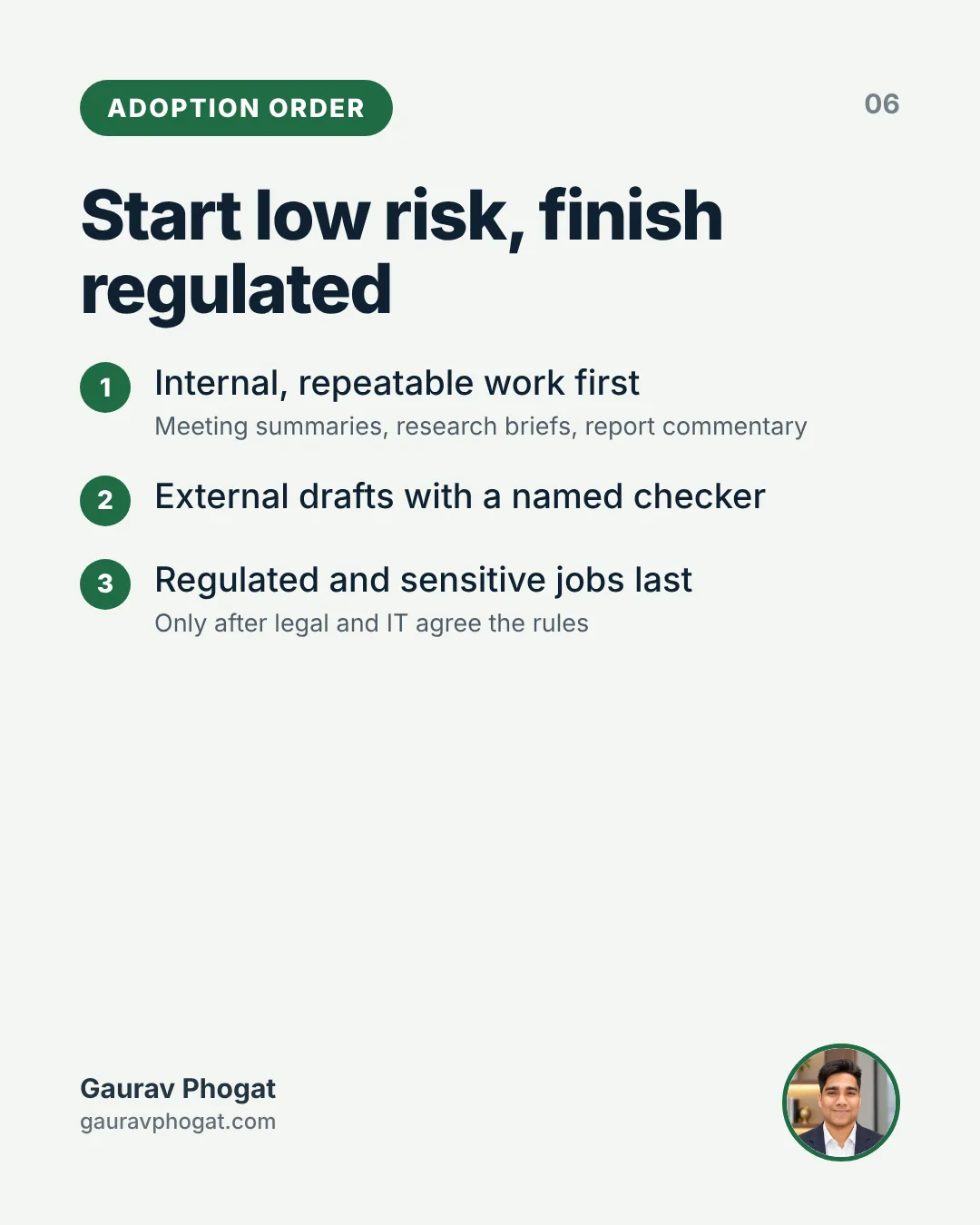
The sequence in which you adopt AI tools for marketing matters as much as the choice. I rank jobs on two axes: how often the task repeats, and how severe a failure would be. High volume with low failure impact comes first. Low volume with high failure impact comes last, and sometimes never.
Start with internal, repeatable work
Meeting summaries, first-pass research briefs, report commentary and content repurposing are good first jobs. The output is read by your own team, mistakes surface quickly, and the time saved is easy to observe. A team that gets a win here builds the habits it needs for riskier jobs.
Move to external drafts with a named checker
Next come emails, social posts and landing page copy. Here the review step carries the weight. One person owns the final check, with a written standard covering facts, claims, tone and consent. An AI tool for digital marketing earns trust in this zone slowly, one approved batch at a time.
Hold back regulated and sensitive jobs
Anything involving health claims, testimonials, children, financial promises or personal data should reach a tool last, and only after legal and IT have agreed the rules. If your sector has a regulator for advertising claims, assume the regulator will treat the published output as yours, however it was produced. For a broader view of how teams sequence this work, see AI in digital marketing.
A worked example: a one week trial with a scorecard
Take a realistic case for evaluating AI tools for marketing. Your team sends a monthly newsletter and spends a long afternoon each month drafting it. You are evaluating an assistant for first drafts. Here is how I would run the week.
The week
- Day 1, set the frame. Write the five-question page. Job: first draft of the newsletter from an approved outline. Input: the outline and three past newsletters, with no subscriber data. Review: the editor, using the standard checklist. Failure impact: moderate. Exit: drafts and prompts saved in team documents.
- Day 2, capture the baseline. Time one normal drafting session and count the edits the editor usually makes. Without a baseline you cannot judge anything.
- Days 3 and 4, run the trial. Draft the same newsletter with the tool, working from the same outline. Record time spent, edits needed and every factual error found.
- Day 5, score and decide. Two people score independently, compare, and agree one of three outcomes: adopt, adjust and retest, or drop.
The scorecard
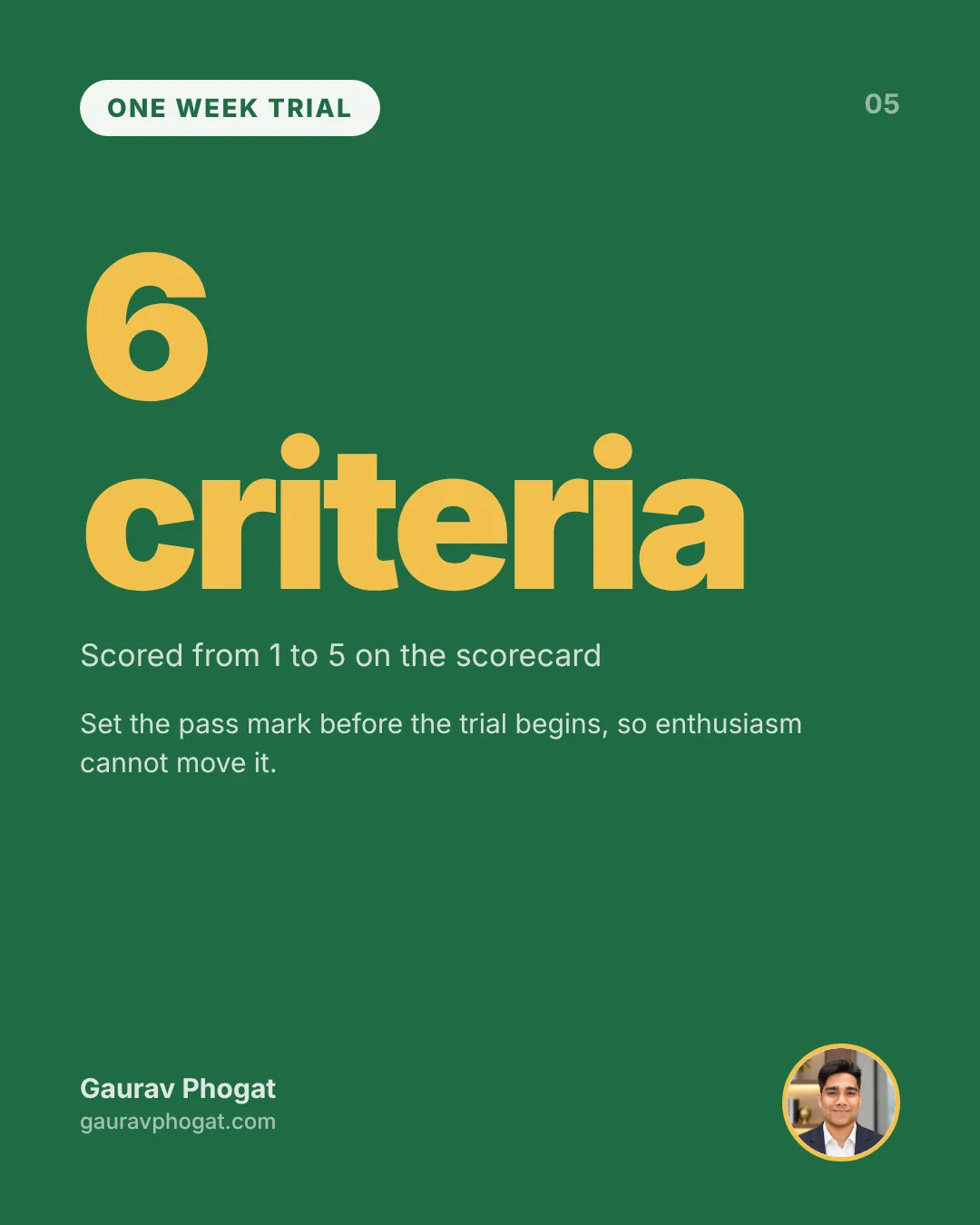
Score each criterion from 1 to 5, and set the pass mark before the trial begins so enthusiasm cannot move it.
- Output quality after editing: how close the edited draft is to your standard.
- Time saved: measured against the day 2 baseline, including editing time.
- Error rate: factual or tonal errors per draft, and how easy they were to spot.
- Data handling clarity: whether you can state, in writing, what happens to the inputs.
- Exit readiness: whether you could stop tomorrow and lose nothing important.
- Team fit: whether the people who would use it every month actually want to.
Two rules keep the scorecard honest. Any score of 1 on data handling ends the trial regardless of the total. And time saved only counts when the quality score is at least 3, because a fast draft that needs a full rewrite saves nothing. If the tool passes, repeat the test on the following month’s newsletter before adopting it, since one good week can be luck.
Data protection: what must never be pasted into a tool
India’s Digital Personal Data Protection Act, 2023 treats the organisation that decides why and how personal data is processed as a data fiduciary, and that responsibility does not disappear because a tool did the processing. Consent, purpose limitation and extra care with children’s data apply to marketing just as they apply to any other function. I have written a sector-specific reading in a detailed look at the DPDP Act for marketers in healthcare, and the principles carry over to any industry.
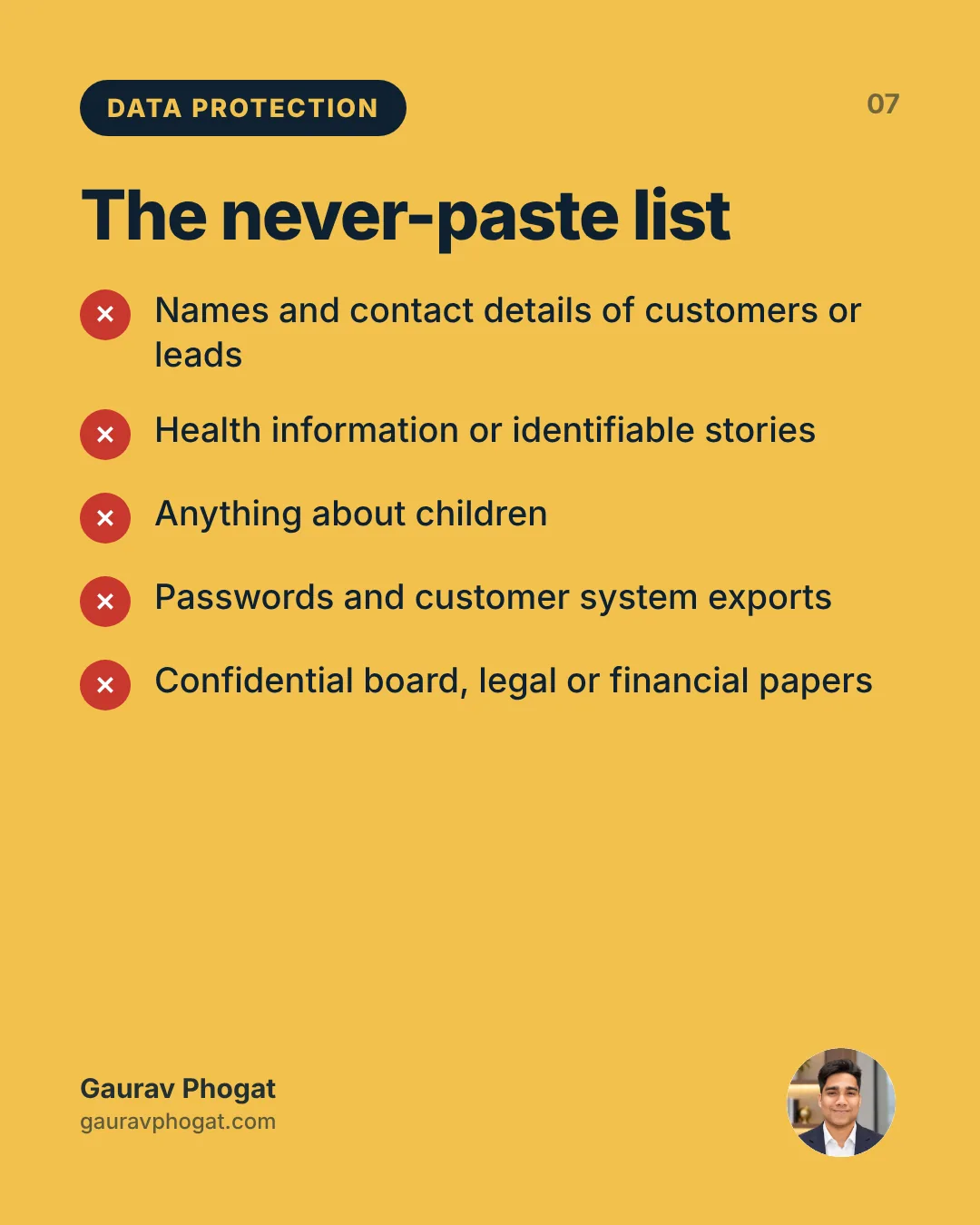
The never-paste list
- Names, phone numbers, email addresses or identifiers of customers, patients or leads, singly or in lists.
- Health information, diagnoses, case details, or any story from which a person could be identified.
- Anything about children, including images, school details and ages.
- Passwords, access keys, internal links and exports from your customer relationship system.
- Unreleased financial results, board papers, legal advice and documents under confidentiality terms.
- Internal strategy documents and competitive intelligence you would not email to an outsider.
Questions IT and legal should answer before a tool is approved
Does the provider keep your inputs, and for how long? Are inputs used to train models? Where is data processed and stored? Can access be limited to named users, with a record of who did what? Can you delete your data on request? If the provider cannot answer in writing, treat the answer as no.
Anonymise or use invented data whenever the job allows, and keep a short written list of approved tools and approved data types so that people are not guessing. The simplest rule for a team is this: if you would hesitate to read the text aloud in a public place, do not paste it into a tool.
Human review that actually catches errors
Saying that a human will review the output is not a control. It becomes one only when the reviewer knows what to look for, has time to look and has the authority to reject. In practice, reviewers under time pressure skim, and fluent text invites skimming. That is the quiet risk in every adoption of AI tools for marketing.
Make review specific. For copy, check every factual claim against a source, every promise of an outcome, and every mention of a person or place. For images, check hands, text, products and anything that implies endorsement. For analysis, trace each number back to the original report and recompute one by hand. For summaries, compare against the original for what was left out, not only what was said.
Keep a record of what the reviewer finds
Log the errors found in review, with a one-word category: fact, tone, claim, format or consent. After a month the log tells you more than any demonstration could. It shows which jobs the tool handles well, which need tighter checks and which should go back to people. It also gives you evidence to show a sceptical leader that the oversight is real.
How to avoid tool sprawl
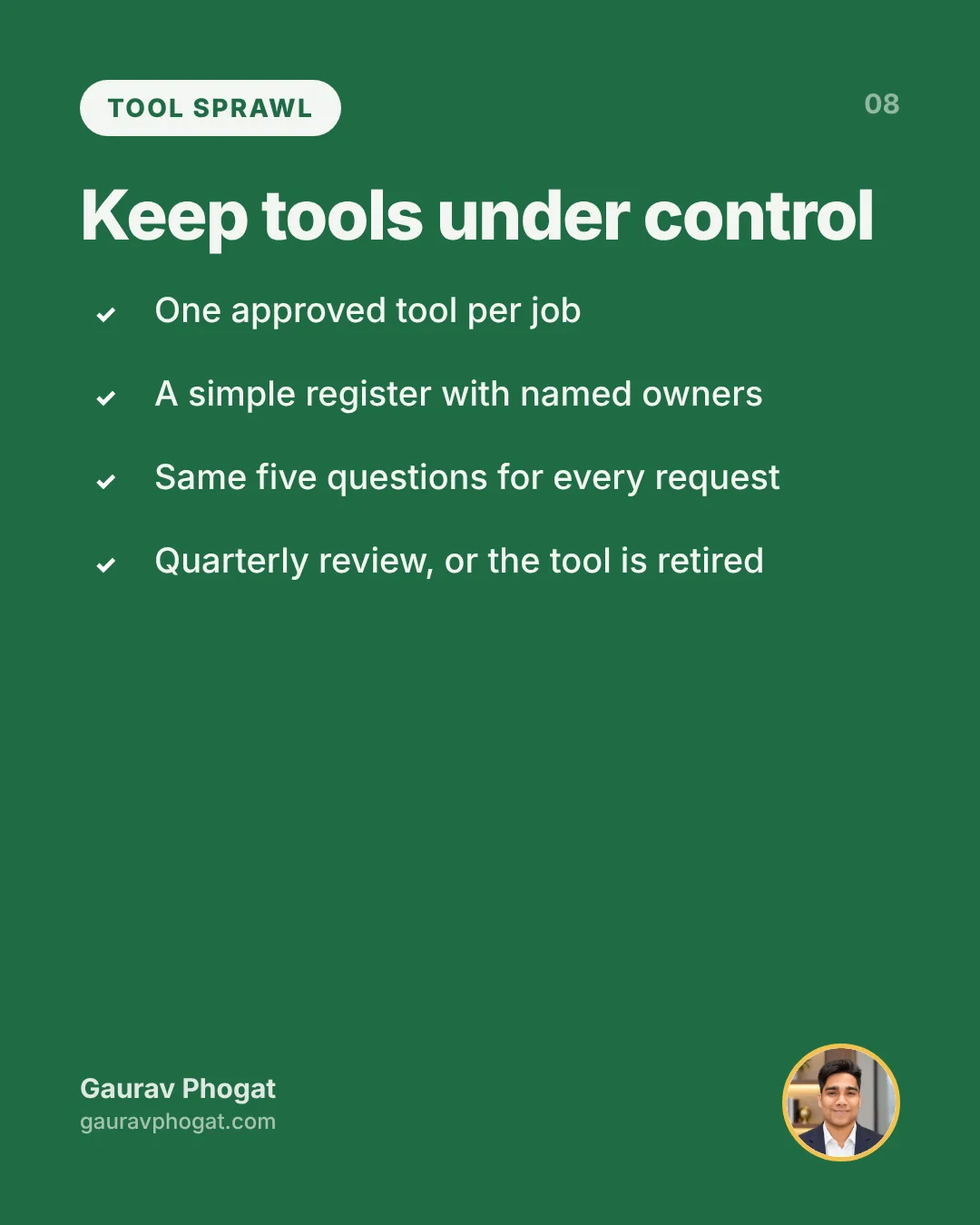
Sprawl starts innocently. Each person finds a useful tool, nobody tells anyone, and within six months the team has several tools doing the same job, several places where data has been pasted, and nobody who owns any of it. A few habits prevent this.
- One approved tool per job, with a named owner.
- A simple register listing each tool, its job, its owner, the data types allowed and the next review date.
- A fixed route for requests: anyone can propose a tool, and it goes through the same five questions and one week trial.
- A quarterly review in which each tool must show its scorecard result again, or it is retired.
- A rule that a new tool replaces an old one wherever the jobs overlap.
Sprawl is also a data protection problem, because every tool someone quietly adopts is a place where personal data may be going without anyone knowing. A register is the simplest defence.
The order to hold on to
Choose the job first, then the data, then the checker, then the tool. Teams that keep this order find that the question of which tool becomes much smaller, and that the right AI tools for marketing turn out to be the ones that fit a job you can already describe in a single sentence.
Read next
Questions people ask
Compare against a baseline measured before the trial. Track hours spent per deliverable, rounds of edits, errors caught in review, turnaround time and the volume of work finished by the same team. If hours fall and errors do not rise, the tool is working. If hours fall but rework rises, effort has only moved elsewhere. Review these measures every quarter.
Expect a short register of approved tools, one or two jobs running with named reviewers, a written list of data that must never be pasted, and a measured before and after for each job. Do not expect transformation. Expect clarity about what works, what was dropped and why, which is a stronger position than a large number of loose experiments.
Pick a task that repeats often and has a low failure impact, such as meeting summaries, research briefs or turning a long article into short posts. The output stays internal, mistakes surface quickly, and the improvement is easy to measure. Leave regulated claims, testimonials and anything involving personal data until your review habits and approvals are firmly in place.
Check whether inputs are retained and for how long, whether they are used to train models, where data is processed and stored, whether access can be limited to named users with an activity record, and whether data can be deleted on request. Also confirm that the tool can be switched off without losing your own documents. Get every answer in writing.
Be plain about the aim, which should be removing repetitive drafting and reporting work, and say so only if it is true. Train everyone on the five questions, the never-paste list and the review checks. Update role descriptions to include checking and judgement, and give people time to practise on low-risk jobs before anything external depends on the output.
Your organisation remains responsible for personal data it processes, including when a tool does the processing. Use data only for the purpose consent was given for, keep personal data out of tools wherever possible, take particular care with children’s data, and confirm in writing how each provider handles inputs. This is general guidance, so seek qualified legal advice on your own situation.
Ask for three things each quarter: the register of approved tools with their owners, a summary of errors caught in review by category, and any data incidents or near misses. Ask which jobs were stopped and why. A board does not need tool detail. It needs evidence that rules exist, are followed and leave a record that can be audited.
Run the tool alongside your usual process on one real deliverable, not instead of it. Capture a baseline on day two, record time and errors during the trial, and score the result against criteria agreed beforehand. Keep the scope to one job and one reviewer, so the result is clear and the trial adds only a few hours to the week.
Treat every output as a draft from a confident stranger. Check each fact against a source you have opened, read the text aloud for tone, and ask a colleague to review anything that leaves the team. Never paste personal or confidential data. Keep a note of the mistakes you catch, because that habit will teach you more than the tool does.
For one tool and one job, plan about an hour for the five-question page, a few hours of trial work spread across the week, and an hour for scoring and the decision, shared between two people. A second round on another deliverable confirms the result. That effort is small next to the rework a poorly chosen tool creates later.
Choosing a tool before defining the job, testing without a baseline, pasting confidential data during an informal try-out, treating fluent text as accurate text, and letting several people adopt overlapping tools unnoticed. The last one is the hardest to see because each individual decision looks sensible. A register and a named owner for every tool prevent most of these.
Three things: a written list of data that must never be pasted, a named reviewer for each job with the authority to reject output, and your own approved examples, briefs and brand guidelines kept in documents you control. Without these, teams end up judging tools on fluency rather than fit, and the data question gets answered by accident.
Scale the method, not the tool. Share the five-question page, the scorecard and the register, then let each team trial its own jobs. Keep one approved tool per job and retire duplicates. Review quarterly, and widen a tool’s use only when its scorecard holds up on another team’s work and the review log shows errors staying low.
Read my takes first in Google Search