

AI Marketing Strategy: A Step-by-Step Framework for Leaders
Written on by Gaurav Phogat. External facts checked against their original sources on the same date.
An AI marketing strategy is a one-page, decision-led document, and this guide shows how to build it in eleven steps. Begin with a single business outcome, map the customer journey to find friction, and inventory your data and consent. Then shortlist use cases and score them on impact, effort, risk, reversibility and data readiness. Decide whether AI assists, drafts or acts, set sourcing principles, design the team, and write governance as approvals. Add a measurement plan with baselines and holdouts, a roadmap in three horizons, and a risk register with a review rhythm. A scoring example and a one-page template are included.
New to the topic? Start here: Hospital growth strategy sets out the reading order.

What an AI marketing strategy document must contain
An AI marketing strategy is a short, decision-led document that says where AI will change your marketing, where it will not, and how you will know the difference. Most teams I meet have tools and a few pilots but no such document, so every new idea gets argued from scratch and every argument is won by whoever saw the most recent demo.
This guide is about building that document, step by step. If you want to know how to run the operating model once the document exists, read the operating-model guide. If you want the broad overview of the field first, start with AI in marketing. Here I stay on building the AI marketing strategy itself.
A good AI marketing plan fits on one page, names an owner for every decision, and can be read by someone outside the marketing team and still make sense. The eleven steps below produce exactly that:
- Define the business outcome.
- Map the customer journey and find friction.
- Inventory data and consent.
- Shortlist use cases and score them.
- Choose where AI acts, drafts or only assists.
- Decide build, buy or borrow in principle.
- Design the team and skills.
- Set governance and approvals.
- Write the measurement plan.
- Lay out the roadmap in three horizons.
- Record risks and fix a review rhythm.
Steps 1 and 2: Fix the business outcome, then map the journey
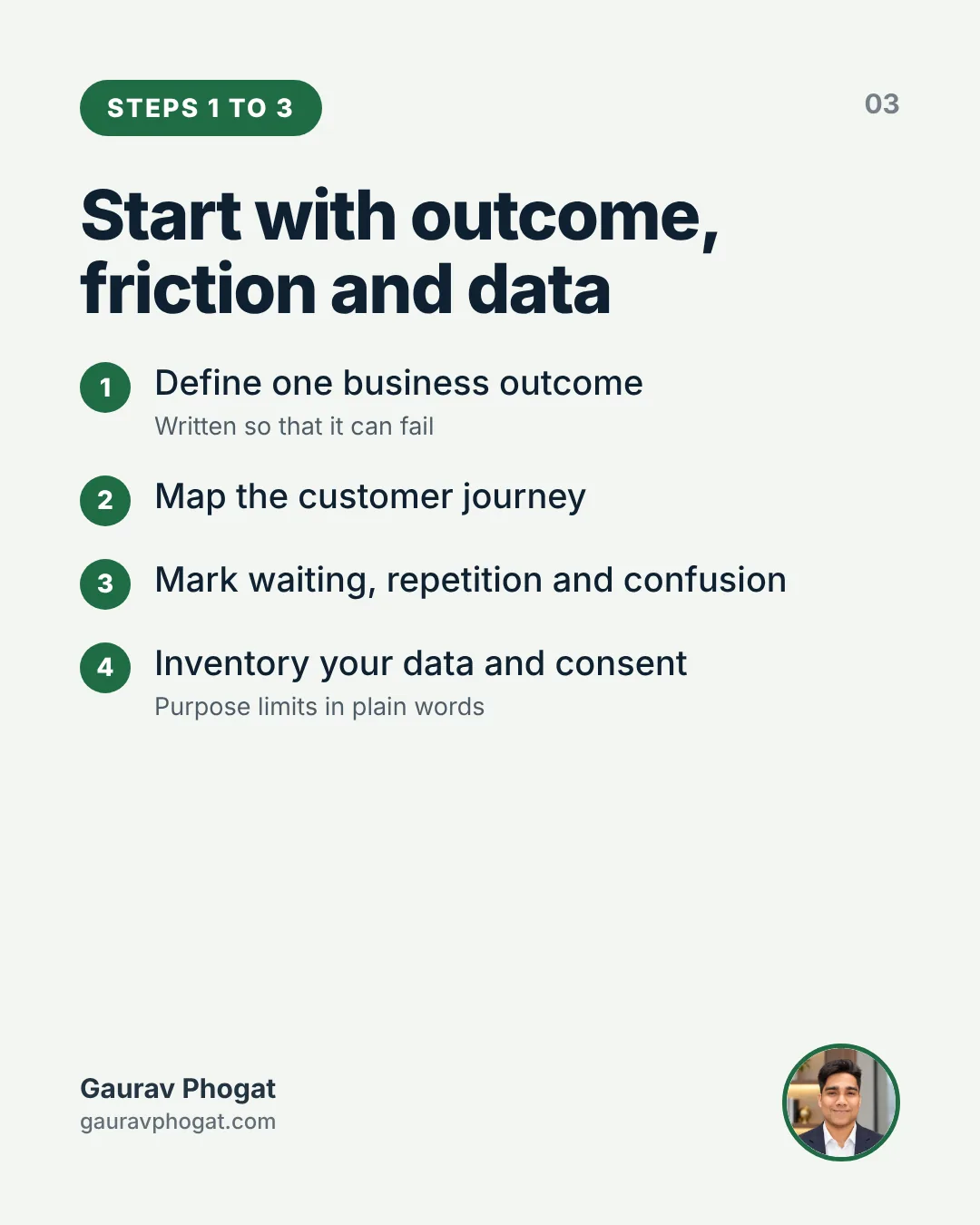
Start with one business outcome, written as a change in customer or business behaviour rather than a technology goal. “Use AI in marketing” is not an outcome. “Reduce the share of enquiries that go unanswered after working hours” is. Choose one primary outcome and at most two supporting ones. Give each a named owner, a baseline you can measure today and a date for the first reading.
Write the outcome so that it can fail
A good outcome statement can be proven wrong. It names the segment, the behaviour, the baseline, the direction of change and the time window. If nobody can say what a miss looks like, it is still a hope.
Map the journey and mark the friction
Draw the customer journey from first search to repeat use. For each stage, note what the customer is trying to do, what slows them down and which team owns that moment. Then mark friction in three kinds: waiting (slow replies), repetition (being asked for the same details twice) and confusion (content that does not answer the actual question).
Friction is where good use cases come from. A tools-first list comes from vendor demonstrations, while a friction-first list comes from customers. In high-trust categories there are also stages where a machine should never act alone. I have written about that boundary in where AI belongs in the patient journey, and the same logic applies to any journey where a wrong answer hurts the customer.
Step 3: Inventory your data and consent
Before the AI marketing strategy shortlists anything, list the data you actually hold. Most teams overestimate this. For each source, record what it contains, where it lives, who owns it, how fresh it is, how clean it is and what the person agreed to when they gave it.
In India the Digital Personal Data Protection Act, 2023 makes that last column non-negotiable. Consent given for an appointment reminder is not consent for building audiences or training a model. Write the purpose limit for each source in plain words, because the people who will later use the data will not read the legal text.
- Source and owner: the system, the team and the person accountable.
- Fields and freshness: what is captured and how recently it was updated.
- Quality: duplicates, gaps, inconsistent formats.
- Consent basis and purpose: what the individual agreed to, and what they did not.
- Permitted use: who may use it, for what, and with which safeguards.
Give each source a data readiness score from 1 to 5. That score feeds directly into step 4. The finding is often uncomfortable: the highest-impact idea depends on data you cannot yet use. It is far better to learn that on paper than three months into a pilot.
Step 4: Shortlist and score AI marketing use cases
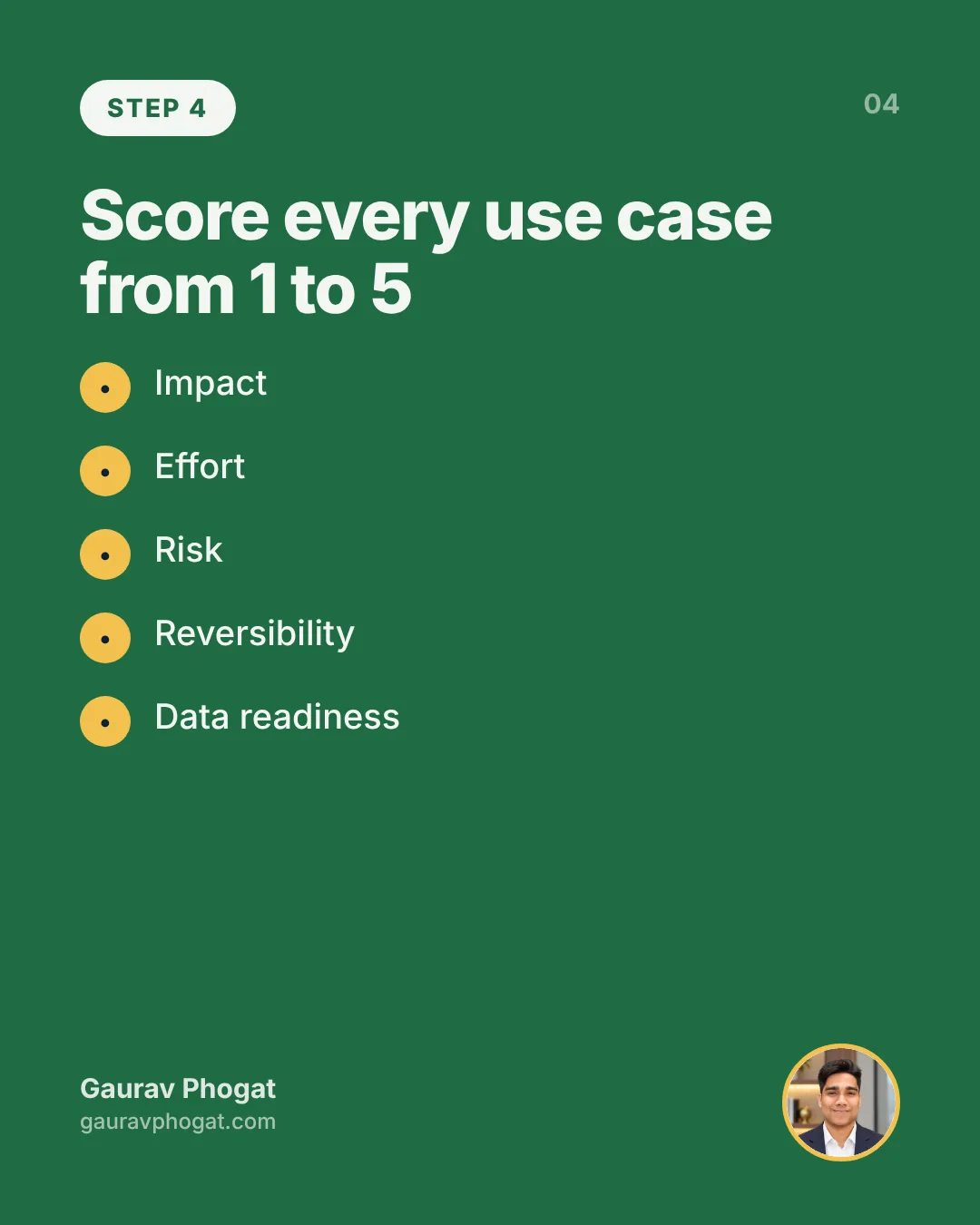
Turn the friction points from step 2 into a long list of candidate AI marketing use cases. Ten to fifteen is plenty. Cut it to three to five by scoring every candidate from 1 to 5 on the same criteria:
- Impact: how far it moves the outcome from step 1 if it works.
- Effort: how much team time and change it demands (5 is heavy).
- Risk: the harm to customers, brand or compliance if it goes wrong (5 is high).
- Reversibility: how easily you can switch it off and undo what it did (5 is easy).
- Data readiness: whether the data and consent exist today (5 is ready).
A simple priority score is impact plus reversibility plus data readiness, minus effort, minus risk. It is crude, and that is the point. The arithmetic exists to start a disciplined conversation, not to end it, so override it openly when judgement says otherwise and record why.
A worked example with three invented use cases
The scores below are illustrative scores, not statistics. They show how the method behaves, not how any real team would score.
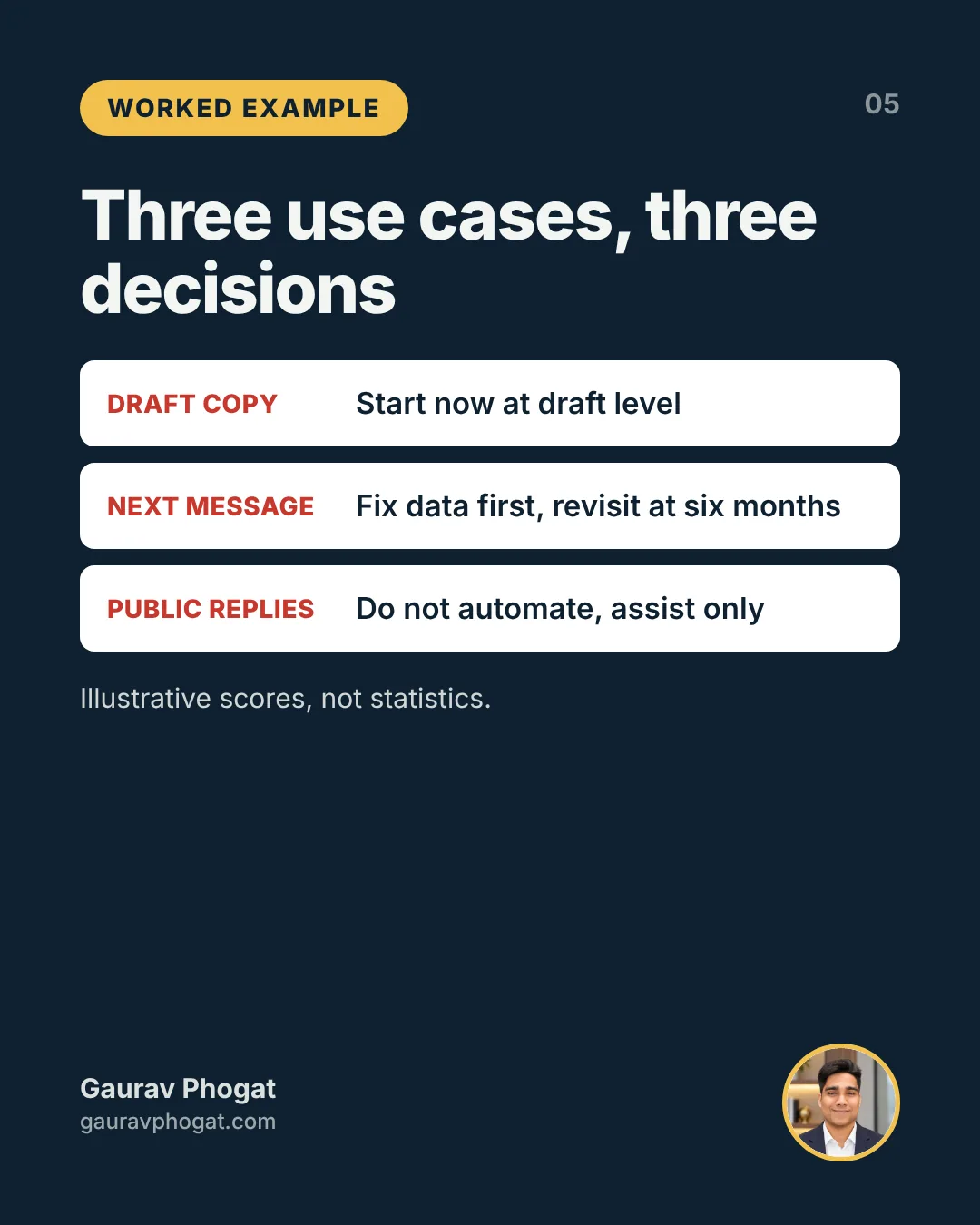
Use case A: first drafts of email and landing page copy, edited by a human. Impact 3, effort 1, risk 2, reversibility 5, data readiness 4. Priority score: 3 plus 5 plus 4 is 12, minus 3, which gives 9. This is generative AI marketing at its most practical: quick to start, easy to undo, and a human sees every word before a customer does.
Use case B: choosing the next message for each customer from behavioural data. Impact 5, effort 4, risk 3, reversibility 3, data readiness 2. Priority score: 5 plus 3 plus 2 is 10, minus 7, which gives 3. The impact is real, but the data and consent are not ready. The decision is to fix the data first and revisit at the six-month horizon.
Use case C: autonomous replies to customer complaints on social media. Impact 2, effort 3, risk 5, reversibility 1, data readiness 3. Priority score: 2 plus 1 plus 3 is 6, minus 8, which gives minus 2. A public reply cannot be unsent, and the risk dominates. The decision is not to automate, and to use AI only to summarise complaints for the human team.
The table below sets the three side by side.
| Use case | Impact | Effort | Risk | Decision |
|---|---|---|---|---|
| A: Human-edited first drafts of email and page copy | 3 | 1 | 2 | Start now at draft level |
| B: Next-message selection from behavioural data | 5 | 4 | 3 | Fix data first, revisit at six months |
| C: Autonomous replies to public complaints | 2 | 3 | 5 | Do not automate, assist only |
Steps 5 and 6: Decide where AI acts, drafts or assists, and how to source it
Three levels of autonomy
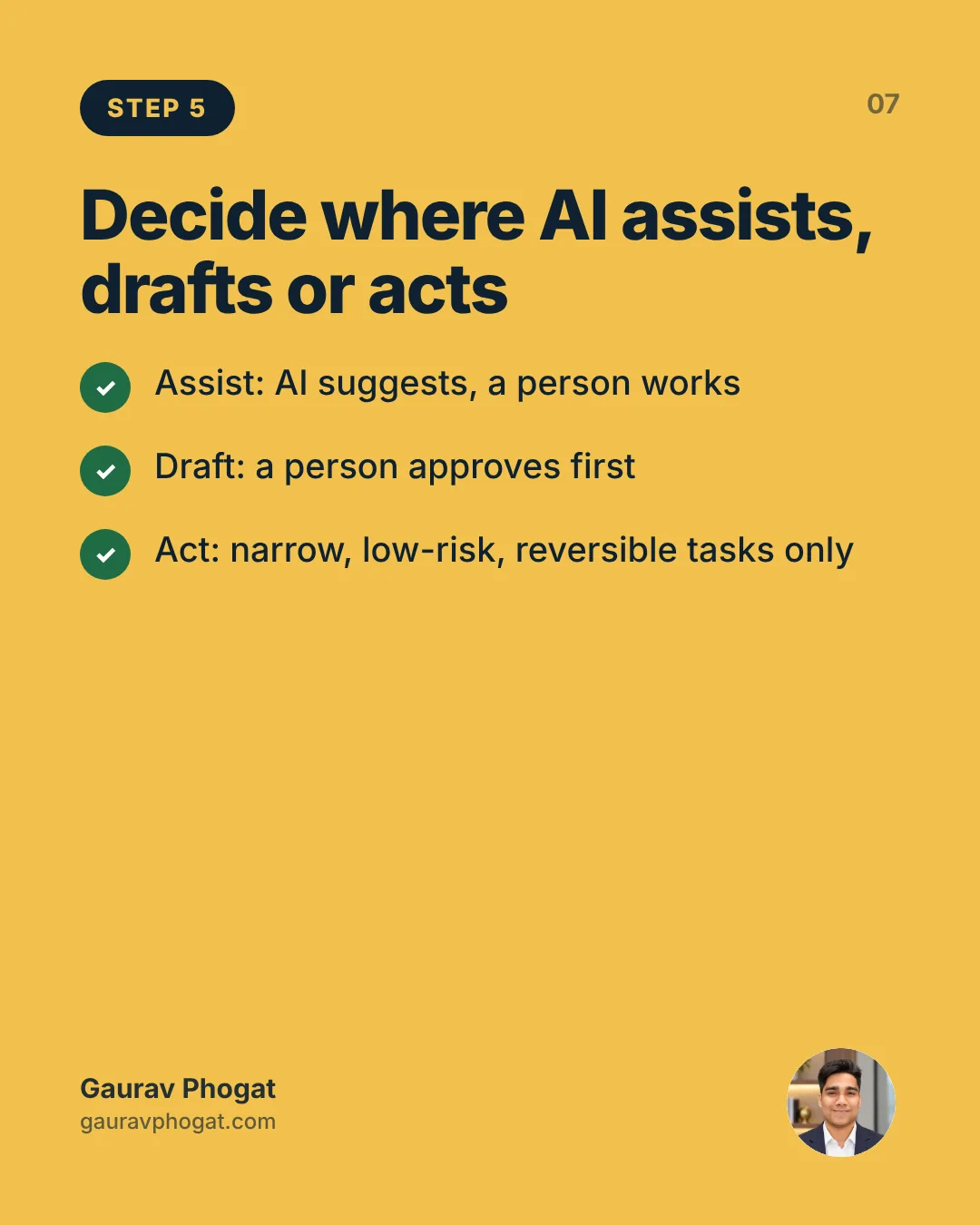
For every shortlisted use case, choose one of three roles for AI. Under assist, AI summarises, tags, researches or suggests, and a person does the work. Under draft, AI produces a version and a person approves it before anything reaches a customer. Under act, AI completes the task and the customer sees the result without review.
My default rule is to start every use case at assist, move it to draft only once output quality has been measured against a rubric, and allow act only for narrow, low-risk, reversible tasks with monitoring and a way to switch it off in minutes. Generative AI marketing makes drafting fast, which is exactly why approval discipline matters more, not less.
Build, buy or borrow in principle
Decide the principle before anyone meets a supplier, and keep product names out of the strategy document entirely. Build when the capability is differentiating and you own the data and the skills to maintain it. Buy when the capability is common and the task is standard. Borrow when you need to test an idea quickly using features you already have or a short-term arrangement, before committing to anything lasting.
Four questions settle most cases. Does it touch the data that sets you apart? Can you leave in a reasonable time without losing your data, prompts and workflows? Can you inspect and explain what it produces? Who will maintain it a year from now? Write the answers down as principles, and the specific choices later become easier to defend.
Steps 7 and 8: Team, skills and governance in your AI marketing strategy
Design the team around roles, not headcount
The strategy needs a named owner, usually the marketing head. Around that owner you need a data steward who knows what can be used, a technical partner from IT, a brand or content reviewer, a legal or compliance reviewer who is involved early rather than at the end, and the practitioners who run the workflows every day.
The skills that matter are less exotic than people expect: designing a workflow, writing clear instructions, judging output against a rubric, reading data with care and exercising editorial judgement. Most of this is learnt by doing real tasks with a rubric and a reviewer. Also write down team capacity honestly, in hours per week for each role, because a strategy that assumes spare time nobody has will quietly stall.
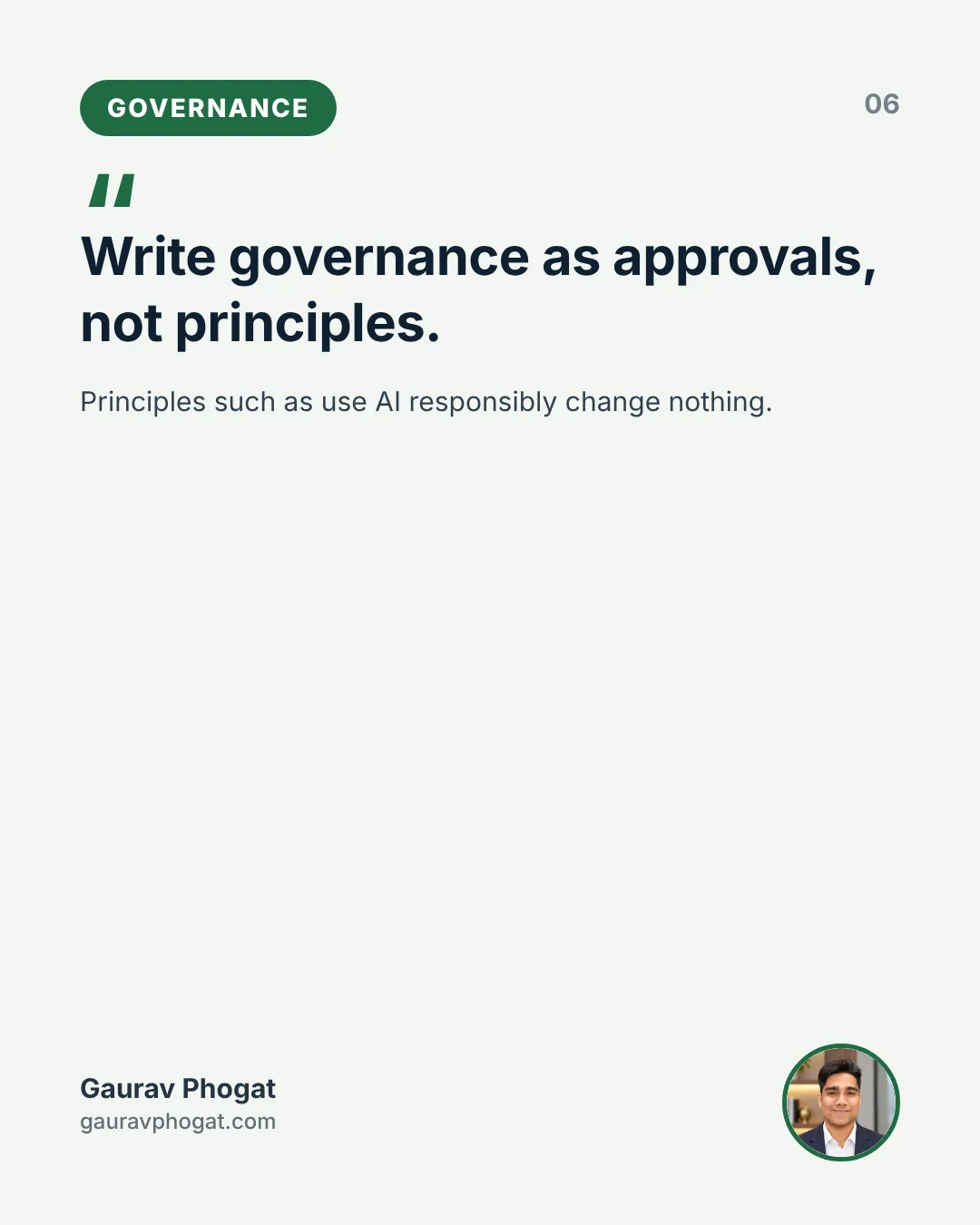
Write governance as approvals, not principles
Principles such as “use AI responsibly” change nothing. Governance in an AI marketing strategy that works is a short list of approvals. State which content categories need human sign-off, who may give it and how fast. State what must never be generated, such as testimonials, outcome claims and anything covered by sector rules or advertising codes, for which Indian marketers should check ASCI guidelines and their own regulator. Add disclosure rules, a log of prompts and outputs for audit, a route for approving new tools and a simple incident process.
Governance is also where this plan meets the senior leadership agenda. Chief marketing officers who want the wider view should read how to measure non-clinical AI projects alongside this section, since approvals and measurement are two halves of the same control system.
Step 9: Build a measurement plan with baselines and holdouts
This is the part of an AI marketing strategy that most documents leave vague. Write the plan before the first pilot starts, because results interpreted afterwards are almost always flattering.
Baseline first
Record current performance for the outcome metric over a stable period, ideally four to eight weeks, so you have something honest to compare against. Without it, every improvement is a story.
Hold out a comparison group
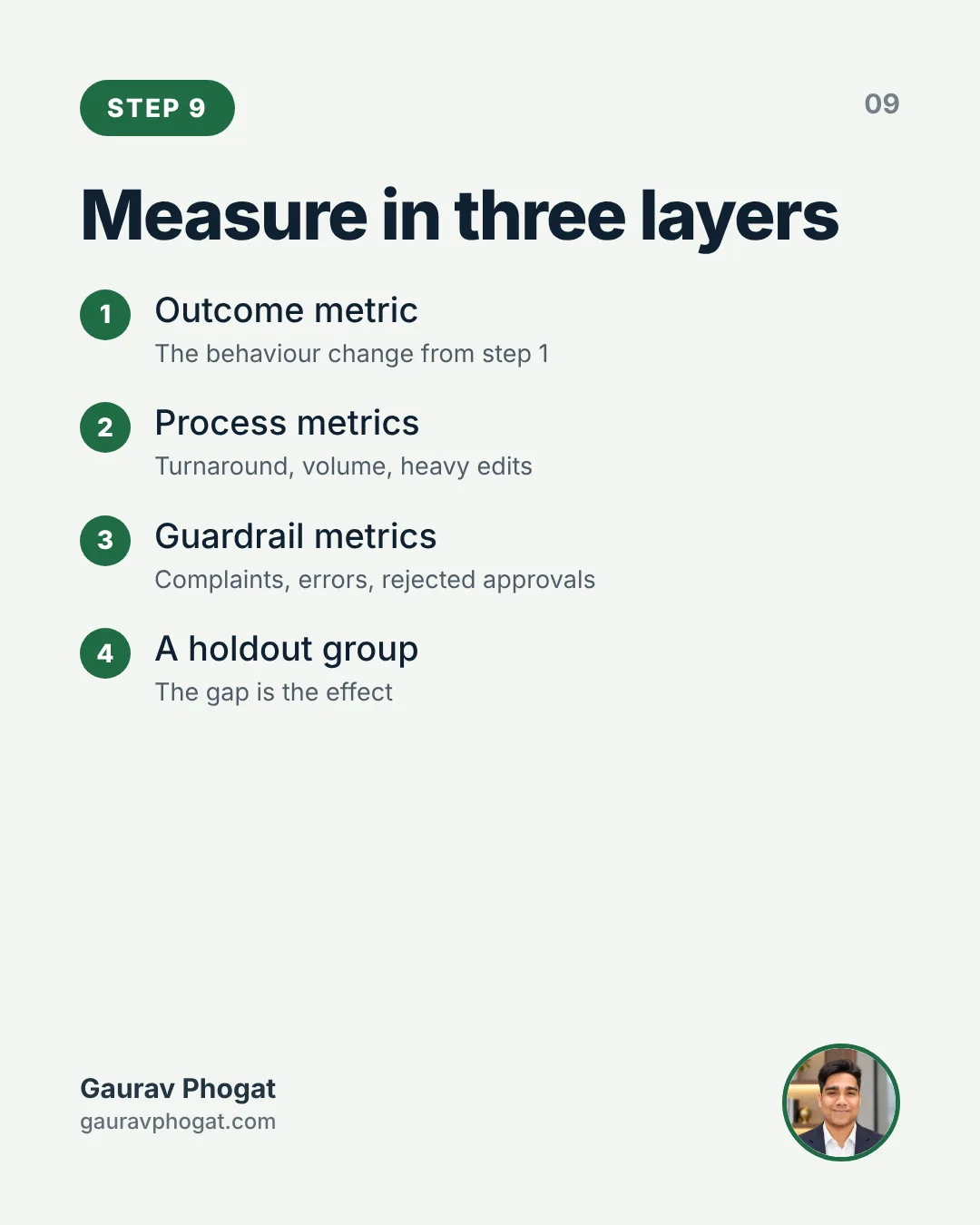
Keep a comparable group of customers, campaigns or enquiries untouched by AI. The gap between the two groups is the effect; everything else, such as seasonality, a festival, a news cycle or a competitor move, affects both groups and cancels out.
Measure in three layers
- Outcome metric: the behaviour change defined in step 1, such as enquiries answered within a set time.
- Process metrics: turnaround time, volume handled, share of drafts needing heavy edits.
- Guardrail metrics: complaints, unsubscribes, error rate, approvals rejected. Set a threshold that pauses the pilot automatically.
None of this needs financial figures. Time saved, response speed, quality scores and conversion rates are enough to judge whether a use case deserves to continue.
Steps 10 and 11: Roadmap in three horizons, then risks and review rhythm
Roadmap in three horizons
- Horizon 1, the first 30, 60 and 90 days: complete steps 1 to 4, record baselines, and run one or two use cases at assist or draft level. By day 30 the outcome and the data inventory are signed off. By day 60 the first pilot is live with a holdout. By day 90 you hold a first honest reading and a keep, change or stop decision.
- Horizon 2, six months: scale what worked to adjacent teams, fix the data gaps found in step 3, train the wider team and revisit use cases that were parked for readiness reasons.
- Horizon 3, twelve months: consider limited act-level automation for proven, reversible tasks, review the sourcing principles, and re-score the whole use-case list against a changed journey.
Risks and a review rhythm
Keep a short risk register with an owner against each line. The usual five are wrong or invented facts reaching customers, a privacy or consent breach, drift in brand voice, over-reliance that erodes team skills, and dependence on a tool that changes or disappears.
Then fix the rhythm in the calendar. A thirty-minute weekly check of the guardrail metrics, a monthly use-case review, and a quarterly session where the whole list is re-scored and the document is rewritten where reality disagreed. A marketing strategy with AI is never finished; it is a document with a version number.
A one-page AI marketing strategy template
Use this as the final deliverable. If any line cannot be filled in, that is the next piece of work, not a reason to leave it blank.
- Outcome: the single primary outcome, its owner, baseline and first reading date.
- Journey friction: the three biggest friction points, with the stage and the team that owns each.
- Data and consent: usable sources, readiness scores and purpose limits.
- Selected use cases: three to five, with scores and the decision on each.
- AI role: assist, draft or act for each use case, and the conditions for moving between levels.
- Sourcing principles: the build, buy or borrow rules, with no product names.
- Team: owner, data steward, IT partner, reviewers, practitioners, and weekly hours for each.
- Governance: approval list, never-generate list, disclosure rule and incident route.
- Measurement: baseline period, holdout design, outcome, process and guardrail metrics, stop thresholds.
- Roadmap: 30, 60 and 90 days; six months; twelve months.
- Risks: top five with owners.
- Review rhythm: weekly, monthly and quarterly checkpoints, with the version number and date.
When this page is complete, your AI marketing strategy is ready to be challenged, which is the only test that matters. Circulate it to finance, legal, IT and sales before launch, collect objections in writing, and revise.
Questions people ask
Compare the outcome metric against the baseline and the holdout group, then check process measures such as turnaround time and rework, and guardrail measures such as complaints and errors. If the outcome improves in the AI group but not in the holdout, and the guardrails hold, the strategy is working. Review this quarterly.
Expect a signed-off outcome, a data and consent inventory, a scored use-case list, one or two live pilots with baselines and holdouts, and a first honest reading with a keep, change or stop decision. Do not expect transformation. Expect clarity about what works, what is blocked and who owns each decision.
A content calendar schedules output. A strategy decides outcomes, use cases, levels of autonomy, approvals, measurement and review. You can have an AI-assisted content calendar without a strategy, and it will drift, because nothing says which tasks AI should handle, who approves them or how you would know it is helping.
IT should confirm where customer data lives, who can access it, how consent flags are stored, which tools are approved and how outputs and prompts can be logged. You do not need a new platform to begin. You need clear answers on data access, security review and a named technical partner who attends the monthly review.
Start by naming the roles in the strategy and the skills each needs, then train on real tasks with a quality rubric. Most roles shift towards review, judgement and workflow design rather than disappearing. Be open early about which tasks will change, because uncertainty damages adoption more than the tools do.
It should state the lawful basis and purpose for each data source, what is never to be fed into AI tools, who approves new uses of personal data, how outputs are logged and how incidents are handled. In India, map these to the Digital Personal Data Protection Act, 2023 and applicable advertising and sector rules, and involve legal from step 3.
Ask which business outcome it serves, what the baseline is, what the holdout shows, which use cases were rejected and why, who is accountable for approvals, what the top risks are and when the plan is next reviewed. A strategy that cannot answer the rejected-use-cases question has probably not been scored properly.
Use rough 1 to 5 judgements agreed by two or three colleagues, write down the reasoning, and treat the scores as hypotheses. The first pilot with a baseline and a holdout will replace guesses with evidence. A transparent rough score is more useful than a precise number nobody can explain.
Agree one outcome that spans both teams, such as faster follow-up on qualified enquiries, and one shared definition of a qualified lead. Then place use cases in the journey so handoffs are explicit. The sales head should sit on the monthly review, since sales feedback is the quickest check on message quality.
For a focused team, a first version takes two to four weeks if the data inventory is not already in hand, and less if it is. The document is not the slow part. Gathering honest baselines, consent information and agreement on the outcome takes most of the time, and that work is worth doing anyway.
Choosing tools before outcomes, scoring only impact and ignoring risk and reversibility, skipping the consent review, launching without a baseline or holdout, letting AI act before drafts have been measured, and never reviewing the document again. Each of these is avoidable by following the steps in order and fixing a review rhythm early.
A small team can start with a few hours a week from the owner, the data steward and one or two practitioners, plus short reviews from IT and legal. Capacity matters more than enthusiasm, so write hours per role into the strategy and cut the number of pilots until the hours are realistic.
Scale when the outcome has improved against the holdout for a sustained period, guardrail metrics stayed inside thresholds, the data and consent position supports wider use, and the team running it can explain how it works. If any of these is missing, extend the pilot or fix the gap first, rather than widening exposure.
Read my takes first in Google Search