

AI Marketing Automation: What to Automate and What Not To
Written on by Gaurav Phogat. External facts checked against their original sources on the same date.
AI marketing automation pays off when it is pointed at work that is high in volume, low in judgement, governed by clear rules and easy to reverse. Rules-based, AI-assisted and agent-style automation carry different risks, so each step should be labelled and safeguarded accordingly. Lead routing, nurture, re-engagement, scoring, reporting and content repurposing can all be automated, but brand voice, claims, sensitive segments, complaints and irreversible actions stay with people. Clean identity, consent and source data come first, followed by suppression rules, holdout tests, monitoring and kill switches. A 30, 60, 90 day rollout lets a team earn trust step by step.
This article is part of the hospital growth strategy series, best read in order from the pillar.
What AI marketing automation actually means
AI marketing automation is the use of software, and increasingly machine learning models, to run repeatable marketing work without a person pressing the button each time. That covers routing a lead, sending the next message in a sequence, scoring interest, assembling a report or turning one long piece into five short ones. The promise is real. So is the damage when it is pointed at the wrong job.
I have watched teams automate the easy parts well and then automate the risky parts badly, often in the same quarter. The tooling is rarely the constraint. Judgement about what deserves automation is. This guide gives you a way to make that judgement, then walks through the core flows, the data that must sit underneath them, the safeguards that keep them honest and a 90 day rollout.
It is deliberately general. Sector rules change the answer, and hospitals are covered separately on the healthcare marketing automation page. If you want the plain definition first, the marketing automation glossary entry is short and clear.
Why the question is sharper now
Marketing automation tools have existed for many years, and most teams already run some version of them. What changed is that generative and predictive models can now write, classify and decide. The set of things that can be automated has widened faster than the set of things that should be. The gap between those two sets is where brand damage, consent breaches and wasted effort live.
For wider context on how models are reshaping the discipline, see my overview of AI in marketing.
Rules-based, AI-assisted and agent-style automation
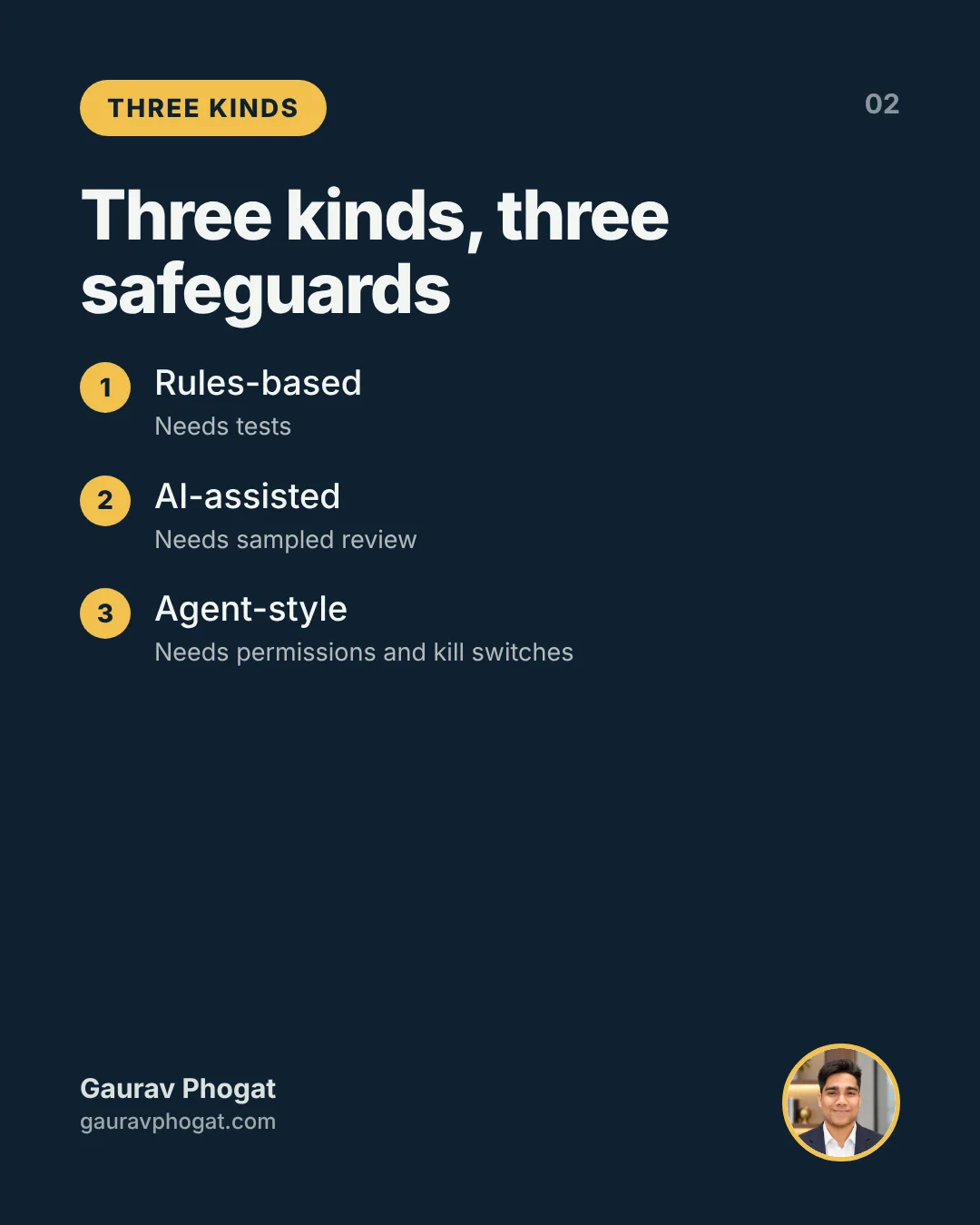
Three different things get sold as AI marketing automation, and they need different controls. Most marketing automation tools now bundle all three behind a single interface, which hides which type of step you are actually running. Label every step in your workflows with its type before you do anything else.
Rules-based automation
This is if-this-then-that logic. A form is submitted from a given city and the enquiry goes to a given team. A new subscriber receives a welcome message. A contact who has not opened anything for 90 days moves to a quieter list. It is deterministic, easy to audit and cheap to reason about. Its weakness is brittleness: when reality departs from the rule, the rule keeps firing anyway.
AI-assisted automation
Here a model proposes and a rule or a person approves. Examples include classifying incoming enquiries by intent, drafting subject lines, summarising call notes, predicting who is likely to respond and suggesting the next best content. The model never has the final word on anything with consequences. This is where most teams should spend the bulk of their effort in year one.
Agent-style automation
An agent is given a goal and a set of tools, then chooses its own actions: it might pick an audience, write a message, schedule it and adjust the schedule based on results. It is the most capable form and the least predictable. Use it only with narrow permissions, reversible actions, a hard ceiling on volume and full logging of what it did and why.
In practice, AI driven marketing automation is a mix of the three. The useful discipline is to match the safeguard to the type: rules need tests, assisted steps need review sampling, and agents need permissions and kill switches.
A decision framework for what to automate
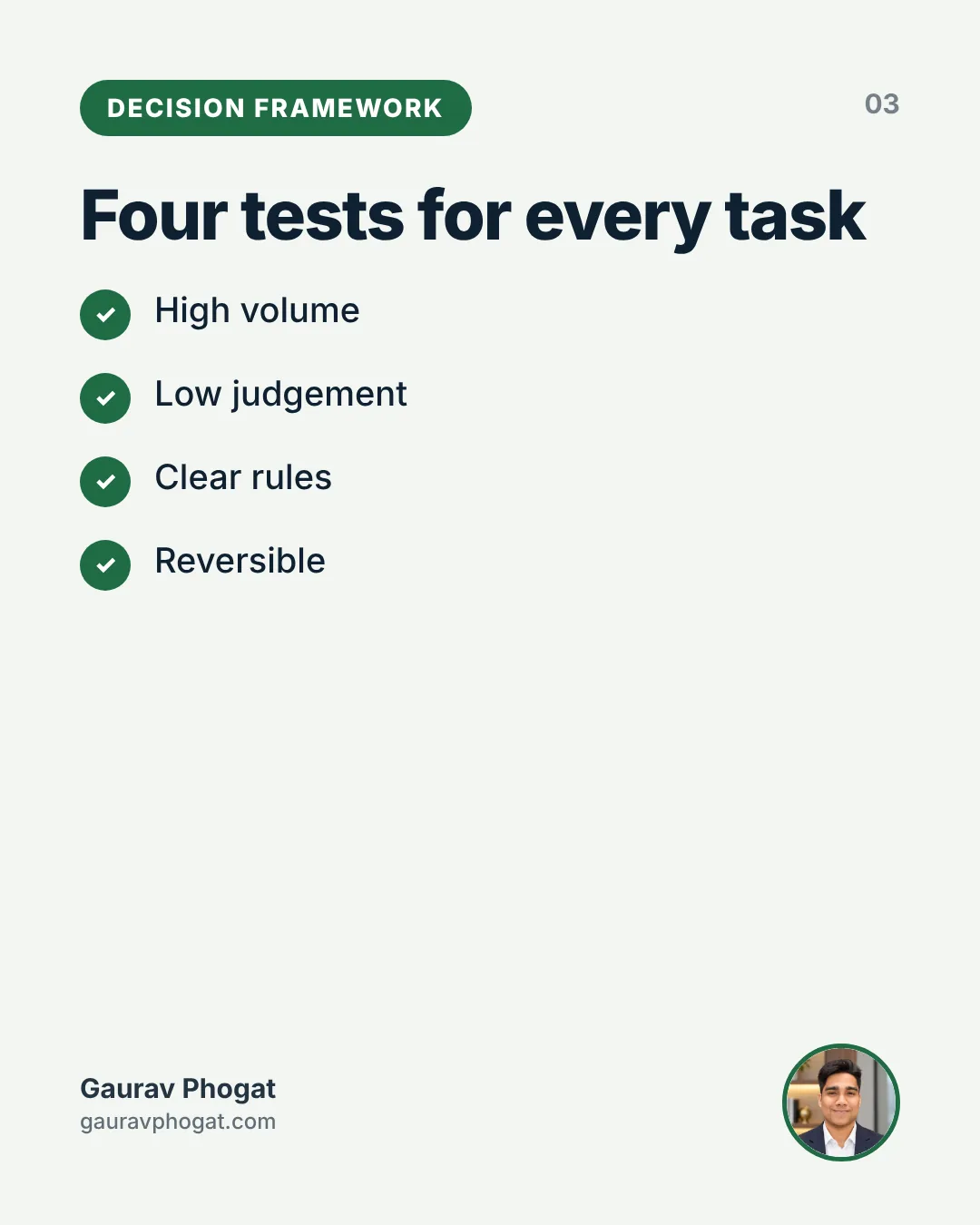
Run every candidate task through four tests. A task is a strong automation candidate when the answer to all four is yes.
- High volume. The task repeats often enough that a person doing it by hand is a bottleneck or a source of inconsistency.
- Low judgement. A competent new joiner could do it correctly after a short briefing and a checklist.
- Clear rules. You can write down what correct looks like, including the edge cases, in plain language.
- Reversible. If it goes wrong, you can undo it or contain it before it reaches many people or becomes public.
Score each test from zero to two and add them up. A task scoring seven or eight can run unattended with monitoring. A task scoring four to six should run with an approval step or a sampled review. Anything lower stays manual. One rule overrides the arithmetic: if a task is irreversible, it is never fully automated, however well it scores elsewhere.
What stays with people
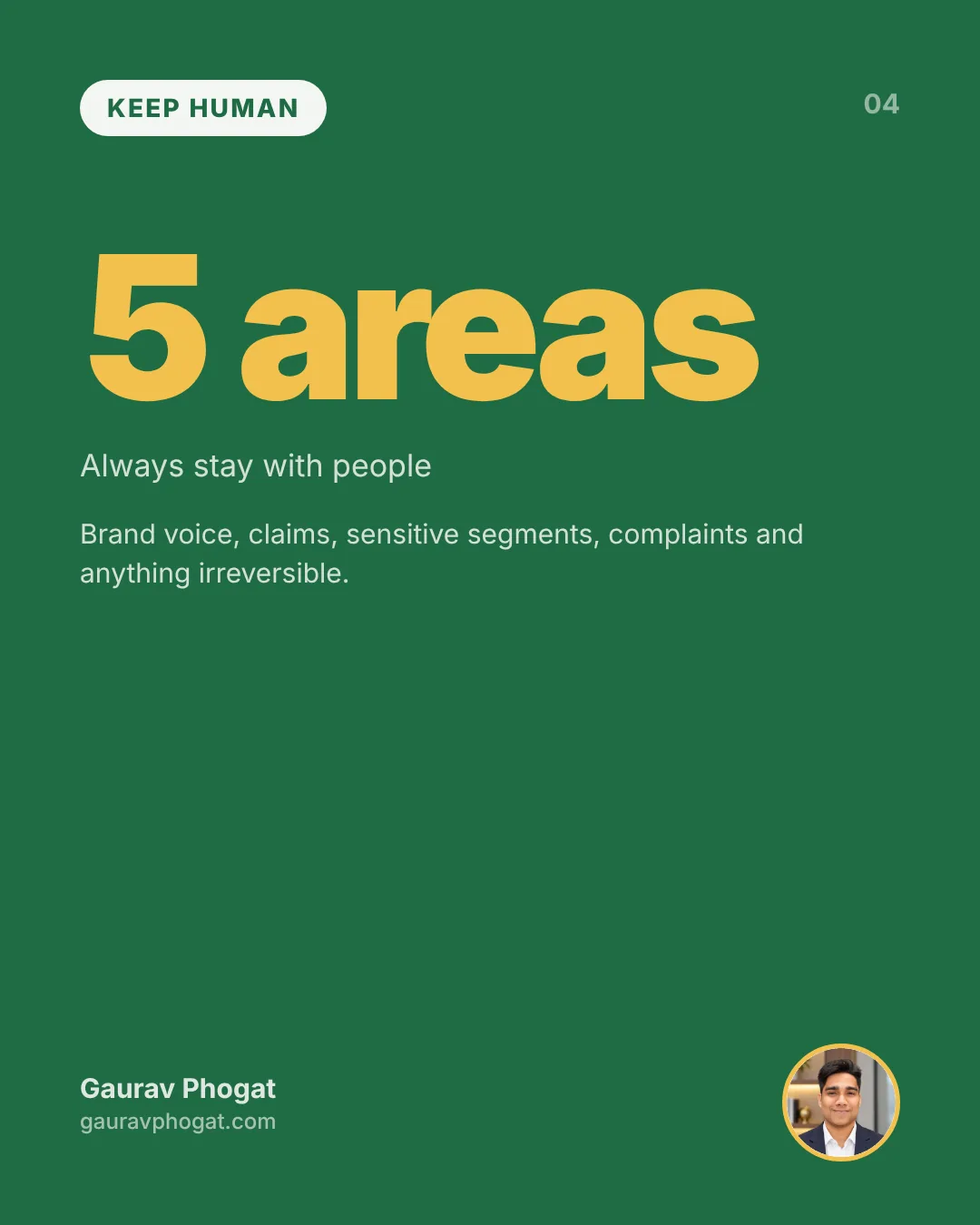
Five categories belong to people, with AI allowed to assist but never to finish the job alone.
- Brand voice. Models drift toward a bland average. A person decides what sounds like you and what does not.
- Claims. Anything that asserts a result, a comparison or a guarantee needs a named human who can stand behind it, and in regulated sectors a compliance check as well.
- Sensitive segments. People in vulnerable situations, minors, and anyone whose data reveals something personal need a deliberate decision about whether and how to contact them.
- Complaints. An upset customer who receives a cheerful automated reply becomes a louder problem. Route complaints to a person quickly.
- Anything irreversible. Mass sends, deletions, merges of customer records and public posts cannot be recalled once done.
The core flows, one by one
The same four tests apply to every AI marketing automation flow, but the answer differs by flow. Here is how I think about each of the six that matter most.
Lead capture and routing
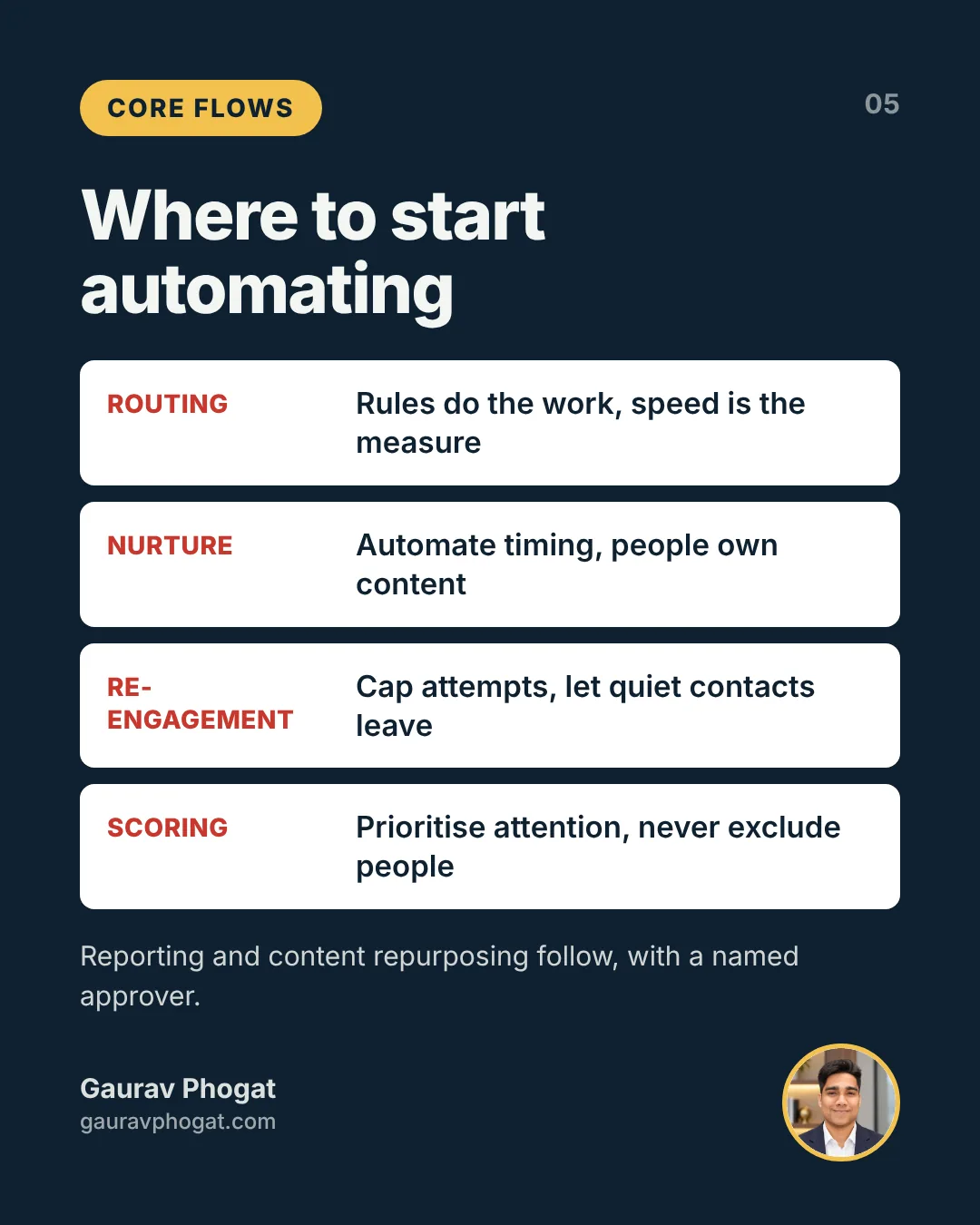
This is the best place to start. Capture the enquiry, validate it, remove duplicates, tag the source and assign it to the right person within minutes. Rules do most of the work. A model can help classify free-text enquiries by intent or urgency, but the routing table itself should be written by humans and reviewed regularly. Speed matters here more than cleverness, so measure time to first response and let the automation protect it.
Nurture sequences
Email automation is the backbone of nurture: a short series of messages that answers the questions a prospect is likely to have, in the order they tend to arise. Automate the timing, the branching and the first drafts. Keep a person responsible for the content, the claims and the exit conditions. A sequence should stop the moment someone replies, books or opts out, and that rule must be tested, not assumed.
Lifecycle and re-engagement
Welcome, onboarding, renewal reminders and win-back messages follow predictable patterns, which makes them good candidates. The risk is volume without relevance. Define what counts as inactive, cap how many re-engagement attempts a contact can receive, and let a quiet contact leave the list gracefully instead of being chased indefinitely.
Scoring
Lead scoring is a classic AI-assisted task. A model, or even a simple weighted rule set, ranks contacts by likelihood to act. Use the score to prioritise attention, not to exclude people. Check regularly that high-scoring leads genuinely convert more often, and watch for bias that creeps in when the training data reflects past habits rather than real demand.
Reporting
Assembling weekly dashboards and plain-language summaries is high volume and low judgement, so automate it. Keep a human accountable for the interpretation and for any figure that goes to leadership. A model that summarises numbers can still misread them, so spot-check the summary against the source every time you change a data field.
Content repurposing
Turning a webinar into a summary, a long article into short posts or a product page into several variants is well suited to AI assistance. The output is a draft. A person checks facts, tone and claims before anything is published, because repurposed content inherits every error in the original and adds a few of its own.
| Flow | What to automate | What to keep human | Safeguard |
|---|---|---|---|
| Lead capture and routing | Validation, deduplication, source tagging, assignment, first acknowledgement | Routing table design, handling of unusual or sensitive enquiries | Response time alerts and a weekly routing review |
| Nurture sequences | Timing, branching, first drafts of messages | Content approval, claims, exit conditions | Stop on reply or opt-out, global frequency cap, holdout group |
| Lifecycle and re-engagement | Welcome, onboarding, reminders, win-back triggers | Definition of inactive, tone for lapsed or unhappy contacts | Limit on attempts, central suppression list |
| Scoring | Ranking contacts by likelihood to act | Decisions to exclude anyone, review of model fairness | Regular check of scores against real conversions |
| Reporting and content repurposing | Dashboards, summaries, draft variants of existing content | Interpretation, final facts and tone, publishing approval | Spot-checks against source data, named approver |
Data foundations before any automation
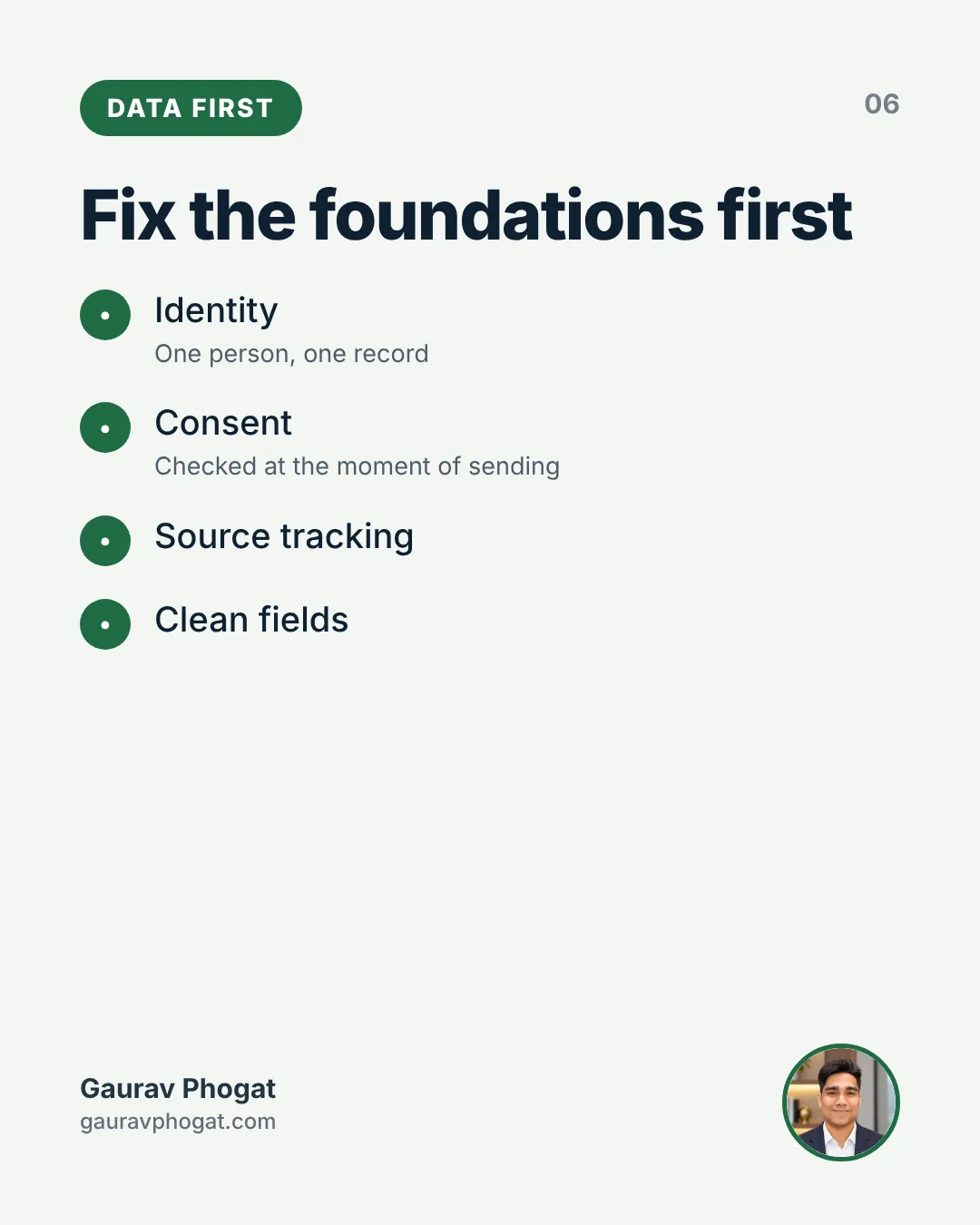
AI marketing automation multiplies whatever data it is fed. If the data is messy, you will produce mistakes faster and at greater scale. Four foundations come before everything else.
Identity
Decide how one person is recognised across forms, calls, messages and purchases. Without a reliable identifier, the same individual receives three versions of a sequence, and your reports count three people. Agree on matching rules, handle duplicates deliberately and never merge records automatically without a review step, since a wrong merge is hard to reverse.
Consent
Store what each person agreed to, when, through which channel and under which wording. Consent should be a field attached to the person, not a note in a spreadsheet. Every automated send should check that field at the moment of sending, not at the moment of list building.
Source tracking
Record where each contact came from using a consistent, controlled vocabulary. Free-text source fields turn into dozens of spellings of the same thing within weeks. Reliable source data is what makes scoring, routing and reporting trustworthy.
Clean fields
Use dropdowns and validation where you can. Standardise phone formats, city names and date formats. Retire fields nobody uses. A small number of well-maintained fields beats a large number of half-filled ones, and models perform visibly better on tidy inputs.
Safeguards that keep AI marketing automation honest
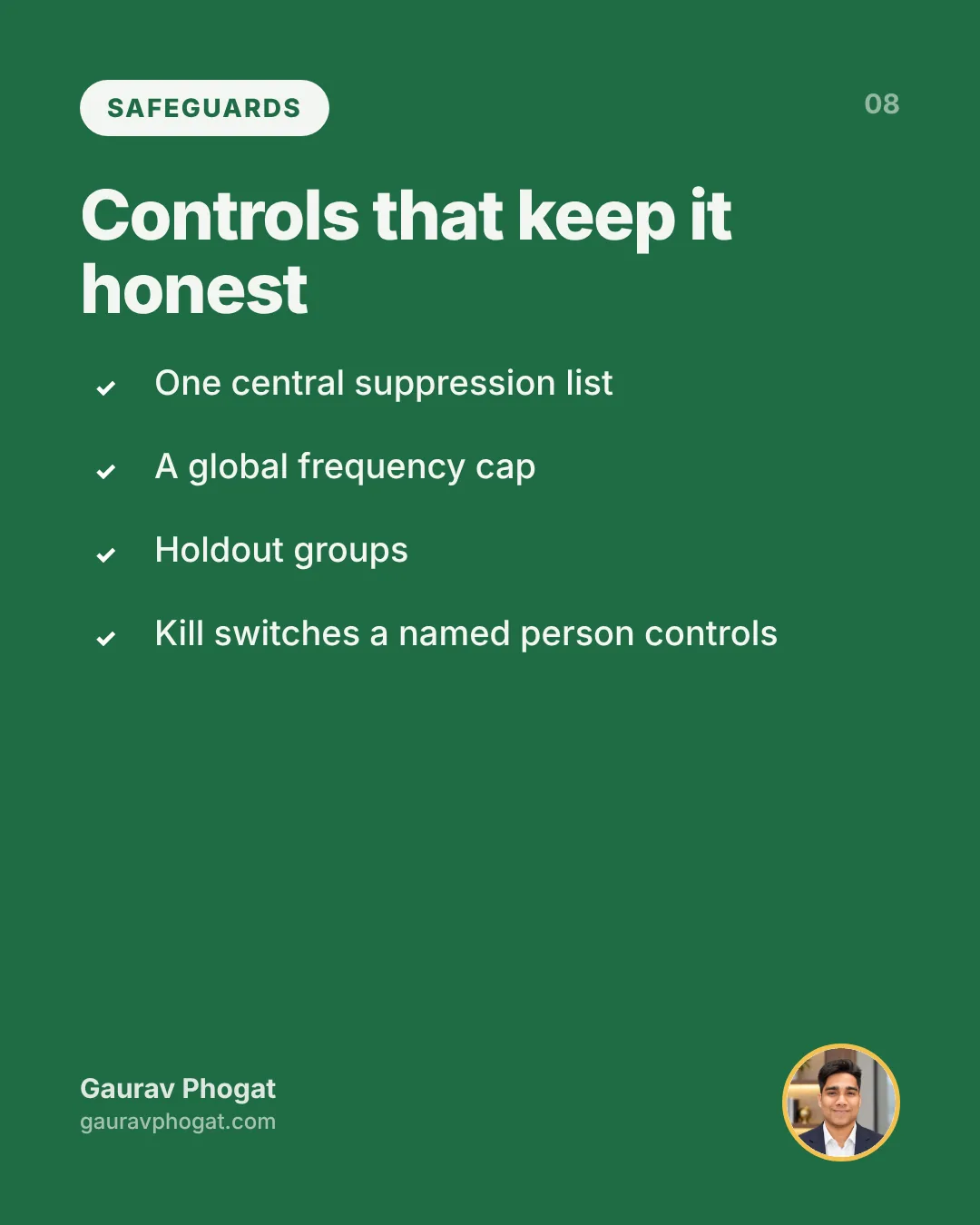
The difference between a useful system and a liability is rarely the model. It is the controls around it. Four sets of controls matter.
Suppression and frequency rules
Build one central suppression list that every flow checks before sending: opted-out contacts, recent complainants, current customers in an open service issue, and anyone excluded for a sensitive reason. Add a global frequency cap per person per week across all flows, not per flow. Without a global cap, five sensible sequences combine into one irritating deluge.
Testing and holdouts
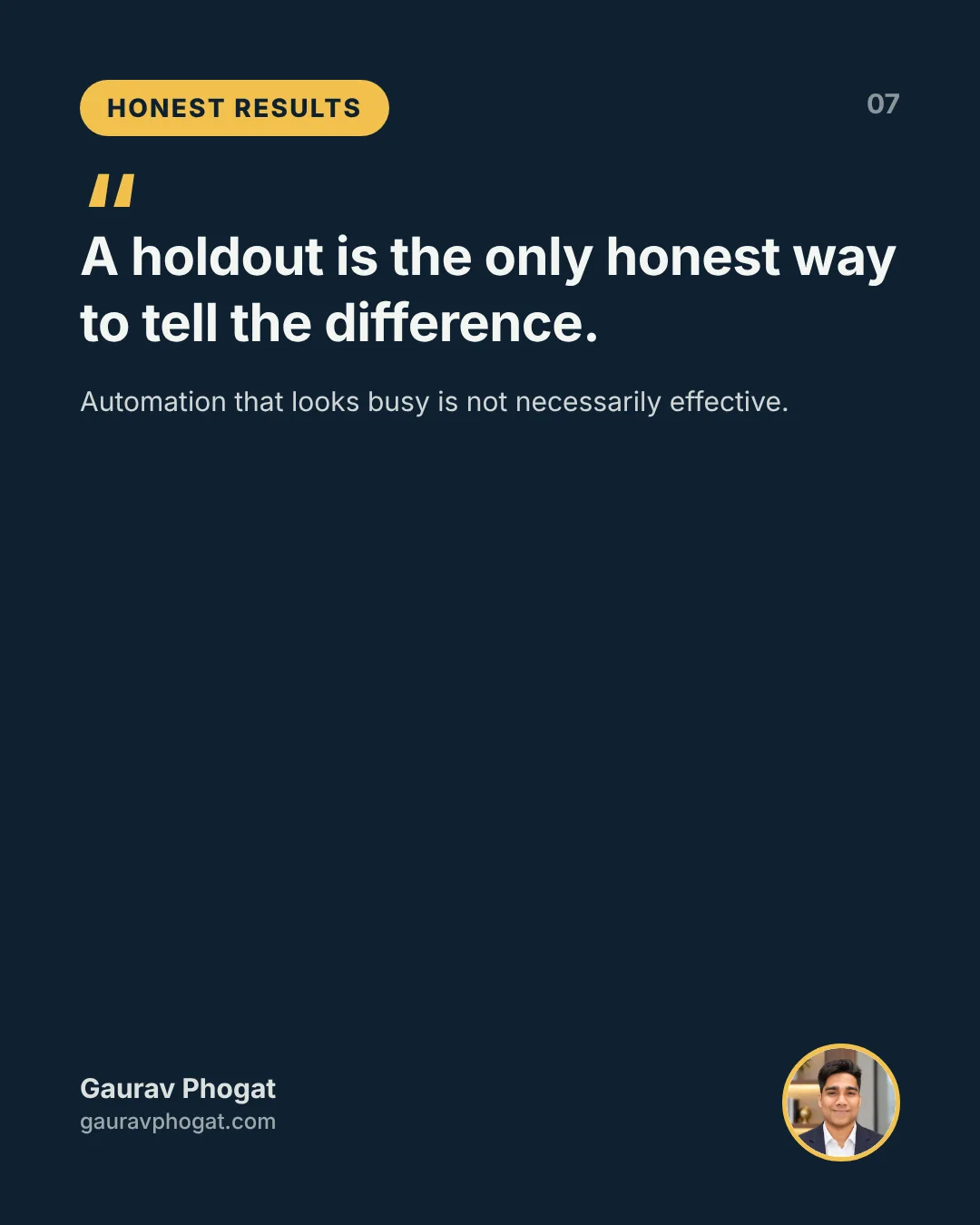
Test before launch with internal addresses and a small live sample. After launch, keep a holdout group that receives nothing, or receives the old version, so you can see what the automation is actually adding. Automation that looks busy is not necessarily effective. A holdout is the only honest way to tell the difference, and it also protects you from crediting the system for results that would have happened anyway.
Monitoring
Watch a short list of signals daily: send volume against expected volume, bounce and complaint rates, opt-out rates, response times and unusual spikes. Set thresholds in advance and decide who is alerted. Review a sample of AI-assisted outputs every week, reading the actual messages rather than only the metrics.
Kill switches
Every automated flow needs an off switch that a named person can use within minutes, without asking a developer. Agent-style steps need a second layer: a hard cap on sends, a limit on the audiences they can touch and a rule that they cannot change their own permissions. Test the switch before you need it.
Governance: consent, opt-outs and the audit trail
In India, the Digital Personal Data Protection Act, 2023 sets the frame for how personal data is collected and used. In plain terms, consent must be voluntary, specific, informed and given by a clear affirmative action, people must be told what their data is used for, and withdrawing consent should be as easy as giving it. AI marketing automation makes these obligations practical rather than optional, because a system that cannot honour an opt-out within a reasonable time is a system that is out of step with the law. For the hospital angle, see the DPDP Act guide for hospital marketers.
Consent and purpose
Use data only for the purpose a person agreed to. If a contact gave their number to receive an appointment reminder, that does not automatically cover promotional messages. Your automation should carry a purpose tag with each consent record and refuse to send outside it.
Opt-outs
Make opting out a single step, honour it across every channel and flow, and propagate it to every connected system quickly. Test it end to end: opt out with a test contact and confirm that nothing further arrives from any sequence.
Audit trail
Keep a log of who or what sent what, to whom, under which rule or model version, and on which consent record. When a complaint or an internal question arrives, you should be able to answer it in minutes. For AI-assisted and agent-style steps, log the prompt, the output and the approver, because "the model decided" is not an explanation a regulator or a customer will accept.
A rollout plan for the first 90 days
Resist the urge to switch all your AI marketing automation on at once. A staged rollout lets the team build trust in the system and catch problems while they are still small.
Days 1 to 30: foundations
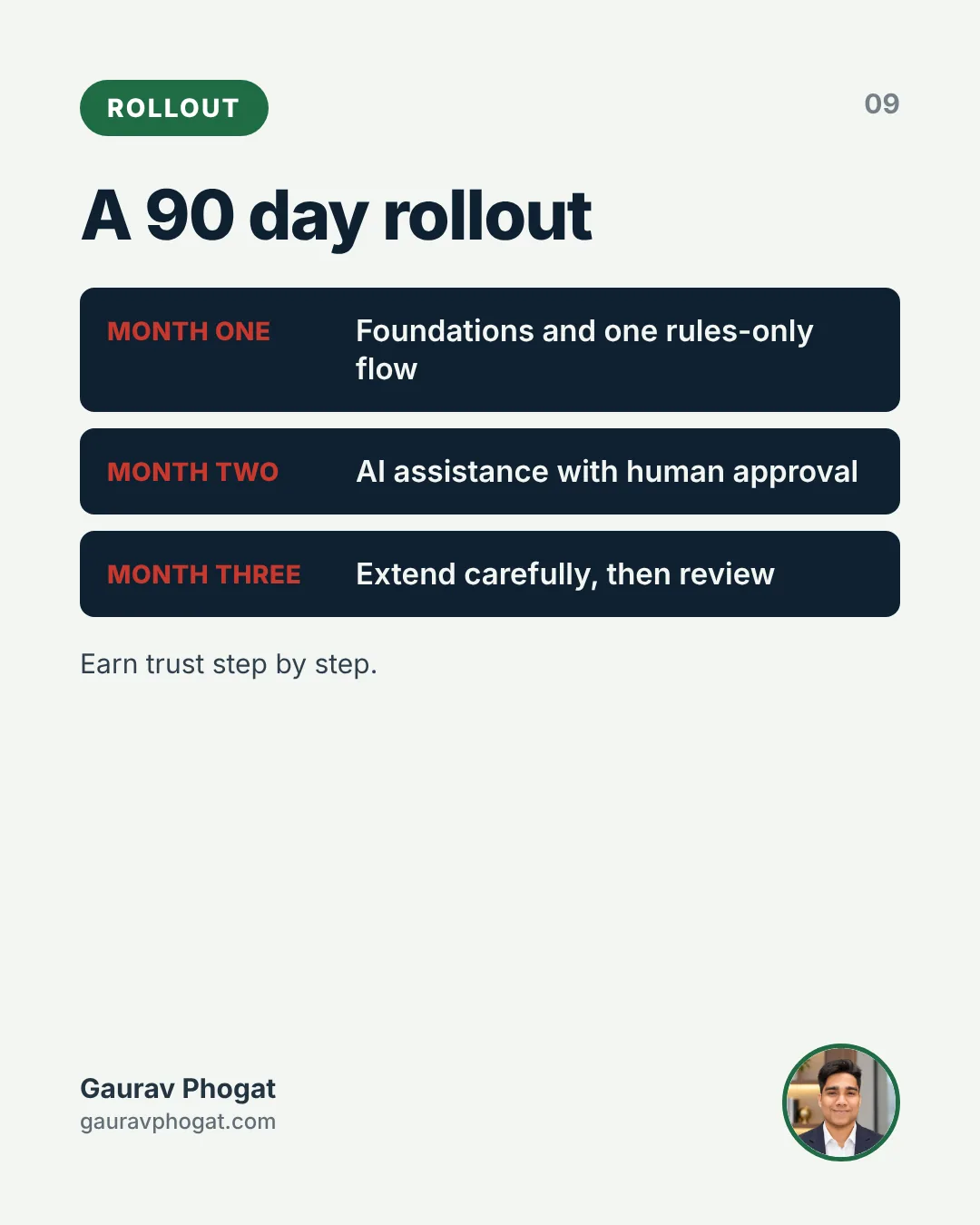
Map your current flows and label each step as rules-based, AI-assisted or agent-style. Score every candidate task against the four tests. Fix identity, consent and source fields. Build the central suppression list and the global frequency cap. Choose one flow, usually lead routing, and automate it with rules only. Agree who owns the kill switch.
Days 31 to 60: assist and measure
Add AI assistance to two or three low-risk steps: enquiry classification, draft subject lines, report summaries. Put a human approval step in front of anything customer-facing. Launch the first nurture sequence with a holdout group. Start the weekly review of sampled outputs and set monitoring thresholds.
Days 61 to 90: extend carefully
Extend to lifecycle and re-engagement flows once the first sequence has behaved well for several weeks. Introduce scoring as a prioritisation aid. If you want to trial an agent-style step, give it one narrow task, a volume ceiling and a full log. Hold a review at day 90: what ran unattended, what needed correction, which tasks were pulled back to manual and why.
Knowing where automation stops is the main skill this exercise builds. For related practical reading on putting these tools to work in sales and marketing teams, see AI for sales and marketing.
Questions people ask
Expect around 90 days to reach a stable first version if you work in stages. The first month goes on data foundations and one rules-based flow, the second on AI-assisted steps with human approval, and the third on extension and review. Teams that skip the foundations usually spend longer later, repairing duplicates and consent gaps.
Use operational evidence. Compare outcomes against a holdout group that did not receive the automation, track time to first response, error and complaint rates, and note how many staff hours moved from repetitive tasks to judgement work. If the holdout performs about the same, the automation is adding activity rather than value.
Ask which flows run unattended, which require approval, and who owns the kill switch. Ask to see the central suppression list and the audit log. Ask what the team has pulled back to manual and why. Good answers are specific. Vague answers about the tool being smart are a warning sign.
Automating before the data is clean. Duplicate contacts, free-text source fields and missing consent records turn every flow into a source of errors at scale. The second most common mistake is running several sensible sequences with no shared frequency cap, so the same person is contacted far too often.
A single reliable identifier per person, controlled fields with validation, access controls on who can edit flows, and logging of every send and every model output. IT should also confirm that an opt-out propagates to every connected system, and that an off switch can be used by a named business owner without a developer.
Repetitive production work shrinks, while review, data stewardship, testing and editorial judgement grow. Plan training in reading model output critically, maintaining fields and designing tests. Make clear that approving or rejecting AI output is a skilled responsibility with a named owner, not a rubber stamp added at the end.
Consent must be voluntary, specific, informed and given by a clear affirmative action, with a notice explaining the purpose. Withdrawal should be as easy as giving consent. Automation should therefore check consent and purpose at the moment of sending, honour opt-outs promptly across every channel, and keep an audit trail you can produce on request.
Boards should ask about accountability, controls and evidence: who is answerable for what the system sends, what stops it going wrong, and how the team knows it works. Ask about incidents and near misses, the audit trail, how consent is recorded and how often outputs are sampled by a person.
List every automated flow you already run and label each step as rules-based, AI-assisted or agent-style. Then check three things: whether a global frequency cap exists, whether opt-outs reach every flow, and whether anyone can switch each flow off quickly. Fixing those gaps usually beats adding anything new.
Keep automation for speed and admin: acknowledging enquiries, routing them and logging activity. Keep conversations, objections and anything personal with your team. Make sure sequences stop the moment a salesperson makes contact, and that a lead who replies is routed to a person quickly rather than receiving another scheduled message.
A small team can start with a few hours a week of focused effort on one flow. The recurring load is review: reading sampled outputs, checking alerts and maintaining fields. Capacity is better spent on fewer flows done carefully than on many flows nobody has time to monitor.
Yes, if the foundations are shared. Use one identity scheme, one consent record, one suppression list and one frequency cap across units, with local teams owning content and approvals. Scaling the flows without centralising these controls is how contacts end up receiving conflicting messages from different parts of the same organisation.
Confirm the purpose matches what the person agreed to, limit the fields the model can see to those needed, and check where the data is processed and stored. Log the inputs and outputs, and keep sensitive segments out of automated generation unless a person has explicitly approved the use.
Read my takes first in Google Search