

AI Content Creation: A Workflow That Keeps Quality High
Written on by Gaurav Phogat. External facts checked against their original sources on the same date.
AI content creation works when people own the decisions and the AI handles transformation. Write a brief first, with audience, angle and permitted claims. Supply facts through a verified source pack, and give the AI defined roles such as outlining, drafting, variants, repurposing, editing, translation and summarising. Never delegate claims, numbers, quotes, opinions or lived experience. Check every draft against a short review checklist, apply a style guide, and avoid thin, templated pages at scale. Search and answer engines reward helpful, experience-led pages, so name authors and show first-hand evidence. Disclose AI use sensibly, repurpose from approved material, refresh pages on a schedule, and measure accuracy, reader response and efficiency rather than output volume.
See every hospital growth strategy guide in one place.
Start AI content creation with a brief, not a prompt
AI content creation goes wrong in a predictable way. Someone types a request into a tool, receives fluent text in seconds, edits it lightly and publishes. The result reads smoothly and says very little that a reader could not find on twenty other pages. The fix is rarely a better tool. It is a workflow in which people decide what is true, what is worth saying and who is accountable, while the AI does the work that benefits from speed.
This article sets out that workflow in general terms, for any organisation that publishes. It covers the brief, source material, the roles AI can play, the things that must stay with people, checking, voice, search and answer engines, a worked example, disclosure and measurement. The prompting side is covered separately in my guide to prompting systems for marketers, so I will not repeat it here.
What a good brief contains
A brief is the most effective quality control in the whole process, and it is written before any AI is opened.
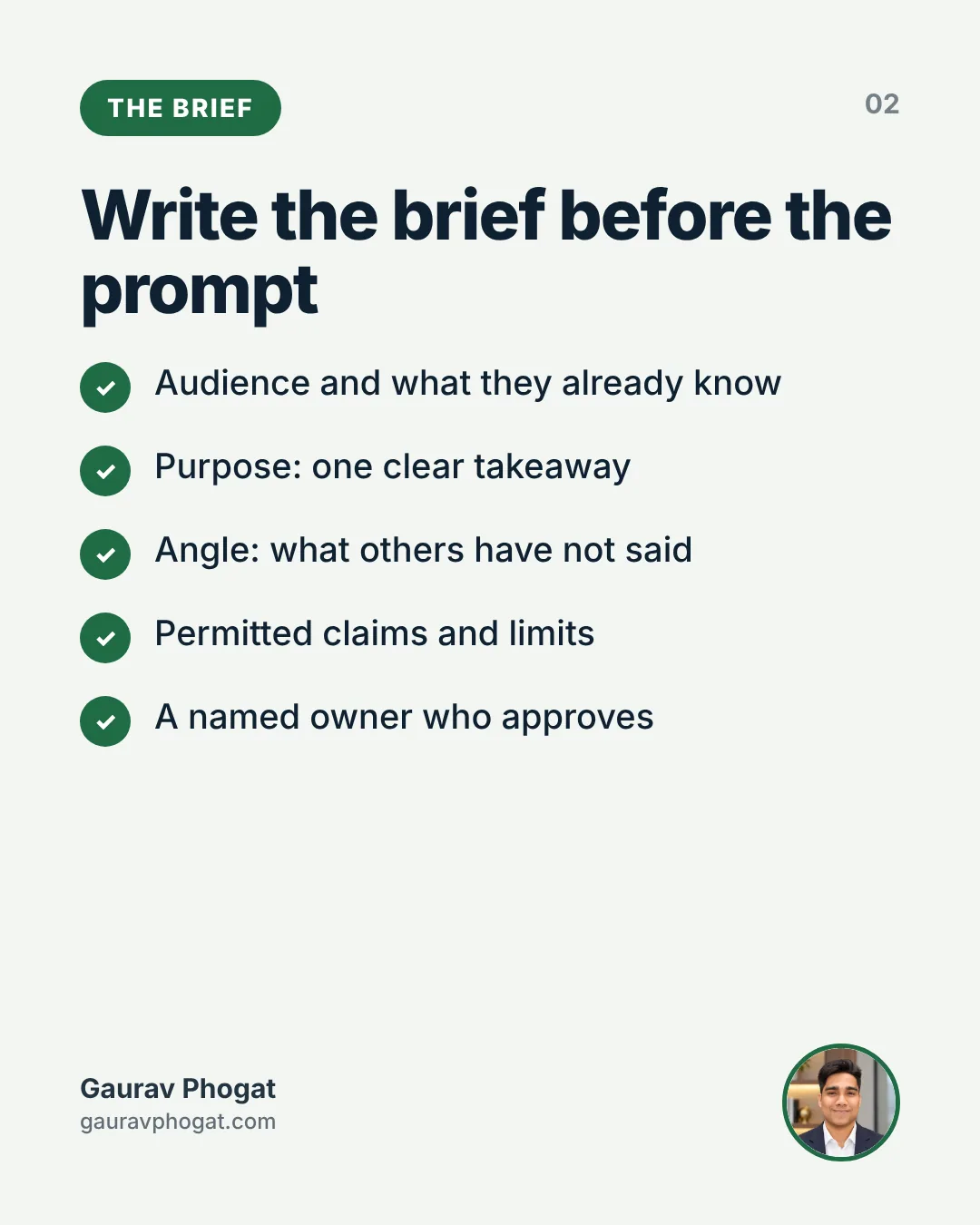
- Audience: who is reading, what they already know and what decision they are making.
- Purpose: the one thing the reader should understand or do afterwards.
- Angle: what this piece says that existing pages do not.
- Source list: the documents, data and people the piece may draw on.
- Claims: statements the piece is permitted to make, and those it must avoid.
- Format: length, voice, channel and the place it will be published.
- Owner: a named person who approves it.
If the angle line is empty, stop. AI content creation without an angle produces the average of everything already published, which is exactly what readers and search systems have learned to skip.
Source material and facts come from people
AI models predict plausible text. They do not know your product, your customers or what happened last quarter. Every fact that matters therefore has to be supplied by a person, attached as source material, with an instruction to use only that material. Good AI content creation depends far more on the quality of that material than on the cleverness of the request.
I keep a simple rule: the human supplies the facts, the AI supplies the sentences. Facts means numbers, dates, process descriptions, expert quotes, policy positions, customer observations and anything else that can be checked. When the source material is thin, the answer is to go and get more from a subject expert, not to ask the tool to fill the gap.
Build a source pack
A source pack is a short folder for each piece. It holds the brief, interview notes or a transcript, two or three reference documents, approved data with its date and origin, and a note on what is out of bounds. Tell the AI to mark any sentence that goes beyond the pack. Those marked sentences are the first things an editor checks, and they are often the first to be deleted.
Where AI helps: the drafting roles
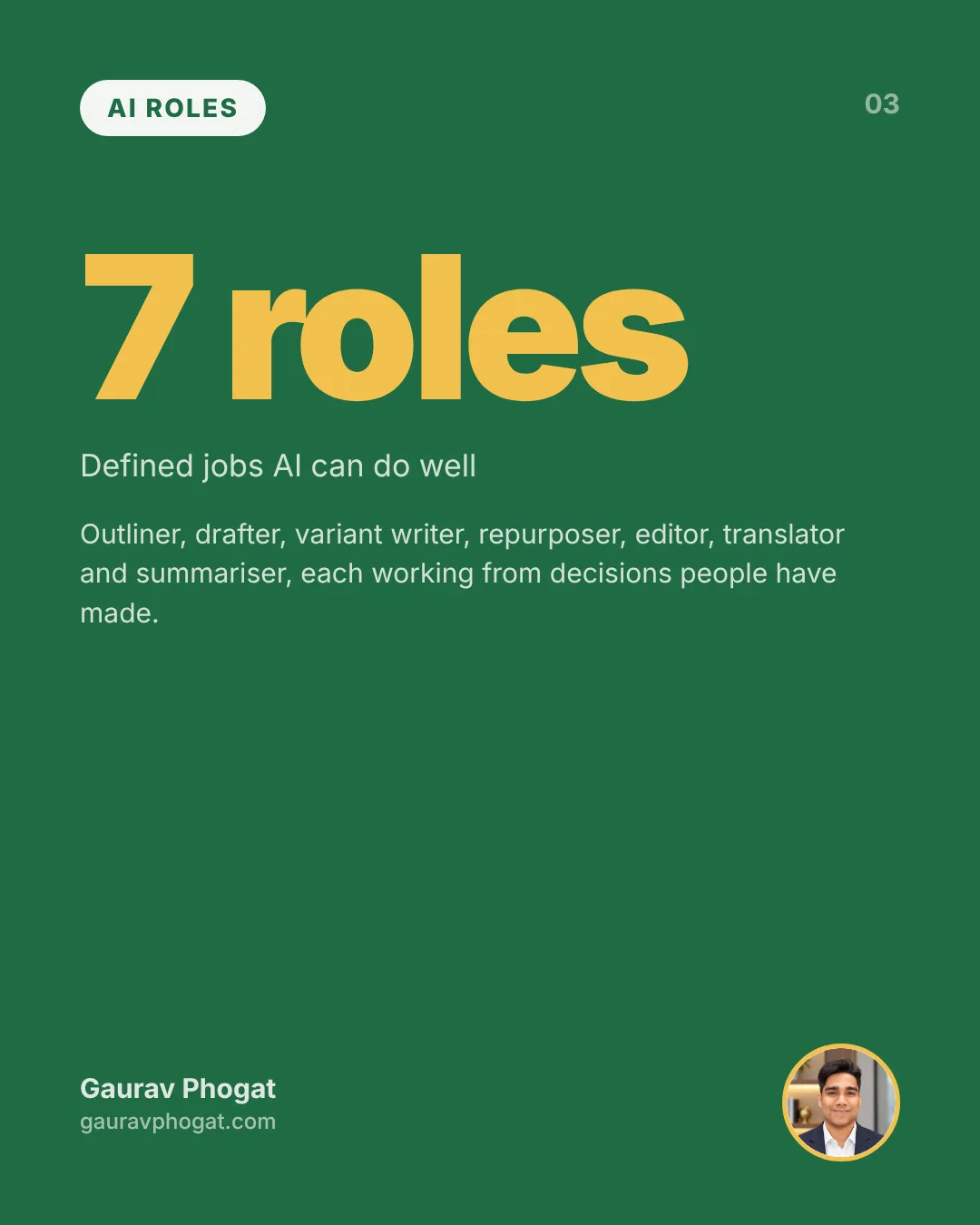
Using AI for content works best when you give it a defined role instead of a vague request to write the article. Seven roles are reliable when the inputs are good.
- Outliner: proposes structures from the brief, which a person reorders against what the reader needs.
- First drafter: turns an approved outline and source pack into rough prose, one section at a time.
- Variant writer: produces alternative headlines, openings, subject lines and captions to choose from.
- Repurposer: reshapes approved material into other formats while keeping the facts unchanged.
- Editor: tightens text, flags repetition, checks consistency with the style guide and points out unclear sentences.
- Translator: produces a first translation, to be reviewed by a fluent reader who knows the subject.
- Summariser: condenses long documents, call notes and transcripts so a person can find what matters faster.
Notice what these roles share. In each, a person has already decided the substance, and the AI is transforming or compressing it. AI tools for content creation are strongest as transformers and weakest as originators.
Translation deserves a specific caution in India, where one idea often has to appear in several languages. A fluent but wrong rendering of a technical term travels well and does quiet damage. Always have a reviewer who understands both the language and the subject read the result before it goes out.
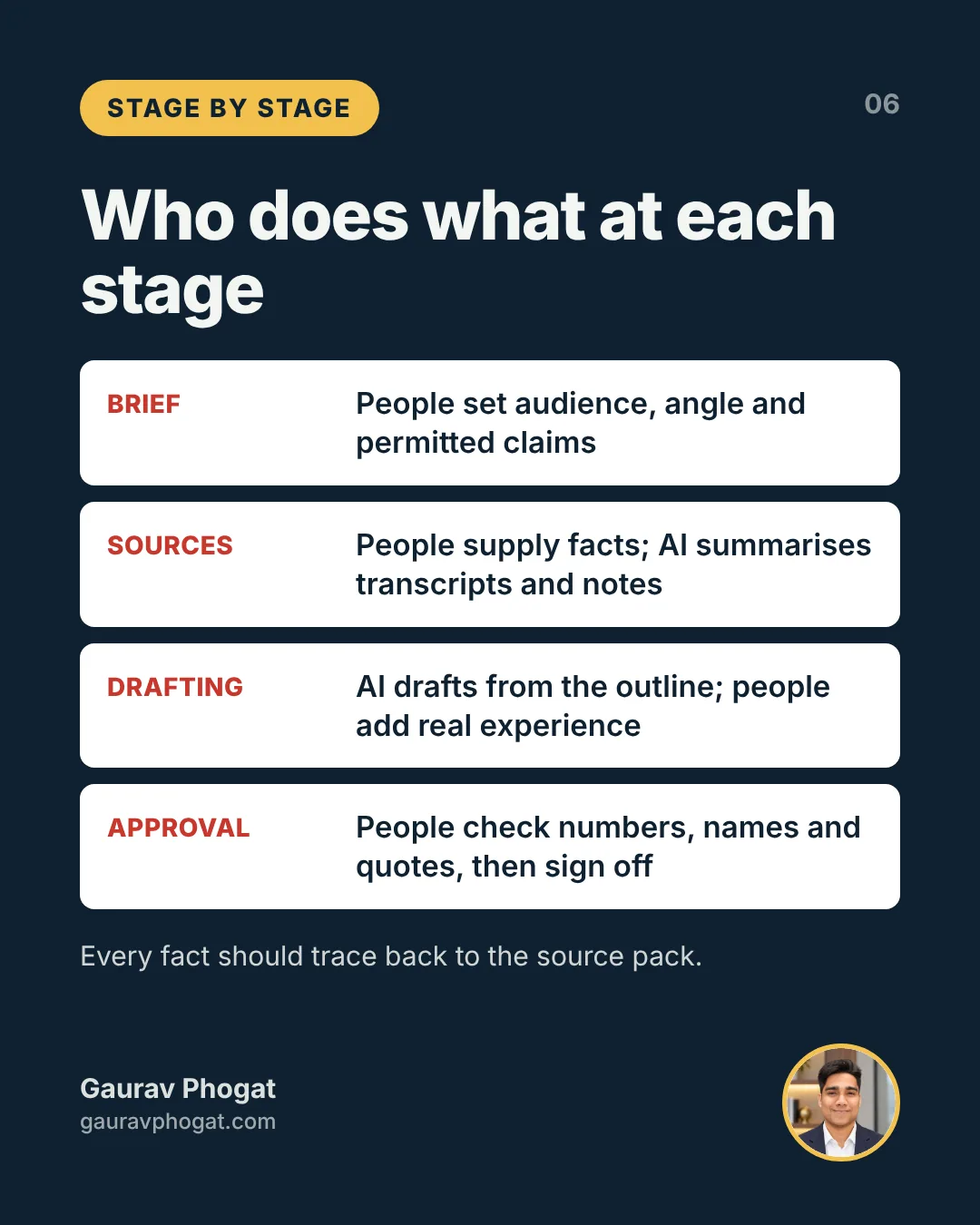
| Content stage | What AI can do | What a human must do | Quality check |
|---|---|---|---|
| Brief and planning | Suggest angles, questions and outlines from the brief | Set audience, purpose, angle and permitted claims | Angle is specific and a named owner has approved the brief |
| Source gathering | Summarise transcripts, notes and long documents | Supply facts, interview experts and approve data | Every fact traces to the source pack |
| Drafting | Write a first draft and variants from the outline and sources | Add real experience, opinions and original examples | Sentences beyond the source pack are flagged and resolved |
| Editing and voice | Tighten text, flag repetition and match the style guide | Decide tone, cut filler and protect meaning | Read aloud once and compare with approved examples |
| Fact-check and approval | Draw up a list of claims to verify | Check numbers, names, quotes and claims, then approve | Review checklist completed and signed by an approver |
| Repurposing and refresh | Reshape approved text into other formats and propose updates | Confirm meaning is unchanged and add new observations | Format matches the approved article and review date is set |
What to never delegate in AI content creation
Some work should stay with people, however good the output looks. A content creation AI can produce a competent overview of almost any topic. That is the problem: competent and generic is the baseline every competitor has too.
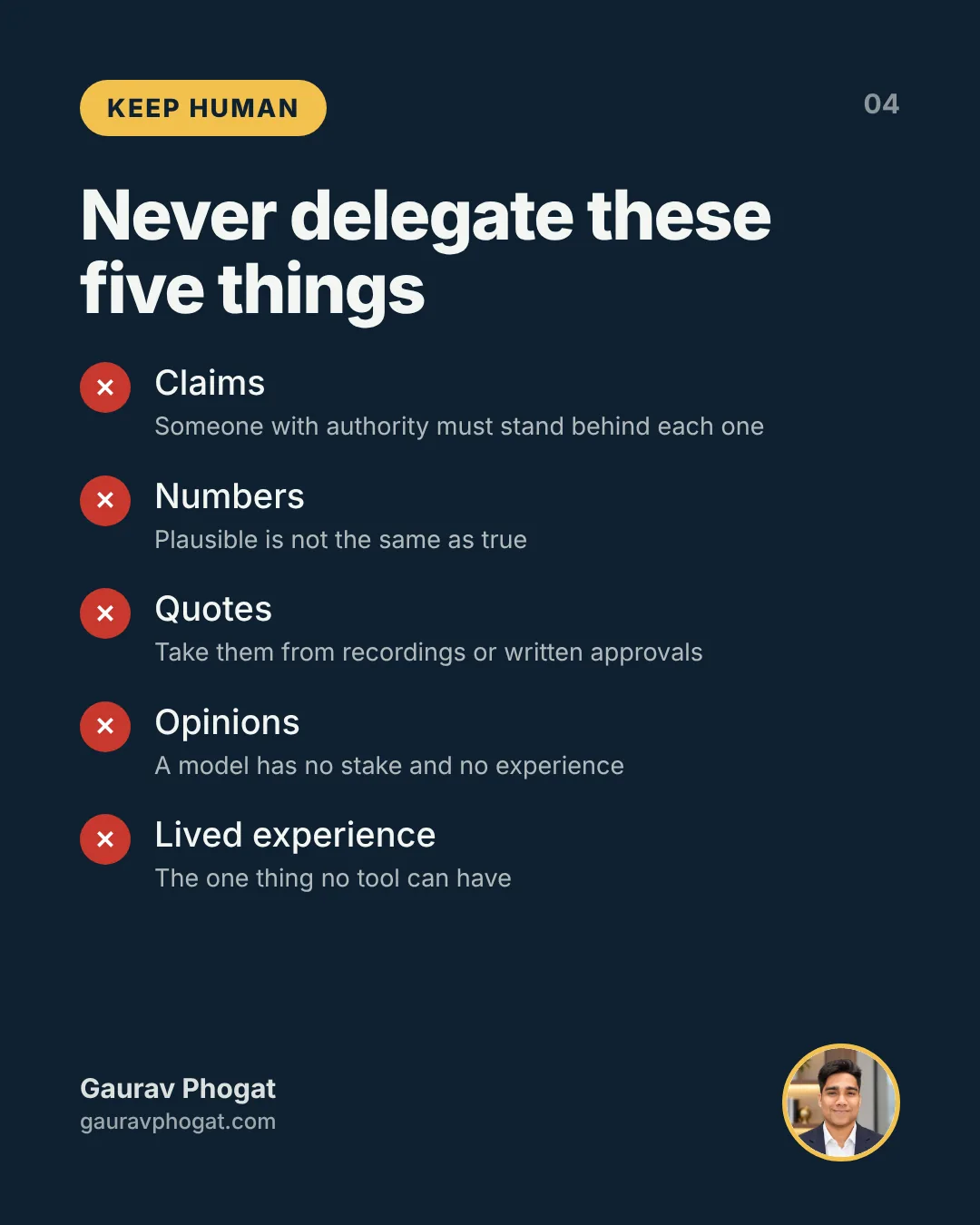
The five things that stay with people
- Claims: any statement that something works, is best, is safe, is first or is guaranteed. A person with authority must stand behind each one.
- Numbers: figures, percentages, dates and comparisons. Tools produce plausible numbers with great confidence, and plausible is not the same as true.
- Quotes: words attributed to a real person or organisation. Quotes come from recordings or written approvals, never from generation.
- Opinions: your position on a debate. A model can summarise views, but it has no stake and no experience, so an opinion it writes is only a sentence shaped like one.
- Lived experience: what you saw, tried, got wrong or learned from a customer. This is what readers value most, and it is the one thing no tool can have.
The last item connects directly to quality. When I review drafts, the paragraphs that carry a specific detail from real work are the ones that survive. Everything else is replaceable. Build the workflow so that a person adds at least one real observation to every piece before it is approved.
Fact-checking and a review checklist
Fact-checking is a separate stage, ideally done by a separate person. The drafter is too close to the text. Check every claim, number, name, date and quote against the source pack, and mark each as verified, changed or removed.
A review checklist you can reuse
- Does the piece match the brief, including the angle?
- Is every factual statement traceable to the source pack or to a named, checkable source?
- Have all numbers, dates and names been checked by a person?
- Are quotes verbatim and approved?
- Is there at least one specific observation from real experience?
- Does it sound like us, according to the style guide?
- Would a reader leave with something they could not get from the first page of search results?
- Are disclosure, privacy and legal requirements met?
- Is there a named approver and a review date?
Keep the checklist short enough to be used. A checklist that nobody completes is decoration. Reviewers should also read the piece aloud once. Repetition and filler that the eye skips become obvious to the ear.
Voice, style guides and the thin page problem
AI output drifts towards a neutral, mildly enthusiastic register that belongs to no one. A style guide of one or two pages fixes most of this. Include preferred spelling, sentence length, words to avoid, how to address the reader and how to handle claims. Add two or three approved examples written by people, and instruct the tool to match them. Update the guide whenever an editor corrects the same issue twice.
Avoiding thin and repetitive pages at scale
Scale is where AI content marketing goes wrong most visibly. It is easy to produce hundreds of pages from a template: same structure, swapped keyword, no new information. Search systems have become good at recognising pages whose main purpose is to exist. Readers recognise them faster still.
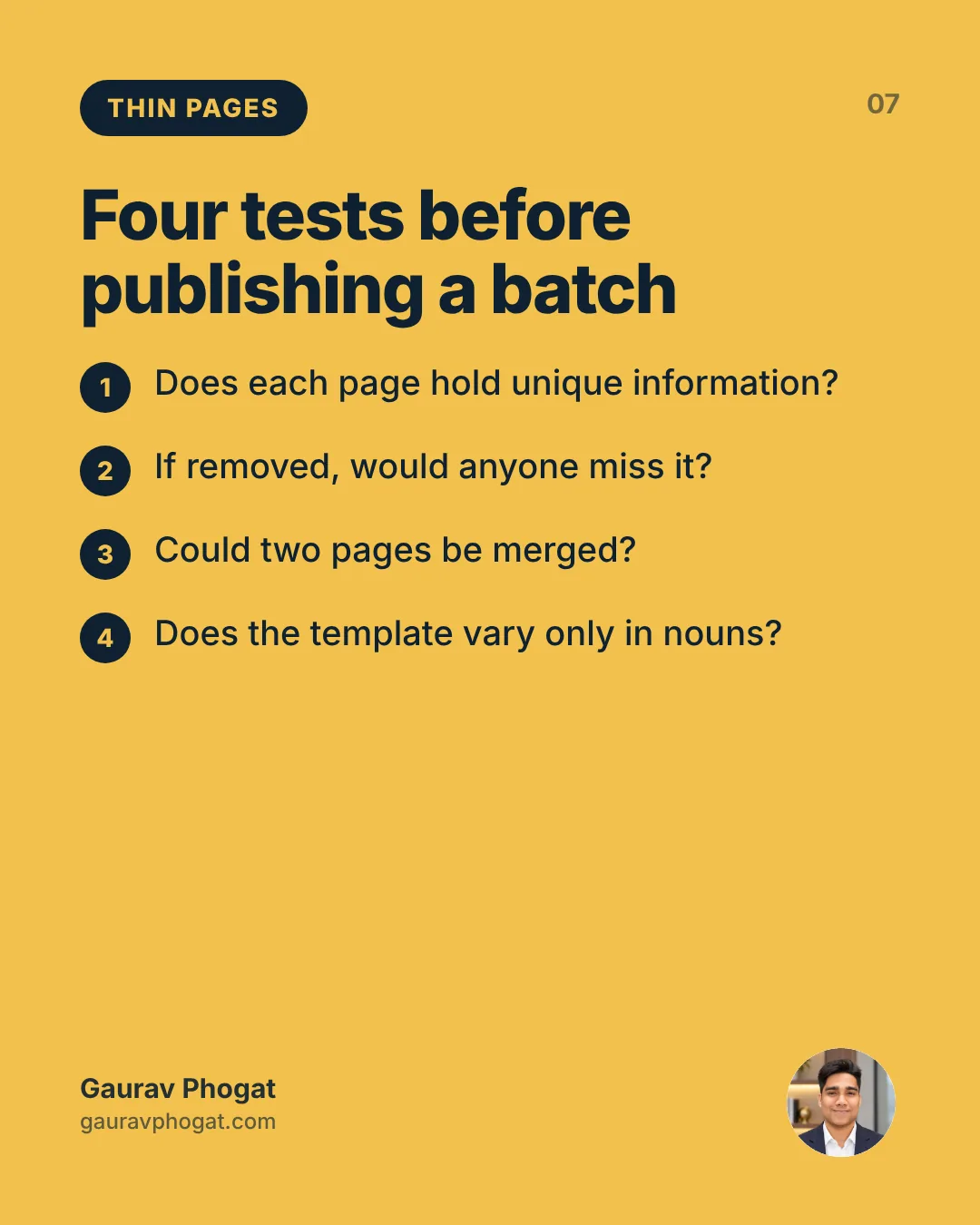
Four tests help before any batch is published:
- Does each page contain information unique to it, such as local detail, data or an expert’s view?
- If the page were removed, would anyone miss it?
- Could two pages be merged without losing anything?
- Does the template vary only in its nouns?
My practice is to publish fewer pages and make each one carry something the others do not. If a template needs a human contribution per page and that contribution is not available, the page is not ready. For a sector where accuracy has serious consequences, I have written about this in AI medical content at scale.
How search engines and answer engines judge helpfulness
Search engines have said consistently that they judge content by whether it helps people, not by how it was produced. AI content creation is not penalised by itself. Producing content mainly to manipulate rankings is. The practical question is whether a page shows the qualities summarised as E-E-A-T: experience, expertise, authoritativeness and trust.
Experience means first-hand evidence: photographs you took, processes you ran, mistakes you made. Expertise means correctness and depth. Authoritativeness is whether others cite or rely on you. Trust is the sum of these, and it is damaged most quickly by errors and by hidden authorship. A helpful page names a real author or reviewer, states what that person knows and shows when the page was last updated.
Answer engines, the assistants that compose a reply from several sources, add another test. They tend to draw on pages that state things clearly, attribute claims and agree with other reliable sources. Direct definitions, labelled steps, honest limits and consistent facts across your pages make your content easier to quote correctly. I explain the wider shift in AI in marketing.
Worked example: one expert interview, four formats
Take a forty minute recorded conversation with an internal subject expert about a question your audience keeps asking. This is how the workflow runs, from interview to four finished formats.
From recording to approved article
- Brief. Agree the audience, the angle (what the expert has seen that public pages have not covered) and the questions to ask.
- Record and transcribe. A person checks the transcript against the recording for names, terms and numbers.
- Mark the transcript. Highlight the expert’s strongest statements, specific examples, every number and every claim that needs approval.
- Outline. The AI proposes an outline from the marked transcript. The editor reorders it.
- Draft. The AI drafts from the outline using only the transcript and source pack, and flags anything beyond them.
- Expert review. The expert corrects the draft and approves quotes and claims in writing.
- Editor pass. The editor applies the style guide and completes the checklist.
The four formats
- Article: the full piece, structured around the expert’s reasoning and carrying their real examples.
- Short: a short video script or a brief post built around one idea, one example and one takeaway, taken from a single approved quote. The expert approves the wording or the final cut.
- Newsletter: a personal note of two to three hundred words with the most useful point, one story from the interview and a link to the article. It is written in the editor’s voice unless the expert approves otherwise.
- Carousel: six to eight slides, each a single statement taken from the approved article, with an opening slide and a closing slide. The AI drafts the slide text, and a person checks that shortening has not changed the meaning.
The rule across all four is that repurposing starts from the approved article, never from the raw transcript, so every format inherits verified claims. Shortening is where meaning shifts. The test is whether a reader who sees only the carousel would understand the claim the way the expert meant it.
Disclosure, refresh and measuring quality, not volume
Disclosure and labelling
Be open about how content is made, in proportion to the risk. Where AI generates or materially alters images, voices or testimonials, label it clearly. Indian advertising standards have set expectations for this kind of disclosure, and I summarise one set in the ASCI labelling rules, written for hospitals but a useful pattern for any sector. For editorial writing, a short note on how AI was used, with a named person accountable, builds more trust than silence. Protect data too: do not paste personal or confidential information into tools without approval, and follow the Digital Personal Data Protection Act.
Content refresh
Published pages age. Set a review date at publication, and each quarter list pages by traffic and by how fact-dependent they are. Refreshing means rechecking facts, adding new first-hand observations, removing outdated advice and updating the date honestly. A refreshed page with a real improvement beats a new page that repeats it.
Measure quality, not volume
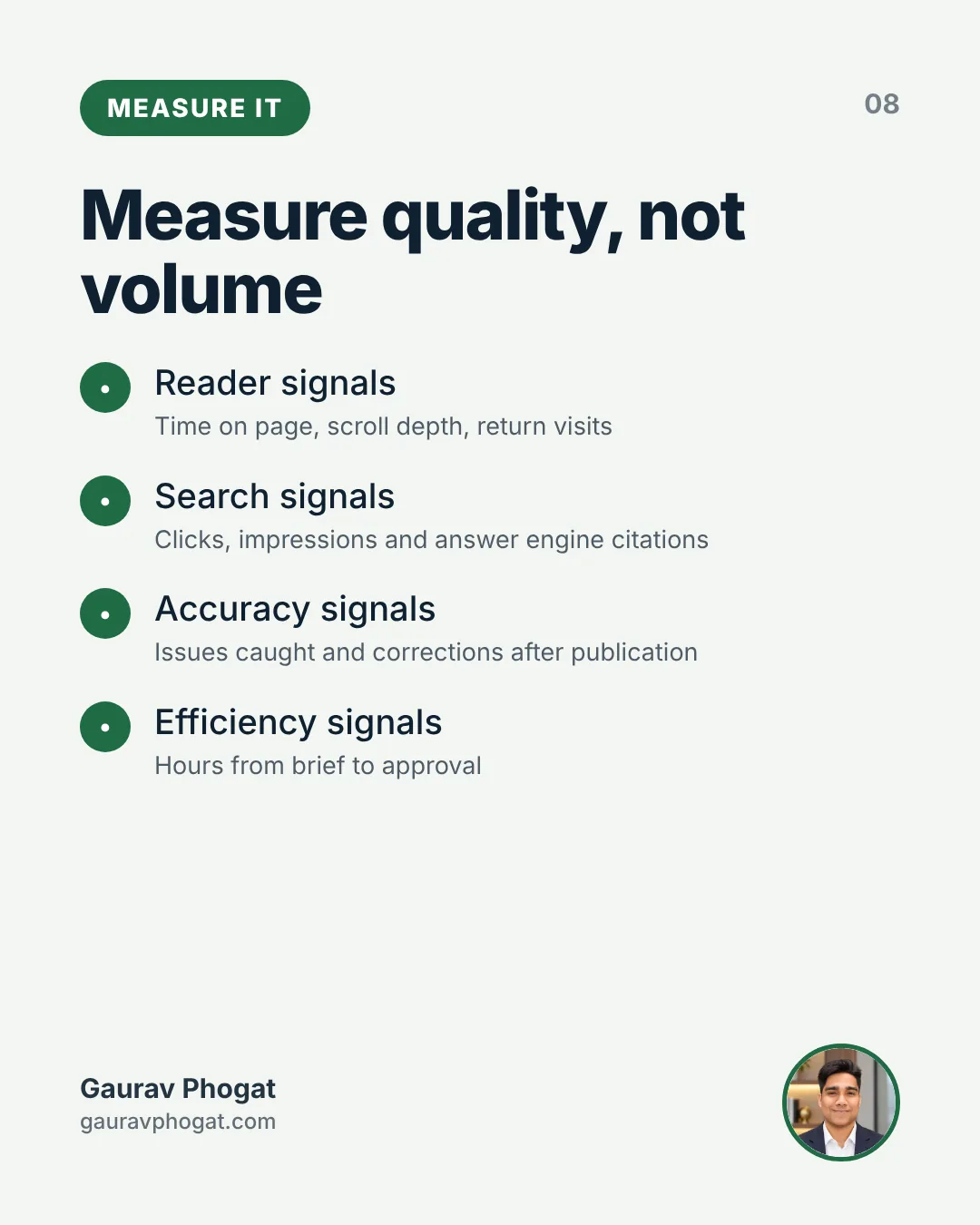
Output counts show how busy a team is. They do not show whether the content works. Better signals are these:
- Reader signals: time on page, scroll depth, return visits and replies to newsletters.
- Search signals: impressions and clicks for the queries a page was written for, and whether it is cited in answer engine replies.
- Accuracy signals: issues caught at fact-check and corrections needed after publication.
- Efficiency signals: hours from brief to approval and the share of drafts approved at first review.
- Outcome signals: enquiries, sign-ups or conversations the content started, tracked qualitatively where numbers are small.
If corrections rise while output rises, the workflow is failing, and the right response is to slow down. Teams that do AI content marketing well usually publish less than they could, and each piece does more.
Start small with AI content creation: one content type, one owner, one brief template and one checklist. Run it for a month, review what the checklist caught and adjust.
Read next
Questions people ask
Look at outcomes per piece instead of pieces per month. Track reader engagement, search visibility for the intended queries, corrections after publication, and the hours from brief to approval. If output rises while corrections rise or engagement falls, the workflow is producing volume without value. Review these together each quarter and decide which content types deserve more attention.
Ask who is accountable for the accuracy of each published claim. The usual failure is unreviewed text that sounds confident and is wrong, followed by generic pages that dilute the organisation’s reputation. A named approver for every piece, a short review checklist and a clear list of what AI may not write answer most of the exposure.
Write a one or two page style guide with preferred spelling, sentence length, words to avoid and three or four approved examples written by people. Give the same guide to every writer and attach it to every drafting request. Review a sample of published pieces monthly, and update the guide whenever editors correct the same problem twice.
Check against the brief before the sentences: does the piece deliver the agreed angle for the intended reader. Then verify every claim, number, name and quote against the source pack. Only after that, edit for voice and flow. Polishing prose first is a trap, because fluent text hides factual errors and makes them harder to spot.
Define which data may never be entered, such as personal information, confidential documents and unpublished figures, and which approved tools staff may use. Keep activity within accounts the organisation controls, set retention and access rules, and record where AI was used in each piece. Align the policy with India’s Digital Personal Data Protection Act and review it as tools change.
Treat it as a skills change, not a headcount question. Train writers in briefing, source packs, fact-checking and editing, since these now matter more than first-draft speed. Update role descriptions to include accountability for accuracy, set clear rules on disclosure, and give people time to practise on low-risk content before using the workflow on important pieces.
Settle who owns the final text, how AI use is disclosed, which claims need formal approval, and how third-party material is handled so nothing is copied or misattributed. Regulated claims and testimonials need extra scrutiny. Keep a record of sources and approvals for each piece, so any statement can be traced and defended if questioned.
A short written policy covering permitted uses, banned uses, review and approval, disclosure and incident handling. The board should see periodic reports on corrections, complaints and quality measures, not output totals. It should also know who is accountable, and how the organisation would respond if an inaccurate or misleading piece were published.
Scale the process only where each page can carry something unique, such as local detail, original data or an expert’s view. Use templates for structure, never for substance. Before publishing a batch, test a sample for overlap, check whether any page could be merged with another, and hold back pages that lack a human contribution.
Write your own outline and your own opening before asking for help, and use the tool for variants, tightening and checks. Always add one observation from your own work or reading. Compare your draft with the edited result and note what changed. Over time you learn judgement, which is the part tools cannot supply.
The brief, source pack and checks add effort at the start and end, while drafting becomes quicker. For most teams the gain is in repurposing and editing rather than the first draft. Capacity improves once briefs and checklists are routine, usually after several pieces. Expect the first few pieces to take longer than your old process.
You need a named owner, a one page style guide, a brief template, a method for collecting source material from experts, a review checklist and a data protection rule. Start with one content type. Without these basics, the tools only make inconsistent content faster, and the problems become harder to find later.
It is a useful first draft, not a finished translation. Technical terms, tone and cultural references often shift quietly. Have a fluent reader who understands the subject review each version, and keep a glossary of approved terms. For anything involving instructions, safety or regulated claims, the review should be as thorough as for the original.
Read my takes first in Google Search