
A Healthcare Marketing Framework for Indian Hospitals: Demand to Treated Patient
Published · By Gaurav Phogat
A healthcare marketing framework for an Indian hospital has to start before marketing and end after it. The one I use, the Treated Patient Chain, has six stages: Capacity, Demand, Capture, Convert, Retain and Prove. Each has one question, one owner and one metric, and the chain is only as strong as its weakest stage.
Most marketing frameworks used in hospitals were borrowed from consumer brands. They begin with awareness and end with a lead, which is exactly where a hospital’s real problems start. A lead is not a patient. A booked appointment is not a kept one. A kept appointment for a specialty with a six-week wait for surgery is not revenue this quarter. I have watched good campaigns fail for reasons that sat entirely outside the marketing plan, and I have watched mediocre campaigns look brilliant because the contact centre behind them was excellent.
This article is part of the hospital growth strategy series, best read in order from the pillar.
So over the years I stopped planning from the funnel and started planning from the treated patient backwards. What follows is that model, written down. It distils thinking spread across this site into one sequence a CMO, a growth head or a unit head can plan, staff and report against.
The Treated Patient Chain at a glance
Six stages, in this order. The order is the point: capacity comes before demand, and proof comes last but feeds the next cycle.
- CapacityWhat can we actually serve, where and when?
- DemandWhich demand pool are we growing, and from where?
- CaptureDoes every enquiry land somewhere with a name on it?
- ConvertDoes the enquiry become a kept appointment and then treatment?
- RetainDoes the patient come back, with consent, when care calls for it?
- ProveCan we show the board what each rupee bought?
The loop back: Prove feeds Capacity. The demand you could not serve, and what each treated patient cost, become next quarter’s capacity and budget conversation.
| Stage | Question | Owner | Primary metric |
|---|---|---|---|
| Capacity | What can we actually serve, where and when? | Growth lead with unit heads and operations | Days to first available appointment, by specialty and unit |
| Demand | Which demand pool are we growing, and from where? | Marketing, referral team, commercial team; growth sees all three | Identified enquiries by pool, specialty and unit |
| Capture | Does every enquiry land somewhere with a name on it? | Contact centre head with the digital and CRM team | Capture rate and first response time, by channel |
| Convert | Does the enquiry become a kept appointment and then treatment? | Contact centre, unit front office and counsellors | Enquiry to kept appointment; advised to treated |
| Retain | Does the patient come back, with consent, when care calls for it? | CRM and patient engagement, with clinical departments | Twelve-month value of a patient cohort |
| Prove | Can we show the board what each rupee bought? | Growth lead, reconciled with finance | Fully loaded cost per new treated patient |
The six stages, one by one
1. Capacity
Marketing in a hospital sells a finite inventory: consultant slots, beds in a room category, theatre time. Planning demand without looking at that inventory is how hospitals pay to send patients to competitors.
- The question it answers: What can we actually serve, at which unit, in which specialty, and how soon?
- The work: Agree three lists with unit heads every quarter: grow (spare slots, beds or theatre time), hold (near capacity, protect reputation rather than add volume) and build (new doctors, services or units that need demand created). Record the lead time offered to every enquirer. Run a short weekly capacity forum.
- The owner: The growth lead owns the signal; operations and unit heads own the capacity itself.
- The metric: Days to first available appointment by specialty and unit, and surgical lead time for procedure specialties.
- The common failure: Spending into a full hospital. Enquiries rise, bookings stay flat, and the contact centre gets blamed for slots it could not see.
- Go deeper: Capacity is a marketing constraint
2. Demand
A hospital runs on separate demand pools that behave differently: the local catchment that searches and remembers, referred patients whose doctor chose for them, and institutional patients who arrive because a contract, empanelment or scheme exists. One funnel for all of them hides which one is moving.
- The question it answers: Which pool are we growing this year, at which unit, and through which channels?
- The work: Assign each grow-list specialty to a pool. Fund search, maps, doctor pages, content and AI search visibility for the catchment; referral programmes for referred demand; corporate, insurer and scheme work for institutional demand. Keep all of it inside NMC 2026 rules.
- The owner: Marketing for the catchment, the medical director or referral team for referred demand, the commercial head for institutional demand. The growth seat is the only one that sees all three.
- The metric: Identified enquiries by pool, specialty and unit; for the catchment, presence in search and AI answers for the specialties you push.
- The common failure: Treating every patient as catchment demand, so referral and empanelment problems get answered with more advertising.
- Go deeper: The three demand pools a hospital group runs on
3. Capture
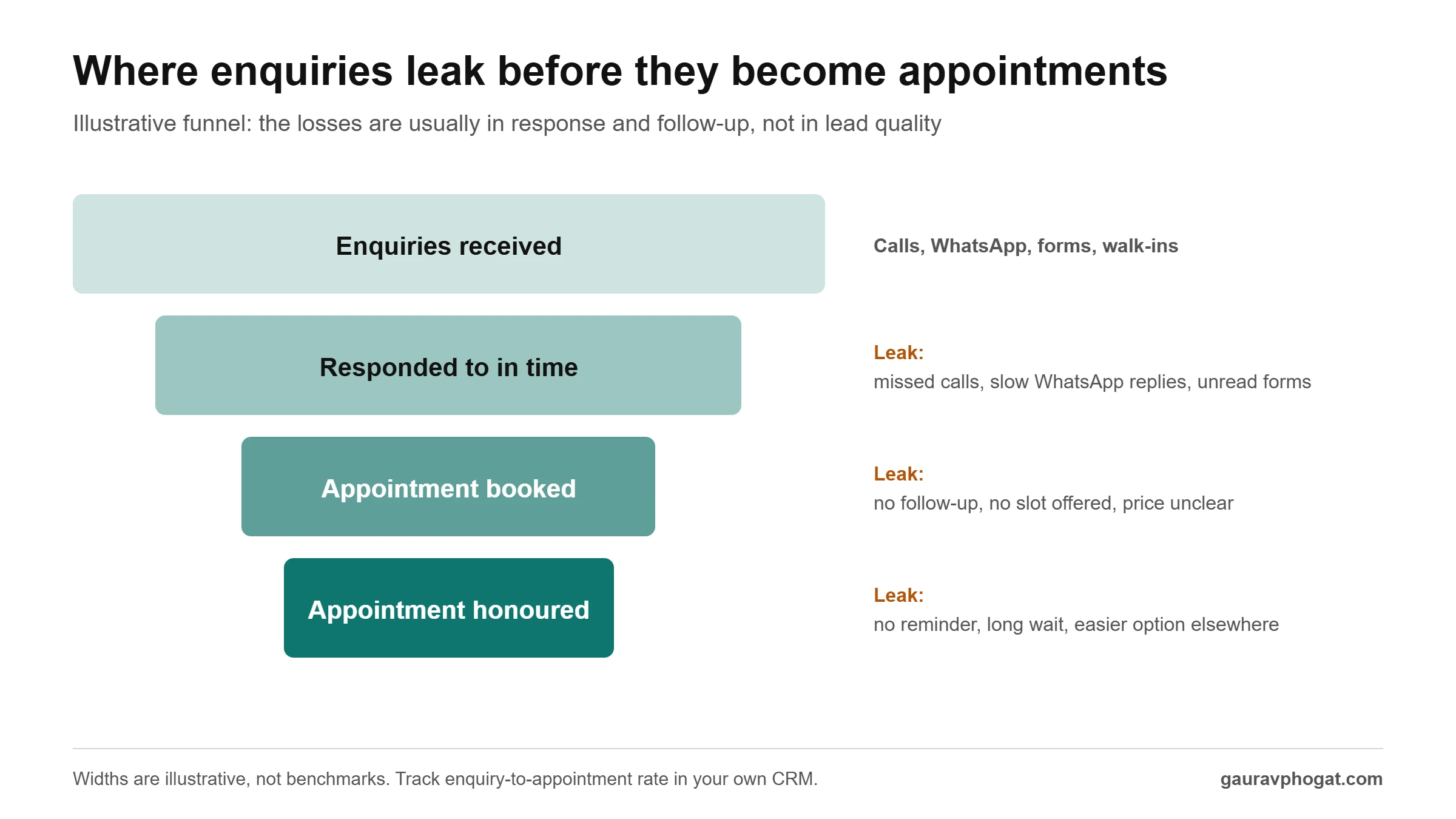
Demand that is not captured does not exist for planning purposes. In Indian hospitals it leaks through unanswered calls, personal WhatsApp numbers, forms that email a closed desk and walk-ins nobody logs.
- The question it answers: Does every enquiry, from every entrance, land in one place with a source, an owner and a next action?
- The work: One CRM record per enquiry across calls, WhatsApp, web forms, chat and walk-ins. One source taxonomy across units. Purpose-specific consent recorded at the first touch. After-hours cover designed, not hoped for.
- The owner: The contact centre head, with the digital and CRM team who own the system.
- The metric: Capture rate (enquiries logged with a source, as a share of all enquiries) and first response time by channel.
- The common failure: Counting only the enquiries the system already sees, so the leak is invisible by design.
- Go deeper: What a hospital CRM is actually for and the enquiry leakage calculator
4. Convert
This is where most hospital acquisition budgets are won or lost, and it is mostly not marketing work. Response speed, a usable slot, a clear estimate and a counsellor who follows up decide whether an enquiry becomes a patient.
- The question it answers: Does the enquiry become a kept appointment, and does an advised procedure become a treatment?
- The work: Response-time targets by channel. Slot visibility for agents. Triage that routes to the right doctor without giving clinical advice. Estimates and cashless answers early. A named counsellor for every advised procedure. A weekly conversion meeting with a fixed agenda.
- The owner: The contact centre and unit front office for appointments; counsellors for advised procedures.
- The metric: Enquiry to kept appointment (measure booked and kept, or the number gets gamed), and advised to treated.
- The common failure: Rewriting scripts while the real causes are slot availability and callback speed.
- Go deeper: Enquiry to appointment, the number that matters
5. Retain
A returning patient, a second procedure or a family member’s care costs far less to win than a new patient, and is often better care. Retention is acquisition with a memory.
- The question it answers: Does the patient come back when their care calls for it, and do we contact them only on terms they agreed to?
- The work: Post-OPD follow-up and recall linked to the care plan, discharge calls, lapsed-patient programmes for chronic conditions, family-level records where consent allows. Every message tied to a recorded purpose under the DPDP Act.
- The owner: The CRM and patient engagement team, with clinical departments setting what follow-up is appropriate.
- The metric: Twelve-month value of a patient cohort across units and services, and return rate for follow-up care.
- The common failure: Blasting a list because it exists. It erodes trust and, under DPDP, creates risk.
- Go deeper: Automating patient follow-up after OPD and re-engaging lapsed patients
6. Prove
Proof is not a monthly marketing report. It is a small set of numbers finance has reconciled, which tells the board what a rupee of growth spend bought and what demand the hospital could not serve.
- The question it answers: Can we show what each rupee bought, by channel, specialty and unit, in numbers finance accepts?
- The work: Link CRM records to appointment and billing status. Import booked and treated outcomes back into ad platforms through offline conversion imports. Report cost per treated patient by specialty and channel, and pre-clear every number with finance.
- The owner: The growth lead, with the CFO’s team reconciling.
- The metric: Fully loaded cost per new treated patient; unserved demand as a share of enquiries; twelve-month cohort value.
- The common failure: Reporting leads, traffic and cost per lead because they are available, then losing the budget argument to someone who has a treated-patient number.
- Go deeper: Cost per treated patient and the cost per treated patient calculator
Score your hospital: a self-assessment
Score each stage from 1 to 5 using the descriptions below, with your unit heads and contact centre lead in the room rather than alone. The total matters less than the lowest score: that is your weakest link, and it caps everything above it.
| Stage | 1: not in place | 3: partly in place | 5: working | Your score |
|---|---|---|---|---|
| Capacity | Marketing plans without slot or bed data | Grow, hold and build lists exist but are not reviewed weekly | Lead time is recorded on every enquiry and reviewed weekly with unit heads | |
| Demand | One funnel for every patient | Pools identified, but budgets and owners are shared | Each pool has an owner, a budget and a metric by unit | |
| Capture | Enquiries live in phones, inboxes and registers | Most channels in the CRM; walk-ins and personal numbers outside it | Every entrance lands in one queue with source, owner, next action and consent | |
| Convert | No agreed conversion number | Booked appointments tracked; kept appointments and advised procedures not | Booked, kept and advised-to-treated tracked weekly by specialty and unit | |
| Retain | Messages sent to whatever list exists | Recall for some specialties; consent unclear | Follow-up tied to the care plan and to recorded, purpose-specific consent | |
| Prove | Leads and cost per lead reported | Cost per treated patient for some channels, not reconciled | Cost per treated patient and cohort value, reconciled with finance every quarter |
A rough reading: 6 to 12 means the chain is not yet a system, so start with Capacity and Capture. 13 to 22 means the basics exist and the weakest stage is costing you more than any new campaign would earn. 23 to 30 means the work is now in the detail, usually Retain and Prove. For a broader view of marketing maturity, the hospital marketing maturity scorecard goes further.
How to use the framework in an annual plan
I build the annual marketing plan as six short sections, one per stage, rather than one section per channel. Channels sit inside Demand; they are a means, not the structure.
- Start with Capacity. The plan opens with the grow, hold and build lists by unit, signed by unit heads. Nothing gets a budget that is not on the grow or build list.
- Budget by stage, not only by channel. Media sits in Demand, but contact centre capacity, CRM work and counsellors sit in Capture and Convert. If those lines are missing, the media budget is overstated in value. See hospital marketing budget by service line.
- One owner and one metric per stage. Six names, six numbers, agreed before the year starts.
- Set targets backwards. Start from treated patients needed by specialty, then work back through conversion and capture rates to the enquiries Demand must deliver.
- Fix the weakest link first. Use the self-assessment above. A plan that adds media to a stage scoring 1 for Capture is paying for leakage.
The board view of an annual plan is a different document, and I have written about it in the CMO annual plan, the board view. For the wider strategy choices, see hospital marketing strategy and patient acquisition strategy for hospitals.
How to use it in a board pack
A board does not want six stages. It wants three numbers, and the chain tells you which three. In the board pack I take one headline number from each end of the chain and one from the middle:
| Board number | Where it comes from in the chain | What it tells the board |
|---|---|---|
| Fully loaded cost to acquire a new treated patient | Prove | What growth spend actually buys, in a number finance has reconciled |
| Demand the hospital could not serve | Capacity and Convert | Revenue lost to slots, beds, response time or follow-up, split by who lost it |
| Twelve-month value of a new patient cohort | Retain | Whether acquisition brings patients who stay with the hospital across services |
Everything else (traffic, followers, cost per lead, campaign results) belongs in the operating review, not the board pack. The structure and the arguments behind it are in the board pack from digital and growth.
Where AI fits at each stage
AI is useful at every stage of the chain, but almost never as a replacement for the owner. I use it on non-clinical work, with review, and judge it on outcomes rather than activity.
| Stage | Where AI helps | The guardrail |
|---|---|---|
| Capacity | Forecasting enquiry volume by specialty and unit from history and seasonality | Forecasts inform the weekly forum; people decide |
| Demand | Drafting educational content, checking ad copy against NMC rules, tracking how AI assistants describe your doctors and units | Medical review before publishing; no claims AI cannot source. See how hospitals get cited by AI search |
| Capture | WhatsApp and web assistants that collect details and book, call transcription and automatic source tagging | No clinical advice; a clear handover to a person. See AI enquiry triage without clinical calls |
| Convert | Call summaries for agents, next-action prompts, routing to the right specialty, estimate drafting from package data | Judge on resolution, not containment. See chatbot containment vs resolution |
| Retain | Timing follow-up to the care plan and spotting lapsed patients | Only within recorded, purpose-specific consent |
| Prove | Anomaly alerts on the weekly numbers, call-audit sampling, first drafts of the monthly narrative | Finance still reconciles every number that reaches the board |
The broader map of AI across the patient path is in where AI belongs in the patient journey.
Why I built it this way
Three decisions shaped the model, and each came from getting something wrong first.
- Capacity comes first because I used to put it last. For too long I treated a falling conversion rate as a contact centre problem. Scripts were rewritten and agents retrained, and the number did not move, because the slots were not there.
- Capture is separate from Convert because they fail differently. Capture fails silently: the enquiry never appears. Convert fails visibly: the enquiry appears and dies. Merging them hides the silent failure.
- Prove is a stage, not a report. When proof was an afterthought, I lost budget arguments to people with cleaner numbers, even when my channels were doing better work.
It also deliberately leaves things out. There is no separate awareness stage, because in a hospital brand works through Demand and through doctors’ reputations, not as a free-standing goal. And there is no stage for compliance, because compliance is not a stage: NMC 2026 and DPDP apply at every one of them. The NMC 2026 advertising guidelines hub covers the rules. The same discipline applies to the wider systems work in digital transformation in healthcare.
If you are starting next quarter
- Run the self-assessment with unit heads and the contact centre lead. Agree the weakest stage.
- Write the grow, hold and build lists for each unit before touching the media plan.
- Name one owner and one metric per stage. Publish the definitions.
- Add lead time offered and booking outcome to every contact centre record.
- Report cost per treated patient for one specialty, reconciled with finance, even if the number is rough.
- Revisit the chain every quarter; the weakest link moves once you fix it.
Sources and further reading
- Google Ads: About offline conversion imports: sending booked and treated outcomes back to the ad platform.
- WhatsApp Business Messaging Policy: opt-in rules for messaging patients.
Questions people ask
It is a structured way to plan, staff and measure marketing so that spend turns into patients who receive care. For a hospital it has to cover more than advertising: whether capacity exists, how enquiries are captured and converted, whether patients return, and how results are proved to finance. A framework that ends at the lead stops where most hospital problems begin.
It is the six-stage healthcare marketing framework I use for Indian hospitals: Capacity, Demand, Capture, Convert, Retain and Prove. Each stage has one question, one owner and one metric. It runs from what the hospital can actually serve to a treated patient the board can see, and the weakest stage limits the whole chain.
Because a hospital sells a finite inventory of consultant slots, beds and theatre time. Marketing a specialty with no near-term slots generates enquiries the contact centre cannot convert and sends patients elsewhere. Starting with grow, hold and build lists by unit means every rupee of demand goes to something the hospital can serve.
Ask which stage of the chain is weakest today and what it is costing. Then ask for three numbers: the fully loaded cost per new treated patient, the share of enquiries the hospital could not serve, and the twelve-month value of a new patient cohort. If those cannot be produced, the weakness is usually in Capture or Prove.
Trust the numbers finance has reconciled: treated patients counted against billing, spend counted against the ledger, and cost per treated patient built from both. Treat leads, cost per lead and traffic as operating signals, not results. A growth team that pre-clears its numbers with finance before each board cycle is one whose reporting you can rely on.
A normal funnel runs from awareness to lead or sale. This one adds what a hospital needs on both sides: capacity before demand, and retention and proof after conversion. It also separates capture from conversion, because enquiries that never reach a system fail silently, while enquiries that are logged and lost fail visibly. They need different fixes.
One growth or marketing leader should own the whole chain, because no other seat sees all six stages. Each stage then has its own owner: unit heads and operations for capacity, marketing and commercial teams for demand, the contact centre for capture and conversion, the CRM team for retention, and the growth lead with finance for proof.
The same six stages apply with fewer people. One person may own several stages, which is fine as long as each has a written metric. A single hospital usually gains most from Capture and Convert: one enquiry queue, fast callbacks, and a weekly review of booked against kept appointments by specialty.
At every stage, on non-clinical work, with review. Forecasting enquiry volume for capacity, drafting and checking content for demand, assistants and call tagging for capture, call summaries and routing for conversion, consent-aware follow-up timing for retention, and anomaly alerts for proof. AI should never give clinical advice or produce a board number finance has not checked.
Mostly in Demand and Retain, where communication reaches the public and patients. Advertising must stay factual and educational, without superlatives, guarantees, testimonials or cure claims, and follow-up must not become promotion. Treat compliance as a rule that applies to every stage rather than a stage of its own, and check copy before it goes live.
Brief the agency on Demand, but share the metrics of Capture, Convert and Prove so it optimises for treated patients, not form fills. Give it the grow list by unit, feed booked and treated outcomes back to the ad platforms, and judge it on cost per treated patient by specialty rather than cost per lead.
Quarterly, with the same people in the room. The weakest stage moves once you fix it, often from Capture to Convert and then to Retain or Prove. Scoring every quarter keeps the annual plan honest and tells you where the next rupee of budget or management time will do the most good.
Read my takes first in Google Search