

AI Digital Transformation in Healthcare: Inside an Indian Hospital Group
Last reviewed
AI digital transformation in healthcare is a phrase that hides more than it explains, so this piece starts with what actually changes inside a hospital group. Digital transformation in healthcare means using digital systems and data to change how patients reach care and how an organisation runs. Inside an Indian hospital group it comes down to four things: the patient’s path in, how demand is captured and followed up, what the group can see about itself, and how fast a unit can act. Everything else is procurement wearing the word.
Updated 29 October 2026: added a plain definition, verified national examples from India (ABDM, eSanjeevani, CoWIN, PM-JAY and NHCX), a six-layer hospital digital transformation framework, a three-year roadmap and the reasons I see transformations stall.
This article is part of the hospital growth strategy series, best read in order from the pillar.
Ask ten people inside an Indian private hospital group what digital transformation means and you will get ten answers, most of them a product name. The app. The new module the HIS vendor is pitching. AI, because that is the word this year. Almost nobody describes a change in how the group actually works.
That vagueness is expensive, because the phrase has become a line item that reliably gets funded, so every project looking for money now arrives dressed as transformation. The difference between a group that is genuinely transforming and one that is buying software does not show up in the spend. It shows up eighteen months later, in whether anyone can answer a straightforward question about the business without three people exporting spreadsheets.
So it is worth stripping the phrase back to what it means on the ground, in a multi-unit group with systems bought at different times by different people, where the primary patient channel is a messaging thread and much of the demand follows doctors who were never asked their opinion about any of it.
What is digital transformation in healthcare?
Digital transformation in healthcare is the redesign of how patients reach care, how care is coordinated and paid for, and how an organisation sees and runs itself, using digital systems and data so that people work differently, not just on new software. The test is behavioural: something a patient, an agent, a doctor or a unit head does differently on an ordinary day.
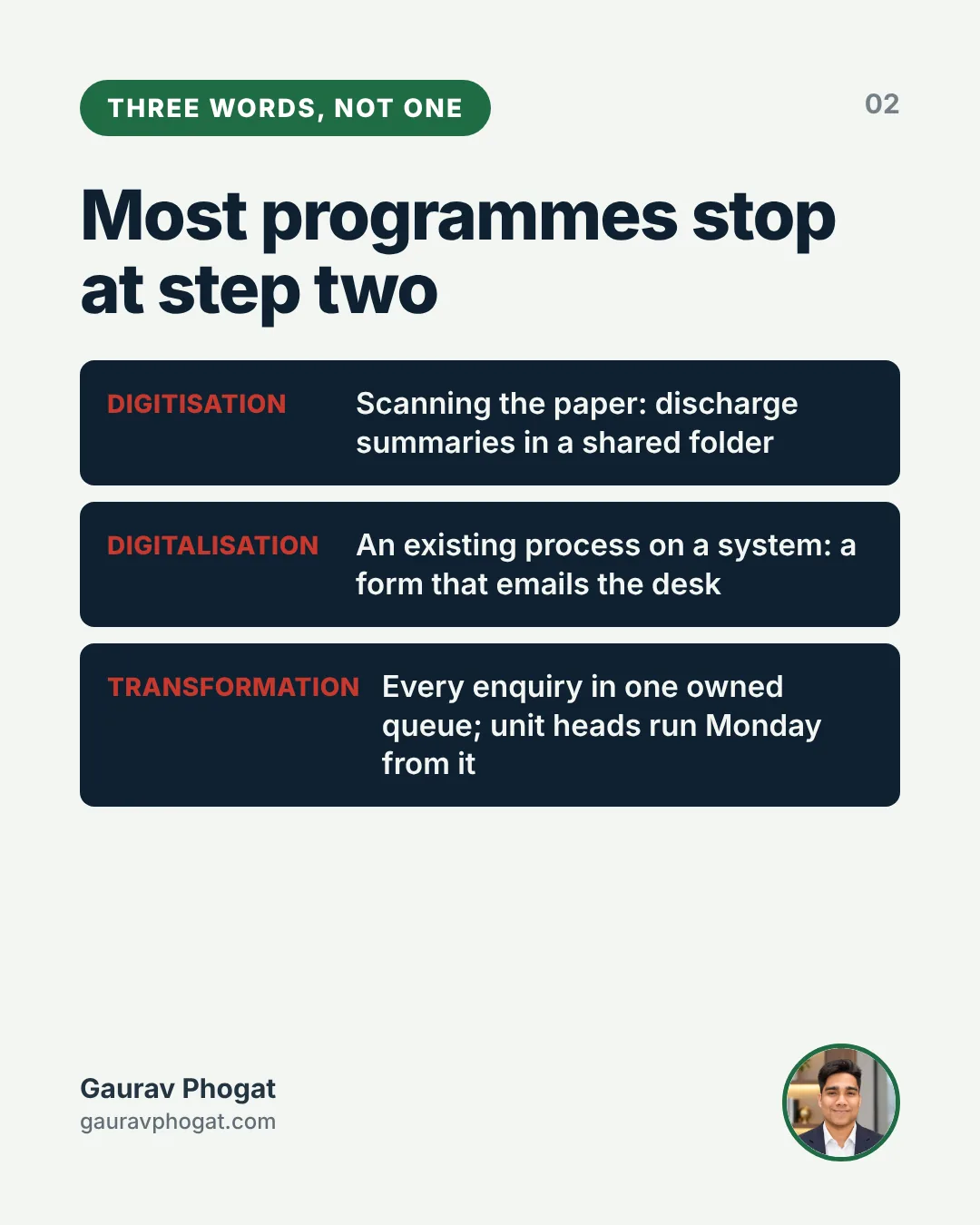
It helps to separate three words that get used as one. Digitisation is scanning the paper. Digitalisation is running an existing process on a system. Transformation is when the operating model changes because the system exists: who owns a patient enquiry, what a unit head decides on Monday, how a claim moves. Most hospital programmes I have seen stop at the second step and call it the third.
| Term | What it means in a hospital | Example |
|---|---|---|
| Digitisation | Converting paper records into digital form | Scanned discharge summaries in a shared folder |
| Digitalisation | Running an existing process on a system | An online appointment form that emails the front desk |
| Digital transformation | Changing how the organisation works because the system exists | Every enquiry, from any channel, lands in one queue with a named owner and a next action, and unit heads run the Monday review from it |
In India the phrase now has two layers. There is national digital public infrastructure, built by government, that every hospital has to connect to. And there is the transformation inside each hospital group, which no public platform can do on its behalf. This article covers both: the national examples, then the framework and roadmap I use inside a group.
What is actually being transformed
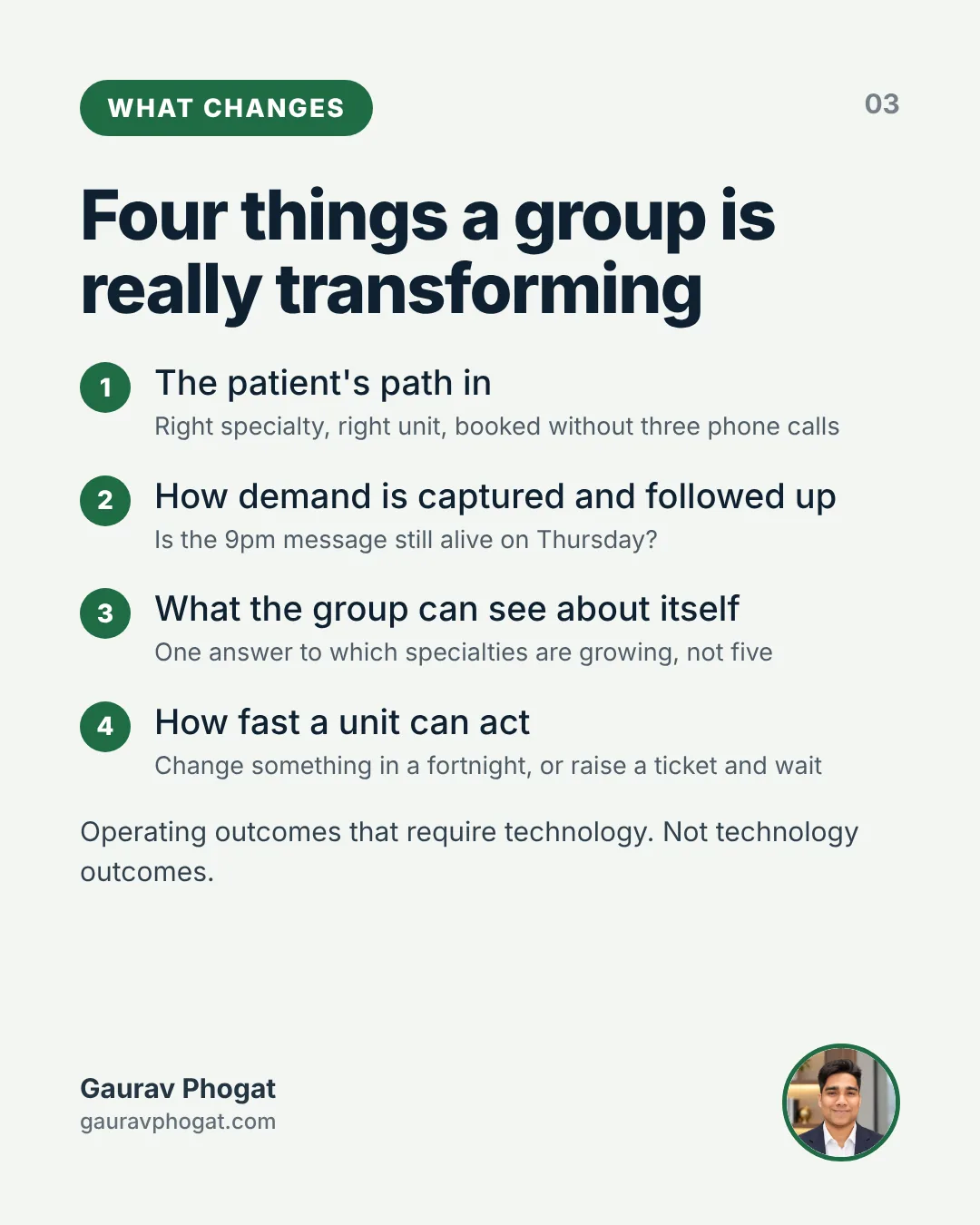
Strip away the vocabulary and there are four things a hospital group is genuinely trying to change. Everything else is a means to one of them.
- The patient’s path in. How someone with a symptom or a second-opinion question finds the group, reaches the right specialty at the right unit, and books, without three phone calls and a callback that never comes.
- How demand is captured and followed up. Whether an enquiry arriving at nine at night on a messaging thread is still alive on Thursday, and whether anybody can say what happened to it.
- What the group can see about itself. Whether “which specialties are growing at which units, and where is the drop-off” has one answer or five.
- How fast a unit can act. Whether a unit head who spots a soft month can change something in a fortnight, or raises a ticket and waits a quarter.
None of those are technology outcomes. They are operating outcomes that require technology. That distinction gets lost somewhere between the strategy offsite and the vendor shortlist.
What gets called transformation but is really procurement
A new app is not transformation. A new HIS module is not transformation. A dashboard nobody opens is not transformation; it is a screenshot that appears monthly in a review deck and is never questioned, which is worse than no dashboard, because it manufactures the impression of visibility.
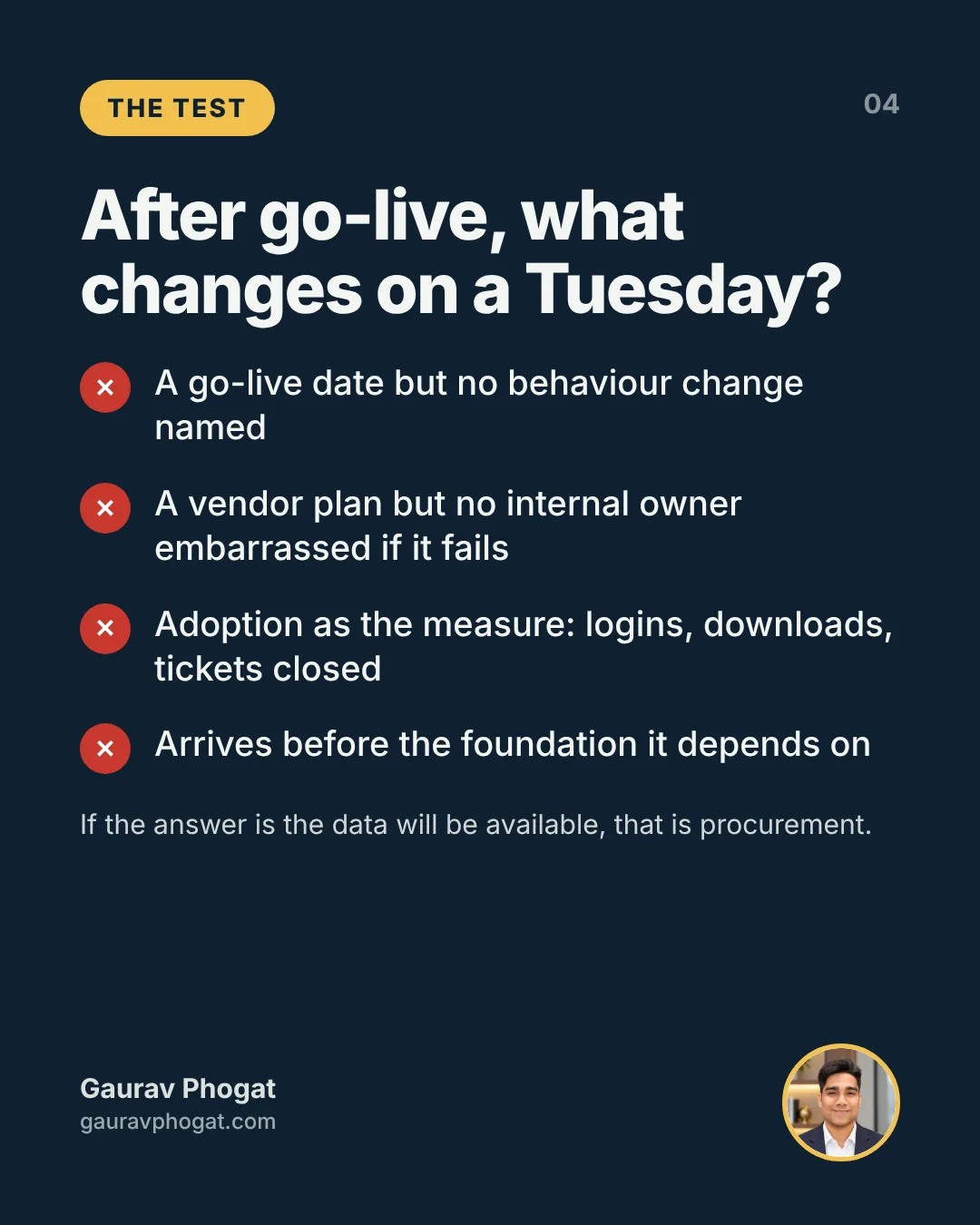
The test I use is blunt. After this goes live, what does somebody do differently on a Tuesday? If the answer is “the data will be available”, that is procurement. If the answer is “the agent sees the patient’s last three interactions before she picks up, so she stops asking her to repeat her history”, that is transformation, and the software is incidental.
Procurement dressed as transformation has a signature. A go-live date but no behaviour change named. A vendor implementation plan but no internal owner who will be embarrassed if it fails. Adoption as the measure (logins, downloads, tickets closed) rather than anything the business cared about before. And it arrives before the foundation it depends on, because the foundation is not demoable and the product is.
The foundation nobody wants to fund
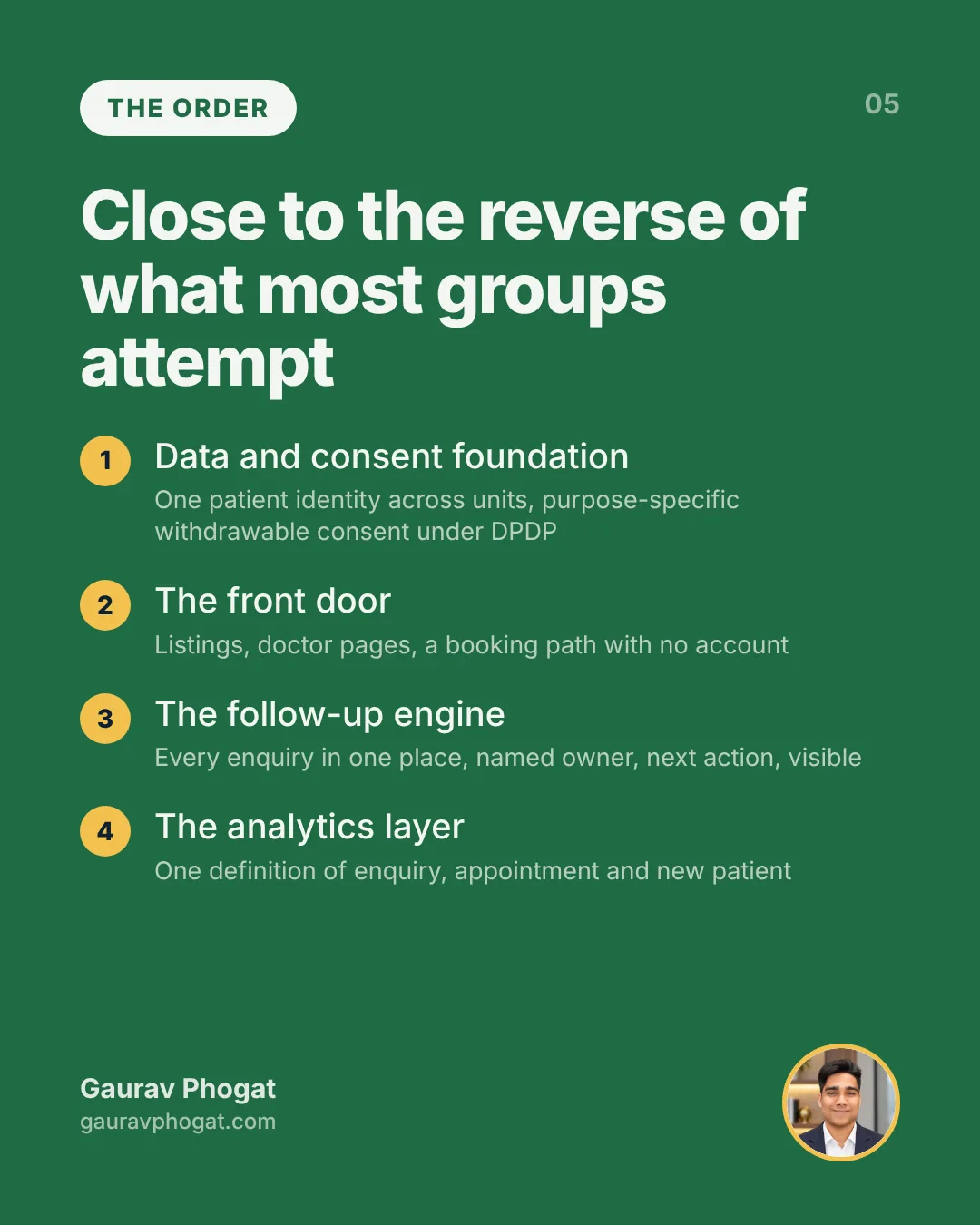
The order that works is close to the reverse of the one most groups attempt. It starts with the data and consent foundation. It is the least popular budget line in the group, and the one everything else sits on.
You will find the same patient existing as four records: one per unit, one from an old campaign, one the contact centre created because the number had a typo. You will find phone numbers belonging to a relative who accompanied the patient in 2019. You will find consent collected as a blanket tick on a registration form, which under DPDP obligations is not purpose-specific, withdrawable consent for follow-up. Most groups carry that gap quietly and hope nobody asks.
Fixing it is months of work that produces nothing to show a board. One patient identity across units. A consent record saying what was agreed, for what purpose, when, and how it can be withdrawn. Nobody puts this in the plan, and every programme that skipped it paid later: a campaign to a list that turned out half stale, a reminder about a unit the patient has never visited.
Then the front door, then the follow-up engine
Second comes the front door. Most groups want to start here, which is not wrong in itself, only wrong before the first step, because a front door pouring demand into a broken record system just fills a leaky bucket faster.
The front door in India is not a website. It is a search result, a map listing, a doctor’s name typed into a search box, an aggregator profile, and increasingly a message thread. Treat it as one surface with many entrances, not a site redesign. The work is unglamorous here too: every unit’s listing carrying the right hours and number, doctor pages reflecting who actually consults where on which days, a booking path that does not demand an account.
Third comes the follow-up engine, which separates a group that generates enquiries from one that converts them. Every enquiry, from any entrance, lands in one place, is assigned to a named person, carries a next action with a date, and is visible to a manager who can see what is stuck. This is CRM, contact centre and messaging work taken together, and it is where the revenue engine actually lives.
The analytics layer comes last, and that is not a demotion
Fourth is the analytics layer. Not a dashboard, a layer. One definition of an enquiry. One definition of a converted appointment. One definition of a new patient versus a returning one, agreed across units, so the monthly review stops being an argument about whose number is right.
It comes last because analytics built on unreconciled data produces confident wrong answers, which are worse than no answers. A group that builds dashboards first ends up with beautifully rendered disagreement. I would rather have one shared sheet everybody trusts than nine dashboards telling each unit head what he wants to hear.
Why groups that invert the order stall
Almost every stalled programme I have seen or heard about from peers inverted this sequence. It began with the visible artefact (an app, a dashboard, the two things a board can actually look at) and worked backwards towards the foundation, which it never reached, because by then the money and the patience were gone.
The failure runs to a script. The app launches, downloads look respectable for a quarter, then somebody asks why an appointment booked in the app never reached the unit’s schedule. The integration was descoped in month three. The app was never the problem; the app was built on top of nothing.
Which is why building a consumer platform is a second-phase decision: the right ambition, the wrong place to begin. And it is why an AI strategy presented before the data foundation exists is a slide, not a plan. Models do not repair duplicate records; they inherit them, at speed and with confidence. The groups getting useful work out of AI now are the ones that did the dull identity and consent work two years ago.
The Indian specifics that change the shape of this
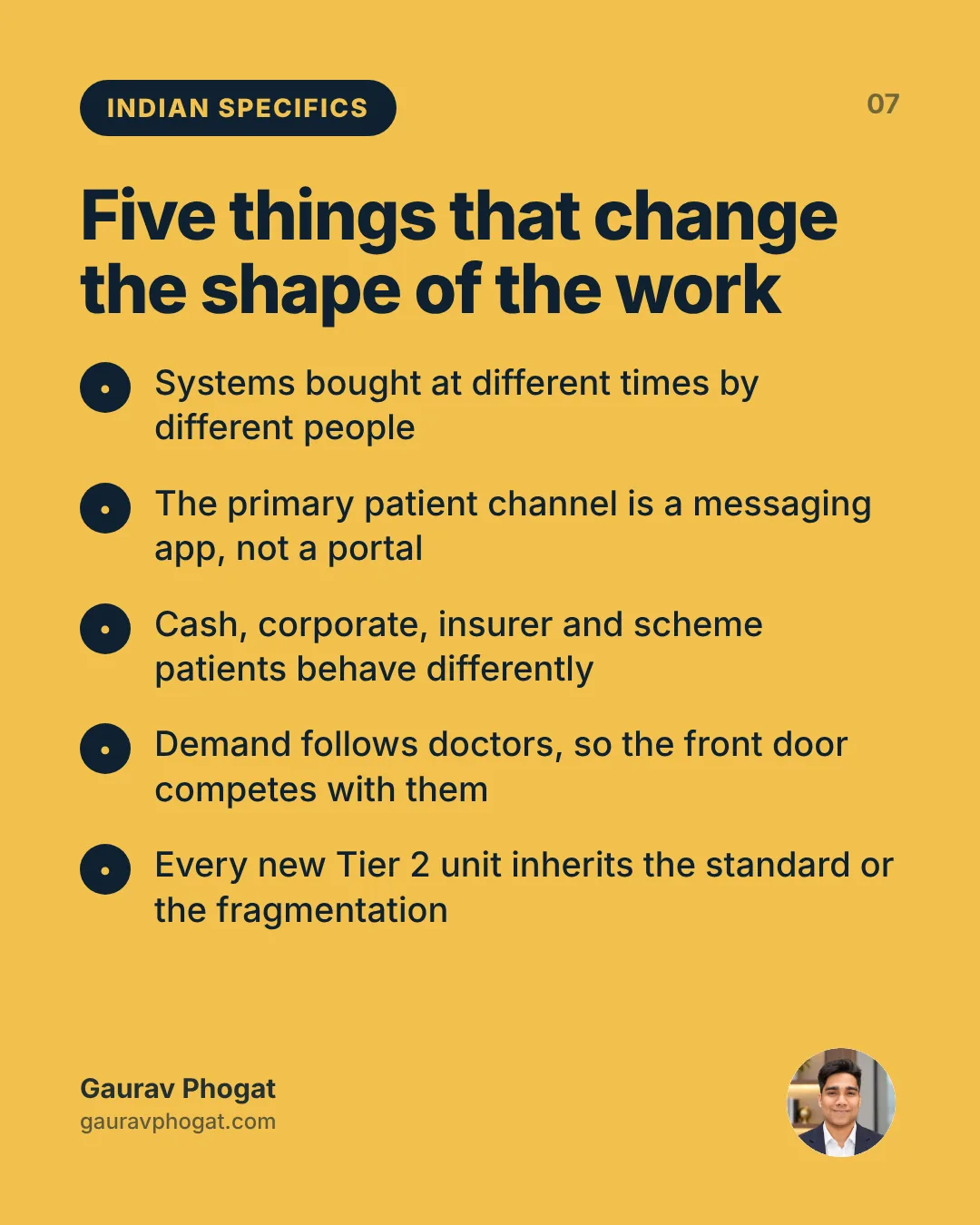
A plan borrowed from a Western health system will not survive contact with an Indian private group. Five things change the shape of the work.
- Systems were bought at different times by different people. Rarely one HIS, one lab system, one billing stack across units. Each acquisition brought its own, and none were bought with group reporting in mind.
- The primary patient channel is a messaging app. Not email, not a portal. Any design assuming a patient will log in is designing for a minority.
- The payer mix is genuinely mixed. Cash, corporate, insurer and government-scheme patients arrive by different paths and behave differently in follow-up. A journey that ignores empanelment reality falls apart at the first cashless query.
- Demand is doctor-led. Much of the volume follows individual consultants, so the group’s front door and the doctor’s own reputation are competing inputs to one decision. Pretending otherwise produces campaigns doctors quietly ignore.
- Tier 2 expansion compounds whatever you have. Every new unit inherits a group standard or recreates the fragmentation. The cheapest moment to enforce one patient identity is before a unit opens.
Digital transformation in healthcare: examples from India
India is one of the few countries where the most instructive examples of digital transformation in healthcare are public infrastructure. Each one below is verifiable on a government source, and each changes something a private hospital has to do.
Ayushman Bharat Digital Mission (ABDM) and ABHA
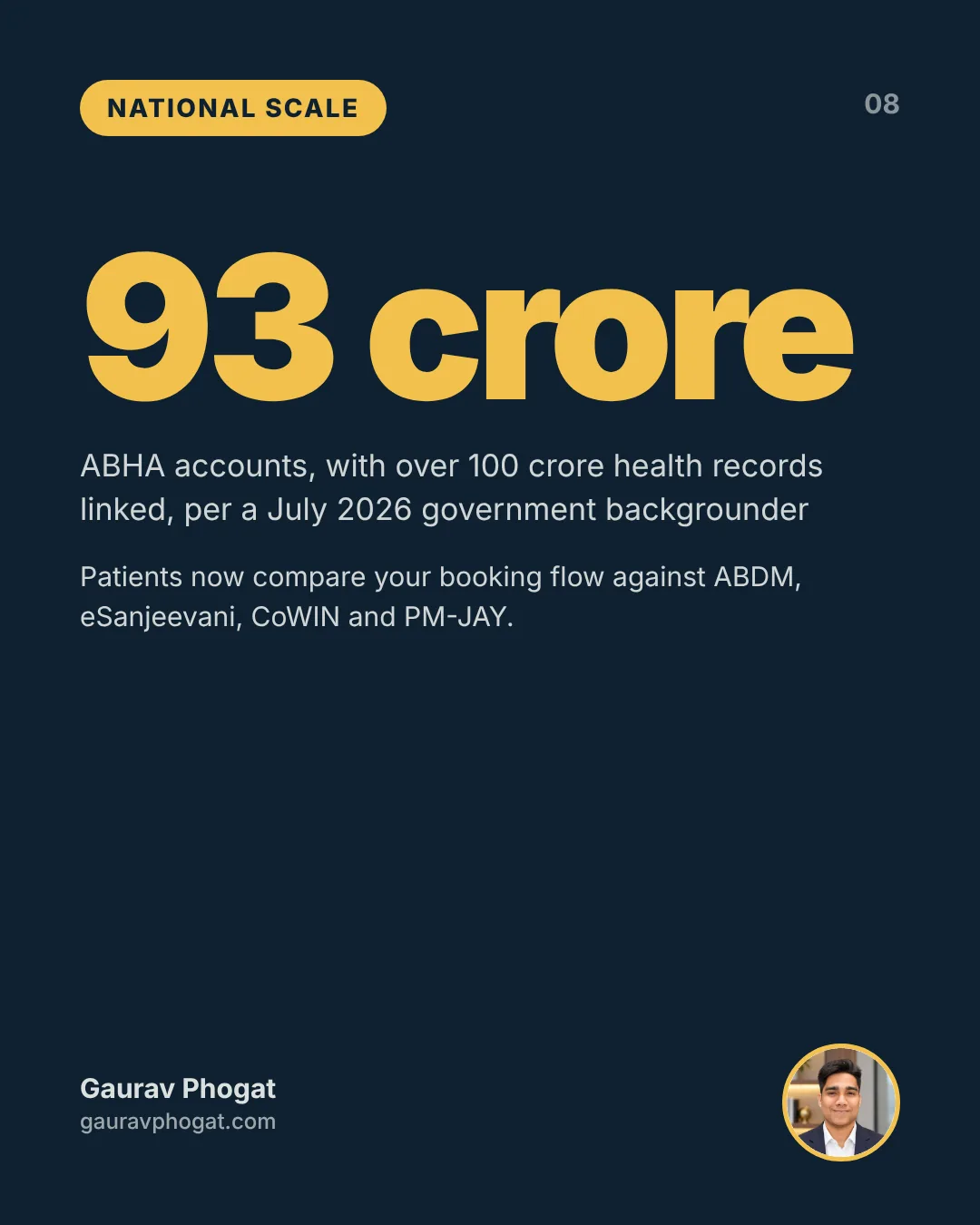
Launched in September 2021, ABDM gives citizens an Ayushman Bharat Health Account (ABHA) and creates registries for health facilities and professionals, so records can move between providers with the patient’s consent. A July 2026 government backgrounder reports over 93 crore ABHA accounts, over 100 crore health records linked, and over 23 crore tokens generated through Scan and Share, the QR code registration that lets a patient skip the OPD registration queue (PIB backgrounder on ABDM, July 2026). What it changes for a hospital: registration, consent and record sharing now have a national standard, and a hospital whose systems cannot speak it will feel slow to patients who have used one that can.
eSanjeevani
The national telemedicine service crossed 50 crore teleconsultations in October 2026, running through more than 1.42 lakh Ayushman Arogya Mandir spokes connected to over 19,000 medical hubs (All India Radio News, October 2026). The lesson is the hub and spoke design: a remote consultation works when the referral path from spoke to specialist is designed, not when a video link exists.
CoWIN and U-WIN
CoWIN recorded over 220 crore COVID-19 vaccine doses with digital certificates, and U-WIN applies the same approach to routine immunisation, with 11.87 crore children and 3.96 crore pregnant women registered as of March 2026 (PIB, India’s Health Transformation, June 2026). For hospitals, the point is expectation: identity, scheduling and a verifiable record have run at national scale on a mobile number, and patients now compare a private booking flow against that.
PM-JAY claims and the National Health Claims Exchange (NHCX)
Ayushman Bharat PM-JAY runs pre-authorisation and claims for empanelled hospitals digitally; the same June 2026 government document reports 12.03 crore hospitalisations covered and about 40,000 claims processed daily. NHCX, developed by the National Health Authority with IRDAI, is a gateway for exchanging claims information between hospitals, insurers and TPAs in a standard, interoperable format (PIB release on NHCX onboarding, November 2023). For a hospital, cashless turns into a data quality problem: clean, structured clinical and billing data moves faster. I go deeper in what PM-JAY auto-adjudication and NHCX mean for hospital data.
Patterns inside private hospital groups
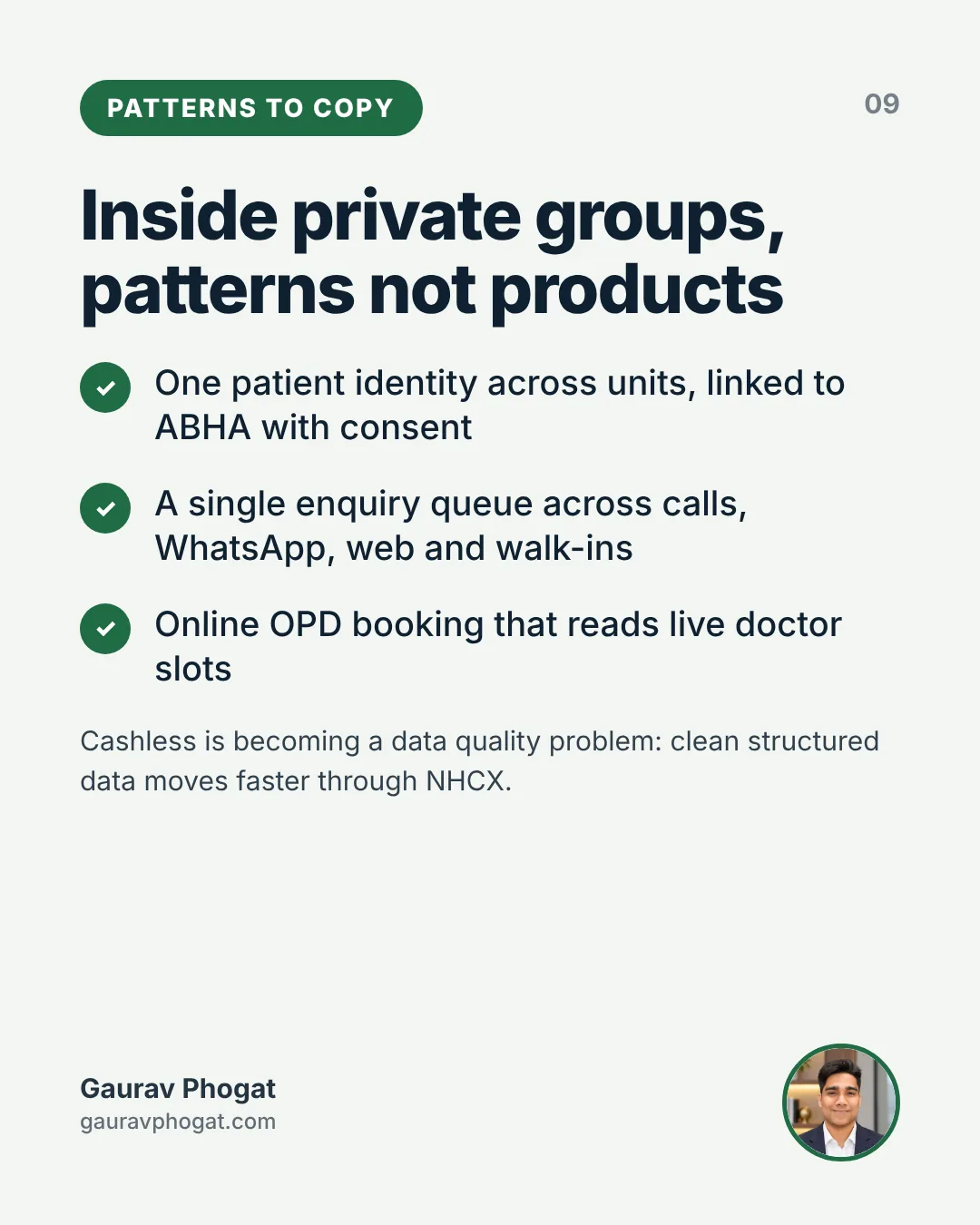
Inside private groups, the transformations worth copying are patterns rather than products:
- One patient identity across units, linked to ABHA where the patient consents.
- A single enquiry queue across calls, WhatsApp, web forms and walk-ins, with a named owner per enquiry. See WhatsApp Business API for hospitals.
- Online OPD booking that reads live doctor slots instead of sending a request to a desk. I tested how this works in practice in my OPD booking flow study.
- Accurate, structured doctor and unit information that search engines and AI assistants can read. My 100-site hospital website benchmark and AI hospital recommendations study show how uneven this still is.
- Consent records that say what a patient agreed to and for what purpose. See the DPDP Act for hospital marketers.
- AI applied to non-clinical work first: call summaries, enquiry tagging, content drafts with medical review. See where AI belongs in the patient journey.
None of these needs a famous vendor. Each needs an owner.
A hospital digital transformation framework
When I assess a hospital group, I look at six layers. They map to the four outcomes above, and the order matters: the lower layers carry the upper ones, so a weakness in data or operations shows up later as a failed app or a stalled AI pilot. If you want a structured starting score, the free hospital digital maturity assessment covers the same ground.
| Layer | What it covers | What good looks like | The common gap |
|---|---|---|---|
| 1. Patient front door | Search results, map listings, doctor pages, website booking, WhatsApp, aggregators, AI answers | Every entrance shows the right doctors, timings and a booking route; online booking reads live slots | Listings out of date; the booking form emails a desk that closes at six |
| 2. Data and CRM | Patient identity, consent, enquiry records, source tagging | One patient record across units; every enquiry in one queue with source, owner and next action; purpose-specific consent on record | The same patient in four records; consent as a blanket tick on a registration form |
| 3. Operations | Contact centre, scheduling, counsellors, estimates, follow-up | Response time measured by channel and unit; every advised procedure followed up by a named counsellor with an estimate | Callbacks depend on who is on shift |
| 4. Clinical systems interface | HIS, EMR, lab, billing, ABDM and claims connections | Booking, arrival and billing status flow back to the CRM; ABHA and claims data move in standard formats | A digital front end that never learns whether the patient arrived |
| 5. AI | Assistants, enquiry routing, summarisation, content, AI search visibility | AI on non-clinical work first, with human review, measured on resolution rather than containment | Pilots that impress in a demo and never reach production |
| 6. People and operating model | Ownership, shared definitions, governance, skills, clinician involvement | One accountable owner; agreed definitions of enquiry, appointment and new patient; a weekly operating review; a medical director engaged early | A steering committee and no owner |
The layer that fails most often is the fourth, the interface with clinical systems, because it belongs to nobody. Marketing builds the front end, IT runs the HIS, and the join between them is a spreadsheet someone emails on Monday. For the second layer, my hospital CRM implementation guide covers the sequence; for the fifth, why hospital AI pilots never reach production; for the sixth, building a digital team inside a hospital group and the chief digital officer role in Indian healthcare. On the growth side, the same logic runs through my healthcare marketing framework, which follows a patient from demand to treatment.
A three-year roadmap
This is the sequence I would put in front of a board for a multi-unit Indian group. A single hospital can usually compress it into eighteen months. Every phase is tied to a number the CFO already tracks, and no phase starts until finance accepts the previous phase’s number.
| Period | Focus | What ships | How you know it worked |
|---|---|---|---|
| Months 0 to 6 | Foundation: identity, consent, definitions | Patient identity and consent audit across units; a consent record; agreed definitions of enquiry, appointment and new patient; one accountable owner named | One enquiry number that finance and every unit head accept |
| Months 6 to 12 | Front door and capture at one proving-ground unit | Listings and doctor pages corrected group-wide; a single enquiry queue at the pilot unit; WhatsApp inside the CRM; response-time reporting | Response time and enquiry to appointment conversion move at the pilot unit |
| Year 2 | Follow-up engine and clinical interface across units | CRM rollout; booking, arrival and billing status flowing back; counsellor follow-up for advised procedures; ABDM and claims standards adopted | Enquiry to appointment and cost per treated patient move group-wide |
| Year 3 | Analytics and AI at scale | A weekly operating review run from one data layer; AI on summarisation, routing and content with review; a board pack built on three numbers | A named decision made differently because of the data |
The board view of this sequence, and the three numbers I would report, are in the board pack from digital and growth.
Who owns it, and why it fails when it sits in one function
It fails with IT alone, and it fails with marketing alone, for opposite reasons.
IT owns the systems, the integrations and the security posture, and is essential to all of it. But IT is not positioned to judge whether a booking flow is worth the friction it adds, or whether a follow-up message reads like care or like selling. Ask IT to own transformation and you get well-integrated systems nobody uses differently.
Marketing owns the demand and the message and understands the patient journey better than anyone in the building. But it does not own the data model, cannot commit IT’s roadmap, and has no standing in a unit’s operating review. Ask marketing to own transformation and you get excellent front-end work on a back end that never changed.
What works is a named owner sitting across both (digital, product, growth, whatever the group calls it) with a real seat in the operating review, a line to the CFO, and explicit backing from a medical director for anything touching how doctors work. Not a steering committee. A person.
The part that never appears in the plan and eats the most calendar time is change management with clinicians. Doctors did not ask for any of this. They judge it on one question: does this cost me time or give me time? In year one the honest answer is often “a little of your time, for now”. Say so. Nothing survives their indifference, and earning attention takes months of showing up, not a training session.
How it gets funded and defended across budget cycles
Transformation does not fit inside a budget cycle. It takes three, and the first mostly buys the ability to see clearly, which is the hardest thing to defend in a room that wants a return. Be honest about that rather than promising results the timeline cannot produce.
The year-one case is a capability case, not a return case: by the end of it the group has one patient identity, a defensible consent position, and a single enquiry number everybody accepts. Year two is when front door and follow-up work show up in conversion. Year three is when analytics changes what gets decided. The infrastructure spend underneath follows its own logic; the capex case deserves its own paper.
Two things protect a programme across cycles. Tie every phase to a number the CFO already tracks (enquiry to appointment conversion, contact centre cost per booked appointment, revenue per unit by specialty), not a digital metric nobody else uses. And deliver something visible every quarter, even in the foundation year. Not a demo; a fix. Duplicate records reconciled at two units. Doctor listings corrected group-wide. Visible progress buys patience for the work nobody can see.
Telling progress from motion
Motion looks a great deal like transformation from a board seat. This is how I separate them.
- Motion counts projects launched. Progress counts questions that now have one answer.
- Motion reports adoption. Progress reports movement in a business number that existed before the programme did.
- Motion adds systems. Progress usually removes one: a register, a sheet, a group chat quietly doing the work the system was meant to do.
- Motion needs the vendor in the room to explain the status. Progress can be explained by the unit head.
- Motion produces dashboards. Progress produces decisions made differently because of a dashboard.
The last is the real test, and it is uncomfortable, because it requires naming an actual decision. If nobody can name one after a year, the group bought software.
Why transformations stall
Sequence is the most common reason, and I covered it above. In my own work the other reasons were quieter, and some of them were mine.
- I let a vendor’s roadmap become the plan. For two quarters the next product release decided our priorities, and the outcome nobody owned slid.
- I reported adoption because it moved. Logins rose and the enquiry number did not. I kept showing the one that moved until a CFO asked the second question.
- The pilot worked and nobody budgeted the rollout. A good pilot without a rollout budget is a demo with a longer life.
- Definitions were never agreed. Every unit’s number was right by its own rules, so the monthly review was an argument instead of a decision.
- The sponsor moved. A programme that depends on one executive’s patience pauses when that executive changes roles. I now write the case so it survives a change of sponsor.
- Clinicians heard about it last. By the time a doctor saw the new workflow, the decision had been made without the one person whose time it spent.
What I changed: one owner, one page of outcomes, one visible fix every quarter, and a rule that no phase starts until the previous phase’s number is signed off by finance. It is slower to start and much faster to finish.
Examples of digital transformation in healthcare that pass the Tuesday test
The test from earlier (what does somebody do differently on a Tuesday?) is the quickest way to tell real examples from procurement. These are the kinds I would point to, none of them dependent on a particular product:
- A contact centre agent sees a patient’s last three interactions before answering, so the family stops repeating its history.
- A patient advised a procedure hears from a named counsellor within two days, with the estimate and the cashless answer, instead of silence.
- A unit head sees enquiries, bookings and lost enquiries by specialty every Monday from one number everyone accepts, and moves money the same week.
- A doctor’s OPD timings change once and update the website, the map listing and the booking calendar together.
- A follow-up message is sent because the patient agreed to it, recorded in a consent log, not because a list existed.
None of these is a launch. Each is a small, permanent change in how the group works, and together they are what the phrase should have meant all along.
If you are starting this next quarter
- Write one page naming the four things you are changing and what changed would look like. The argument it starts is the useful part.
- Audit patient identity and consent across units before scoping anything else. Assume it is worse than you were told.
- Pick one unit and one specialty as the proving ground. A Tier 2 unit often beats the flagship: fewer systems, a unit head closer to the work.
- Name one accountable owner with a seat in the operating review. Not a committee.
- Agree three definitions (enquiry, appointment, new patient) and publish them before building any reporting.
- Bring in a medical director early enough that clinicians hear it from a clinician.
Digital transformation is not a programme you finish. It is the point at which a group stops guessing about itself. Most of the work that gets you there is work nobody will ever ask to see.
Further reading from primary sources
- Ayushman Bharat Digital Mission: India’s national digital health infrastructure.
- IBEF: Healthcare industry in India: sector overview and growth drivers.
- McKinsey: The state of AI: annual survey on AI adoption and business impact.
- PIB: Ayushman Bharat Digital Mission, India’s Digital Health Backbone (July 2026): ABHA, linked records and Scan and Share figures.
- PIB: India’s Health Transformation (June 2026): PM-JAY, CoWIN, U-WIN and eSanjeevani figures.
- All India Radio News: eSanjeevani crosses 50 crore teleconsultations: October 2026 milestone and hub and spoke scale.
- PIB: National Health Claims Exchange onboarding (November 2023): what NHCX is and who built it.
Questions people ask
It means changing four things inside a hospital group: how patients find and reach the right specialty, how enquiries are captured and followed up, what the group can see about its own performance, and how quickly a unit can act on what it sees. Everything else (apps, modules, dashboards) is a means to one of those, or it is procurement with a better name on it.
The data and consent foundation. In a multi-unit group the same patient typically exists as several records, phone numbers are stale, and consent was collected as a blanket tick rather than for a stated purpose. Fix patient identity and build a defensible consent record before you build anything patient-facing, because everything downstream inherits whatever mess is sitting underneath it.
Three budget cycles is realistic for a multi-unit group. The first mostly buys clarity: one patient identity, a defensible consent position, agreed definitions everybody accepts. The second is when front door and follow-up work start showing up in conversion. The third is when the analytics layer changes what actually gets decided. Anyone promising a return inside twelve months is selling something.
One named person sitting across IT and marketing, with a seat in the operating review and a line to the CFO. IT alone produces well-integrated systems that nobody uses differently. Marketing alone produces excellent front-end work on a back end that never changed. Steering committees are where accountability gets shared until it disappears. Name a person, not a forum.
Because they invert the sequence. They begin with the visible artefact, such as an app or a dashboard, because that is what a board can look at, then work backwards towards the foundation and run out of money and patience before reaching it. The app is rarely the real problem. The app was built on top of nothing, and it shows by month nine.
Numbers the CFO already tracks, not invented digital metrics. Enquiry to appointment conversion, contact centre cost per booked appointment, revenue per unit by specialty. And something visible delivered every quarter, even in the foundation year: duplicate records reconciled at two units, doctor listings corrected across the group. Visible progress buys patience for the work that cannot be seen.
It means consent has to be purpose-specific and withdrawable, and you have to be able to say where a phone number came from. A blanket tick on a registration form is not consent to send follow-up marketing. Most groups are carrying that gap quietly. Closing it is unglamorous, takes months, produces nothing to demonstrate, and is not optional.
A single hospital has an easier version of the same problem: fewer systems, one patient identity to establish, one operating review to convince. The sequence is identical and the timeline is shorter. What a single hospital lacks is the balance sheet to absorb a foundation year with no visible return, so tie each phase to a business number from the very first review.
Motion counts projects launched and reports adoption. Progress counts questions that now have one answer, and moves a business number that existed before the programme started. The hardest test is to name one decision that was made differently because of something you built. If nobody can name one after a year, the group bought software rather than changed anything.
Doctors judge anything you build on one question: does this cost me time or give me time? That is a fair question, and in year one the honest answer is often that it costs a little. Say so rather than overselling. Bring a medical director in early enough that clinicians hear about it from a clinician, and never promise a workflow change you cannot support on day two.
It is the primary patient channel in India, not a side project, so it belongs inside the follow-up engine rather than in a separate messaging initiative. The rule is that a message thread is an enquiry like any other: it lands in one place, gets assigned to a named person, carries a next action with a date, and is visible to a manager who can see what is stuck.
Almost never. A consumer app is a second-phase decision: the right ambition, the wrong starting point. Built before patient identity, booking integration and a working follow-up engine exist, it launches, shows respectable downloads for a quarter, and then somebody asks why an app booking never reached the unit’s schedule. The answer is usually that the integration was descoped in month three.
A one-page document naming the four things you are trying to change and what changed would look like, followed by an honest audit of patient identity and consent across units. Neither needs a vendor. Then pick one unit and one specialty as the proving ground. A Tier 2 unit often beats the flagship, because the systems are simpler and the unit head sits closer to the work.
Real examples change what someone does on an ordinary day: an agent who sees a patient’s history before answering, a counsellor who follows up an advised procedure within days, a unit head who reads one agreed enquiry number every Monday, doctor timings that update everywhere at once, and follow-up sent only on recorded consent. A new app or dashboard on its own is procurement, not transformation.
The clearest are public infrastructure: ABDM, which gives citizens an ABHA health account and lets records move between providers with consent; eSanjeevani, the national telemedicine service; CoWIN for vaccination records and certificates; and PM-JAY digital claims, now joined by the National Health Claims Exchange for insurers. Each sets a standard private hospitals have to connect to.
Six layers: the patient front door, data and CRM, operations such as the contact centre and scheduling, the interface with clinical systems like the HIS and billing, AI, and the people and operating model that hold it together. The lower layers carry the upper ones, so fix identity, consent and enquiry capture before scaling apps or AI.
Read my takes first in Google Search