

New hospital marketing plan: 12-month launch checklist to day 90
Last reviewed
Plan new hospital launch marketing in four phases: foundations 12 to 6 months out (catchment, lead specialties, digital setup), pre-launch demand 6 to 1 month out (doctors, referrers, community), launch month (PR, paid search, a fully staffed contact centre), then the first 90 days measured on treated patients by specialty.
Updated 11 October 2026 as per the NMC’s new advertising guidelines. Under the NMC’s Guidelines on Ethical Advertising and Public Communication, in force since 6 October 2026, doctors and hospitals can no longer request or share patient reviews or testimonials for promotion, use before-and-after photos or promotional patient stories (even with consent), offer discounts or other inducements, or make superiority or guaranteed-outcome claims. The advice below has been revised accordingly. See what the 2026 NMC guidelines allow.
New to the topic? Start here: Hospital launches sets out the reading order.
Updated 29 October 2026: merged in our month-by-month checklist for the twelve months before a hospital opens, and added the digital scope, a 12-month launch checklist table, the day-one list and key statistics.
Hospital launches fail quietly. The building opens on time, the inauguration gets coverage, and then the OPD stays half empty for months because nobody created demand for specific doctors in specific specialties before the doors opened. This new hospital marketing plan pulls together everything I have written on launches into one timeline, with a month-by-month checklist for the digital work that has to start a year before opening.




What is the timeline for hospital launch marketing?
| Phase | Timing | Marketing work | Exit test |
|---|---|---|---|
| Foundations | 12 to 6 months out | Catchment research, lead specialties, brand, website, Google profile, CRM and tracking setup | Launch plan signed off by unit head and finance |
| Pre-launch demand | 6 to 1 month out | Doctor introductions, referral meetings, community programmes, content, early search presence | Referral list and pre-registrations growing weekly |
| Launch month | Month 0 | Launch PR, paid search by specialty, contact centre at full strength, replies to every review from day one | Calls answered, bookings logged, no missed launch enquiries |
| First 90 days | Months 1 to 3 | Cost per treated patient by specialty, budget shifts, relaunch of weak specialties | Treated patient trend rising in lead specialties |
Hospital launch: the costly mistake #shorts
Hospital launch: the costly mistake.
Read the transcript
Most launch budgets go to the inauguration and billboards.
Introduce the doctors early.
Have the contact centre ready on day one.
And lead with two or three specialties.
Full guide on gauravphogat.com.
What digital owns in a hospital launch, and what it does not
A hospital gets built by people who measure in cubic metres and kilowatts. The civil contractor, the biomedical planner and the NABH consultant all have dated plans. Digital usually has one line in a capex deck and a meeting about nine weeks before opening where a project director asks why the website is not live. I have sat in that meeting more than once, and the honest answer is always that nobody sequenced it. Digital readiness for a new unit is roughly forty tasks, and a dozen depend on things marketing does not control: a licence number, a bank account in the unit’s name, a signed consultant contract, an empanelment letter.
So agree the scope in writing with the project director early. Digital owns five things: the unit’s identity in search and maps, its pages on the group website, doctor content, the enquiry-to-appointment path including the contact centre and CRM, and launch communication. It does not own signage, the opening event or whether the cath lab is commissioned on time.
Plan for the date to move. In my experience a hospital opening date slips at least once, usually by four to eight weeks, often over a fire NOC or a lift inspection. Every digital asset must survive a date change without rework: no creative with a date burned in until the date is confirmed twice, and no countdown anywhere. If you must compress the plan, compress the back end, not the front.
Phase 1: Foundations (12 to 6 months out)
Study the catchment
Map where patients in the catchment go today, which specialties they travel for, what competitors offer, and which referral doctors and nursing homes matter. Search demand data from Google Keyword Planner and Google Trends shows what people look for by area. The 12-month checklist further down sequences the digital work that follows from it.
Choose lead specialties
No new hospital can market everything at once. Pick two or three lead specialties based on catchment gaps, doctor strength and capacity, and make them the centre of pre-launch work. My notes on how a centre of excellence gets its first hundred patients apply to each lead specialty.
Build the digital foundations
- A unit page and specialty pages on the website, ready to publish.
- A Google Business Profile claimed and verified as soon as the address allows, with the correct category and opening date.
- Call tracking numbers, WhatsApp Business setup and a CRM pipeline for the new unit. See my hospital CRM implementation plan.
- A consent notice for pre-registration forms and camps, in line with the DPDP Act.
Freeze the name, listing and number (12 to 9 months out)
This is the least glamorous work and the only work that cannot be bought back later, because a new unit has to exist as an entity in the places patients look, and those places verify slowly.
- Decide the unit’s naming convention and freeze it. Group name plus locality is usually right. It must match the board resolution, clinical establishment registration, GST registration, signage and bank account, or verification fails months later.
- Create and claim the map listing as soon as there is a site and a board outside it, and let it age. Use Google’s opening date feature so the unit can appear before it opens.
- Allocate the phone number now. The number you publish on day one should be the one that has sat in the listing for months.
- Register with the two or three doctor aggregators and the insurance-linked directories that carry real volume in that city. Each has its own onboarding queue.
- Agree the regional-language strings once, centrally: the unit name, locality and specialty terms, so every later asset uses the same words.
The failure mode here is treating the listing as a five-minute job for an intern. It is the single asset that decides whether someone two kilometres away can find you in the first week.
Unit and specialty pages on the group website (9 to 6 months out)
A new unit does not need a new website. It needs to be a first-class part of the existing one. If the group site treats units as a tab, a dropdown or a PDF of the address, fix that architecture first, because you will add more units. By month six the unit needs:
- A unit page with address, map, directions from the two nearest landmarks, parking, visiting hours, emergency entrance and a single contact number.
- Specialty pages scoped to that unit: what cardiology at this unit actually is, the cath lab, the ICU beds, named consultants once confirmed, the hours.
- An honest facilities list. If the MRI is phase two, the page does not say MRI. I have seen a unit lose a referring physician over one line that promised a service it did not yet have.
- The enquiry form wired to the CRM and tested end to end with a real phone picking up a real call.
Build these pages half-empty and visible only internally. Month six is when you discover nobody can tell you how many ICU beds the unit will have, and you want to discover that then rather than in month one.
An illustrative example: a new hospital spends most of its launch budget on hoardings and the inauguration. Calls spike in the first week, but the contact centre is half staffed and the Google profile still shows no timings. By month two the noise has faded and the OPD is quiet. The same budget split across pre-launch referral work, a verified profile and a trained desk would have kept demand flowing.
Pre-launch: how do you create demand before a hospital opens?
This is the phase most launches underinvest in. The goal is to make sure that on opening day, patients and referrers already know which doctors are joining and what the hospital will do.
- Doctor introductions. Publish factual doctor profiles as soon as appointments are confirmed. When doctors cannot be named yet, build demand around specialties and facilities. See pre-launch demand with no doctors to name.
- Referral network. Meet general practitioners, nursing homes and diagnostic centres in the catchment with the lead specialty doctors. Track every meeting in the CRM.
- Community programmes. Health talks, screening camps and corporate health check tie-ups, with a booking path for follow-up.
- Content and search. Publish answer-first pages for the lead specialties and the unit, so they are indexed before launch.
- Soft or hard launch decision. Decide whether to open services gradually or all at once. I compare both in soft launch or hard launch.
Doctor page machinery before the doctors sign (6 to 4 months out)
Clinical recruitment rarely finishes on plan. Senior consultants often sign in the final weeks, with a notice period and a practice to wind down. Yet doctor pages are among the highest-intent content a hospital has, because patients search by name. So build the machinery before you have the people: a doctor page template, and a collection process for photograph, qualifications, registration number, years of experience, areas of focus, languages, OPD timings and one short paragraph in the doctor’s own words. A medical services person, not marketing, should approve clinical claims.
Then each signed contract becomes a two-day path to a live page, not a three-week one. A consultant whose page is live and attached to the unit’s listing starts receiving enquiries before he has physically moved. One thing I got wrong early was letting photography wait. Book a photographer for a half-day every fortnight in the final quarter and shoot whoever has joined; inconsistent photographs are a year-long argument to fix later.
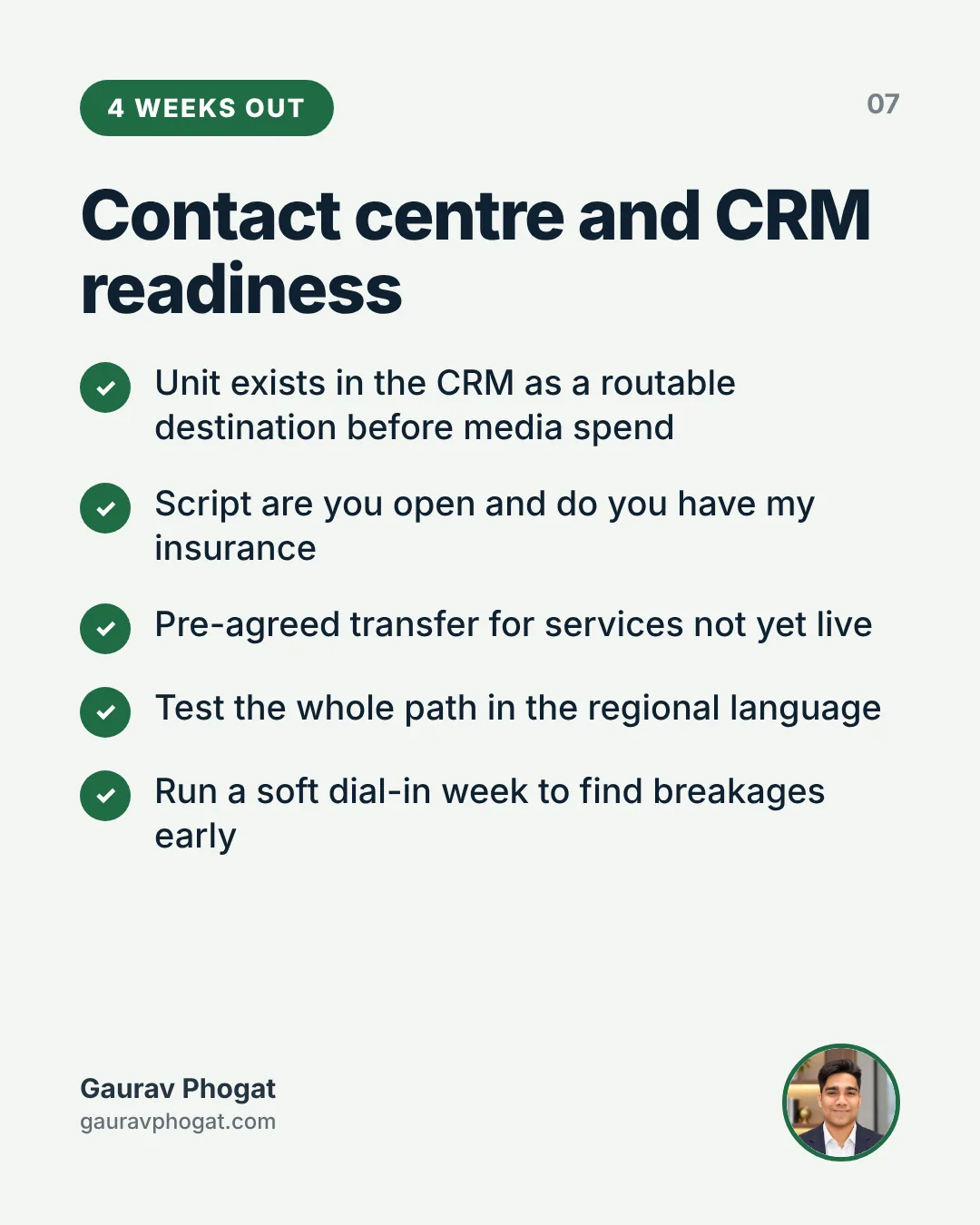
CRM routing and contact centre readiness (by 4 weeks out)
The new unit has to exist in the CRM as a routable destination before the first rupee of media goes out: its specialties, consultants, OPD slots and enquiry sources configured, and a lead tagged to the unit reaching a human who knows it exists.
- Train the contact centre four weeks before opening on the address in the words a patient will use, the landmark, the autorickshaw instruction, and the lists of services that are live and not yet live.
- Script the two questions you will hear most in month one, “are you open?” and “do you have my insurance?”, with answers agreed in writing with the payer team.
- Agree what happens to an enquiry for a service the unit does not yet offer. A pre-agreed transfer to the nearest sister unit keeps the lead; otherwise agents say no and it is gone.
- Test the whole path in the regional language. An agent handling a Telugu or Marathi caller on an English-only screen loses the enquiry.
- Run a soft dial-in week: publish the number quietly, run a small paid campaign into a small catchment, and find the three or four breakages while the stakes are low.
Empanelment communication (2 months to 1 month out)
Empanelment timelines with insurers, TPAs, CGHS, ECHS, state schemes and corporate panels are outside the hospital’s control, and several will not process an application until the clinical establishment licence is issued. What you can control is how you talk about it.
- Publish a payer list only when each name on it has a signed letter.
- Give the contact centre a dated view of what is in process, so the answer is “cashless with that insurer is expected this quarter, reimbursement works from day one” rather than a shrug.
- Brief the front office and insurance desk with the same list on the same day. The most damaging version of this problem is a patient told yes on the phone and no at the counter.
Corporate empanelment runs on its own track: HR contacts at the catchment’s large employers, a health check package and an onsite camp calendar. Start at month three. It converts slowly but steadily, and it is the cheapest demand a new unit will get.
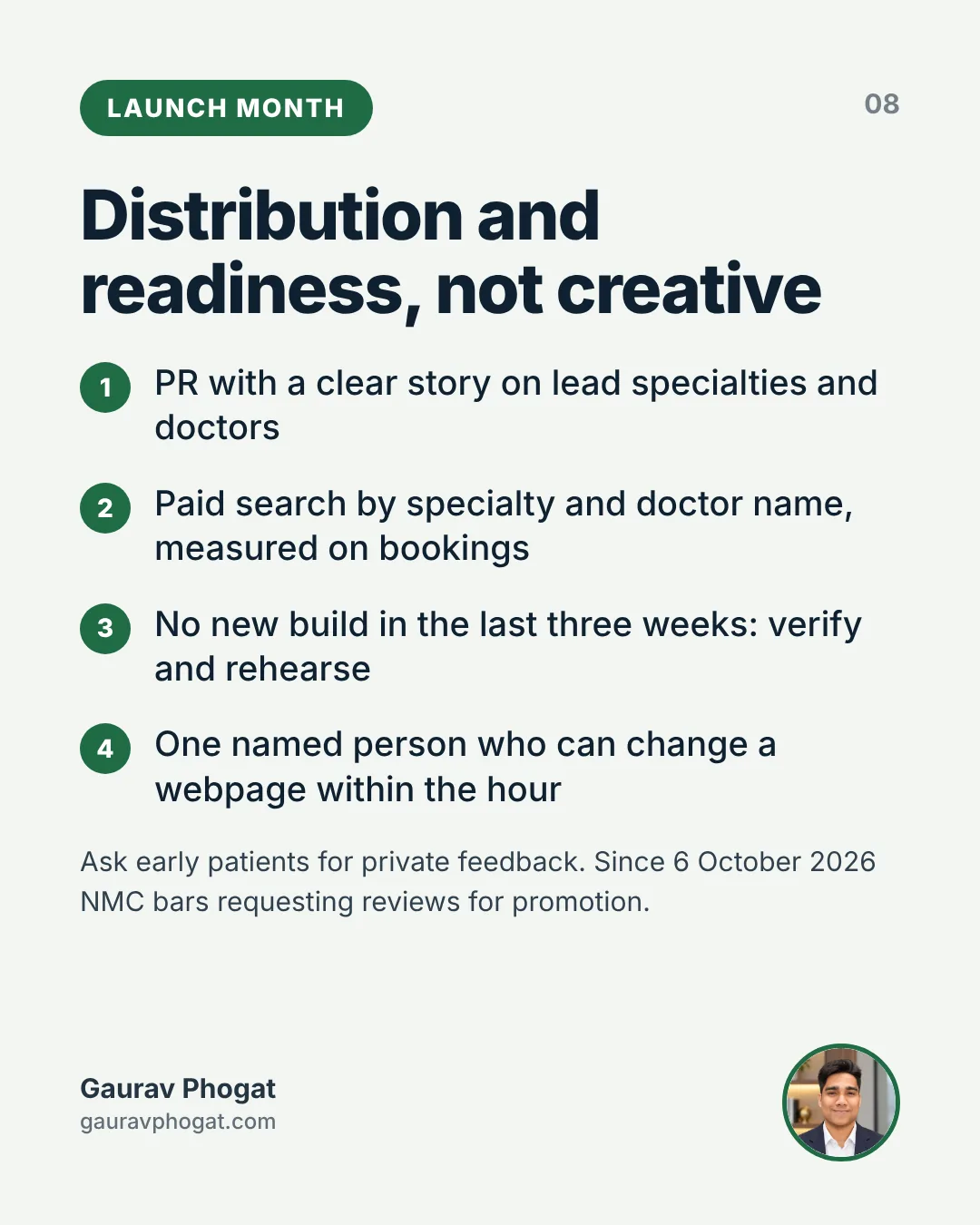
What should a hospital do in launch month?
Launch month is about distribution and readiness, not creative. The announcement only works if people who see it can book easily. My view on the launch announcement as a distribution problem explains why.
- PR: local and trade media with a clear story about the lead specialties and doctors. See launch PR for a new hospital unit.
- Paid search: campaigns by lead specialty and doctor name, sent to specific landing pages, measured on bookings.
- Contact centre: fully staffed with trained agents, scripts for the new unit and a missed-call recovery rule. I wrote a full guide to the launch-month contact centre.
- Ask every early patient for private feedback and fix issues quickly. Do not request public reviews: since 6 October 2026, NMC guidelines restrict doctors and hospitals from requesting reviews for promotion.
- Local search: update the Google profile with photos, services and timings on opening day.
The last three weeks: freeze and verify
No new build in the last three weeks. They are for verification and rehearsal: map listing live and verified with correct hours, the number ringing to a trained agent, the unit page accurate against services actually commissioned, doctor pages live for everyone who has joined, forms tested on a mobile phone on mobile data, and one named person who can change a webpage within the hour on opening day. Something will be wrong on opening day (the hours, a department not ready, a doctor who did not join), and the gap between noticing and fixing should be minutes.
What must be live on day one, and what can wait
| Live on day one, without exception | Can wait, and should |
|---|---|
| Verified map listing with hours and photographs | Blog and video library |
| Unit page with accurate services | Awards page and detailed treatment cost pages |
| Emergency number | Health check e-commerce flow |
| Doctor pages for every consultant physically present | Chatbot |
| Enquiry path tested end to end | App integrations |
| The real cashless and reimbursement position | Anything that depends on a service not yet commissioned |
I have watched teams burn the final fortnight on a chatbot while the map listing showed the wrong closing time. The chatbot can ship in month four; the closing time cannot. The one thing that looks optional but is not is review response: reply to every review within twenty-four hours, in the reviewer’s language, with a name and a number, from the first morning.
The 12-month hospital launch checklist
Each window before opening has a different priority. This table puts the digital work in sequence, with the failure I see most often in each window, so the team can see which work cannot be compressed later and plan around a slipping date.
| Window | Priority | Common failure |
|---|---|---|
| 12 to 9 months | Naming convention, map listing, phone number, aggregators and directories, regional-language strings | Treating the listing as a five-minute job |
| 9 to 6 months | Unit and specialty pages on the group website, enquiry form wired to the CRM | Unit treated as an afterthought on the site |
| 6 to 4 months | Doctor page template, intake form and clinical approval workflow; photographer booked | Waiting for doctors to join before building |
| 4 to 2 months | Unit configured in the CRM; contact centre scripts; soft dial-in week; corporate track started | Media spend before enquiries can be routed |
| 2 to 1 months | Empanelment communication rules; front office and insurance desk briefed | Payer names published before letters are signed |
| Last 3 weeks | Verification and rehearsal; no new builds; opening-day web editor named | Polishing a chatbot while basics are wrong |
If you are starting next quarter, do these first:
- Freeze and document the unit’s naming convention, registration name and phone number on one page signed by the project director.
- Create and claim the map listing this month, even with a hoarding as the only physical proof.
- Audit whether the group website can carry a new unit properly. If it cannot, that is a platform project, not a launch task, so start it now.
- Build the doctor onboarding workflow and approval chain before a single contract is signed.
- Put the unit into the CRM and run a soft dial-in week at least four weeks out.
- Agree empanelment communication rules in writing with the payer team and the front office together.
- Name the person who can edit the website on opening day.
A launch rarely fails because the campaign was weak. It fails because a patient who wanted to come could not find the gate, reach a human, or get a straight answer about her insurance.
Phase 4: The first 90 days
The first 90 days show which specialties have real demand and which need a different approach. Measure weekly.
| Metric | Why it matters |
|---|---|
| Enquiries and bookings by specialty | Shows where demand exists |
| Response time and missed calls | Shows whether the contact centre is losing launch demand |
| Referral sources | Shows which partners are sending patients |
| Cost per treated patient by channel | Shows where to move budget |
| Reviews and complaints | Shows early experience problems before they spread |
If a specialty stalls, diagnose before spending more: capacity, doctor availability, referral relationships or awareness. My piece on relaunching a hospital that stalled covers the recovery playbook, and what a hospital launch teaches about demand explains the patterns I see. Once the unit is running, my patient acquisition strategy takes over.
How is launching in a new city different?
When a group opens in a new city, the brand may be known but the doctors and referral networks are not. Some things transfer, such as brand standards, CRM, contact centre process and paid search structure. Others have to be rebuilt locally, such as referral relationships, community presence and local search. See opening in a new city: what transfers and the greenfield hospital demand plan.
What are the most common hospital launch mistakes?
- Spending most of the budget on the inauguration and outdoor media.
- Opening with an untrained or understaffed contact centre.
- Marketing every specialty equally instead of leading with two or three.
- Leaving the Google profile unverified until after opening.
- Measuring launch success by footfall rather than treated patients by specialty.
- Burning campaign creative with an opening date before the date has been confirmed twice.
- Publishing a payer list before every insurer on it has signed.
- Spending the final fortnight on a chatbot while the map listing shows the wrong hours.
Key statistics, with sources
India’s hospital capacity is expanding while the gap with recommended bed levels remains large, and government scheme empanelment spans tens of thousands of hospitals. New units open into competitive catchments where payer status and visibility matter from the first day, which is why launch digital work has to start a year ahead.
- Eleven listed hospital operators and two large unlisted ones are expected to add around 14,500 beds across FY2026 and FY2027, at a total capex of around Rs 30,000 to 32,000 crore, according to ICRA. Source: ICRA, Indian hospital industry outlook, July 2025.
- India has 1.3 hospital beds per 1,000 people against a recommended 3, and needs about 2.4 million more beds to close the gap, according to Knight Frank India and Berkadia. Source: Knight Frank India and Berkadia, reported by Millennium Post, November 2023.
- Ayushman Bharat PM-JAY had more than 38,000 empanelled public and private hospitals as of 31 August 2026 and has funded about 13.25 crore hospital admissions, according to the Ministry of Health and Family Welfare. Source: PIB, MoHFW: Progressing Towards Universal Health Coverage, September 2026.
Sources and further reading
- Google: Add a business opening date: how a new unit can appear on Google before it opens.
- Google: Guidelines for representing your business on Google: the rules for one accurate profile per real location.
- Google Ads: About offline conversion imports: how to send booked and treated outcomes back to Google Ads.
- IBEF: Healthcare industry in India: sector overview and growth drivers.
Questions people ask
In four phases: foundations 12 to 6 months out, pre-launch demand 6 to 1 month out, launch month with PR, paid search and a ready contact centre, and the first 90 days measured on treated patients by specialty.
At least 12 months before opening, with catchment research, specialty choice and digital foundations. Demand creation through doctors and referrers should run for the last six months.
Catchment research, lead specialties, brand and website, Google profile, CRM and tracking, doctor and referral programmes, community activity, launch PR, paid search, contact centre readiness and a 90-day measurement plan.
Introduce doctors early, meet referral doctors in the catchment, run community health programmes, publish specialty content and capture pre-registrations with consent.
A soft launch suits hospitals that need to test processes and ramp services, while a hard launch suits those with doctors and systems fully ready. Many choose a phased opening by specialty.
Critical. Launch publicity creates a spike in calls, and missed or slow responses waste that demand. Staff and train it before opening day.
Two or three where the catchment has unmet demand, the hospital has strong doctors and there is capacity to serve.
PR builds awareness and credibility around the lead specialties and doctors, but it only converts if search, landing pages and the contact centre are ready.
By treated patients by specialty and channel, response times, referral sources and early reviews, not by footfall or media coverage alone.
Transfer brand, CRM, contact centre and paid media standards, and rebuild referral relationships, community presence and local search for the new city.
Check capacity, doctor availability, referral relationships and awareness by specialty before increasing spend, then relaunch the weakest specialties with a focused plan.
Set the budget by lead specialty targets and expected cost per treated patient, and protect money for the first 90 days rather than spending most of it on the opening event.
Yes. Claim and verify it as early as possible so it is ready on opening day with the correct category, services, timings and photos.
Five things, agreed in writing with the project director early: the unit’s identity in search and maps, its pages on the group website, doctor content, the enquiry-to-appointment path including the contact centre and CRM, and launch communication. Digital does not own signage, the opening event or whether equipment is commissioned on time. Agreeing scope early prevents the last-minute meeting about why the website is not live.
Expect it to slip at least once, often by four to eight weeks over a fire NOC or a lift inspection. Build every asset to survive that without rework: no creative with a date in it until the date is confirmed twice, and no countdowns. Listings, unit pages and doctor workflows are unaffected by a slip; only campaign flighting moves.
Live without exception: a verified map listing with hours and photographs, an accurate unit page, the emergency number, doctor pages for every consultant present, a tested enquiry path and the real cashless and reimbursement position. The blog, videos, cost pages, chatbot and app integrations can wait. Review responses cannot: reply within twenty-four hours from the first day.
Read my takes first in Google Search