
SEO for Doctors and Hospitals in India: A Complete Guide
SEO for doctors is the work of making sure that when a patient in India searches for a doctor, a condition or a treatment, they find your Google Business Profile and your own pages, trust what they read and can book. It rests on four pillars: local SEO and the Business Profile, doctor and service pages, technical SEO and schema, and authority earned through citations and links. Google holds medical pages to a higher trust bar than most topics, and the NMC guidelines in force since 6 October 2026 limit what you can say. Measure it in calls and booked appointments, not rankings.
Reviewed on 29 October 2026 by Gaurav Phogat. External facts checked against their original sources on the same date.
See every healthcare digital growth guide in one place.
I have run search for hospital groups, single-specialty chains and individual consultants, and the same pattern repeats. Doctors are told SEO is about blogs and backlinks. Then I look at the account and find an unclaimed Business Profile, three duplicate doctor listings, a profile page with no timings and a site that takes eight seconds to load on a phone. Healthcare SEO is less glamorous than the pitch decks suggest, and more fixable.
This guide ties together everything I have written on the subject. Each section gives you the short version and ends with a link to the deeper article, so you can read it as a map and then go where your gaps are.
In this guide
- What SEO for doctors means
- How patients in India search for doctors
- The four pillars of SEO for doctors
- Content that ranks for doctors
- SEO for solo doctors, clinics and hospitals
- AI search and GEO
- Measuring SEO for doctors
- A 90-day SEO plan for a doctor or clinic
- Choosing an SEO agency or doing it in-house
- Common mistakes
What SEO for doctors means, and why medical SEO is different
SEO for doctors covers everything that decides whether your practice shows up, and gets chosen, when a patient searches: your Google Business Profile, your profile and service pages, the technical health of the site, and the signals other websites send about you. Healthcare SEO and hospital SEO are the same discipline at a larger scale, with more units, more doctors and more pages to keep accurate.
What makes it different from SEO for a shoe shop is the trust bar. Google classes topics that could significantly affect health, finances or safety as “Your Money or Your Life” (YMYL), and its guidance on helpful content says these get extra weight on experience, expertise, authoritativeness and trust (E-E-A-T), with trust the most important. Google also says E-E-A-T is not a single ranking factor. In practice it means a medical page has to show who wrote it, who reviewed it, which real doctor and clinic stand behind it, and that the facts are current.
Three things follow for doctors in India:
- Accuracy beats volume. One clinically reviewed page on a procedure you actually perform is worth more than twenty generic articles. Thin pages generated at scale are named in Google’s spam policies as scaled content abuse.
- Reputation is judged off your site. Directory profiles, news mentions, association pages and reviews all feed the picture Google and patients form of you.
- Regulation shapes the copy. Superlatives, guarantees and testimonials fail on trust and on the NMC and ASCI rules at the same time.
Go deeper: YMYL and E-E-A-T: how Google judges medical websites, with the editorial and clinical review system I set up to earn that trust.
How patients in India search for doctors
Before any tactic, get the query shapes right. Patients rarely type the words in a marketing plan. When I read search terms and enquiry logs, they fall into a few patterns, each answered by a different asset.
| What the patient types | Example (illustrative) | What has to answer it |
|---|---|---|
| A doctor’s name | Dr A. Sharma cardiologist | Your own doctor profile page, plus consistent listings |
| Specialty and place, or near me | gynaecologist near me, ENT doctor in Kondapur | Google Business Profile and a specialty page tied to the clinic |
| A symptom | chest pain on left side when walking | A clinically reviewed patient guide that says when to see a doctor |
| A treatment or procedure | knee replacement recovery time | A procedure page linked to the doctors who perform it |
| Cost and cover | cashless hospital near me, MRI cost | Honest pages on insurance, TPA tie-ups and what drives cost |
| Urgent | hospital near me open now | Accurate hours and a phone number that is answered |
Four Indian specifics change the plan:
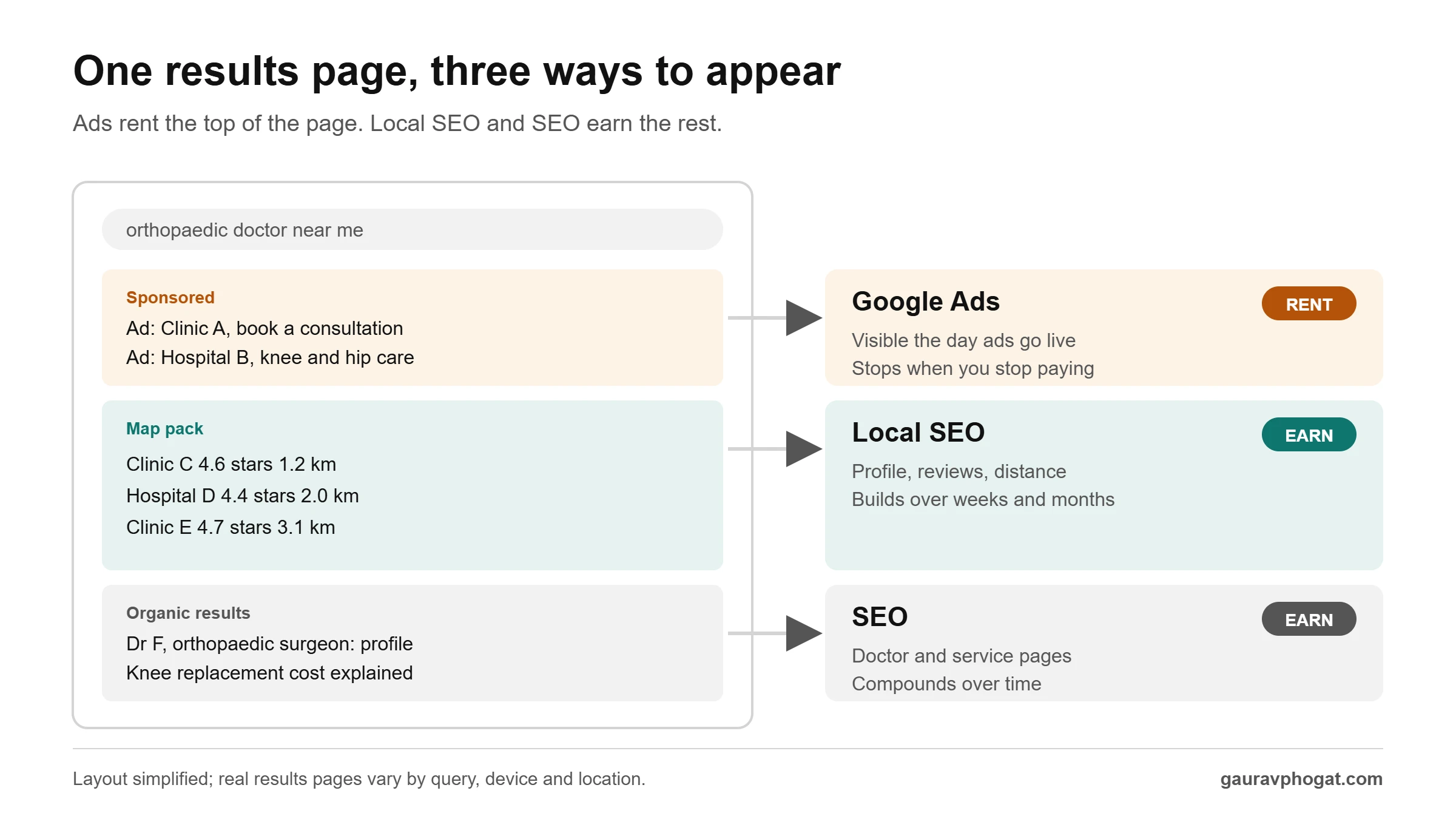
- “Near me” is often implicit. A patient typing “orthopaedic doctor” on a phone usually gets local results without naming a place, so your listing and pages must make location obvious.
- Symptom, treatment and doctor-name searches are different stages. Symptom searches are early and anxious; doctor-name searches are late and ready to book. A clinic that only publishes symptom blogs captures attention it rarely converts.
- Languages and mixed script are real. In tier 2 cities patients search in Hindi, Telugu, Marathi or regional words typed in Roman script. In my benchmark of 100 Indian hospital websites, only 14% had a genuine Indian-language version; most of the rest relied on a machine-translation widget.
- Voice and phone-first behaviour. Spoken queries are longer and more conversational, and they end in a call or a WhatsApp message, not a form.
Go deeper: Near me search intent in healthcare breaks down the five intents behind local searches, and keyword mapping for hospitals: specialty x condition x location turns those searches into a page plan.
The four pillars of SEO for doctors
Almost every healthcare SEO problem I have audited sits in one of four places. Work them roughly in this order, because the first two move bookings fastest.
1. Local SEO and Google Business Profile
For most doctors the Business Profile drives more calls and direction requests than the website. Claim and verify it in an account the doctor or clinic owns, choose the practitioner or clinic structure that fits how you practise, pick the most specific category, keep OPD hours and phone numbers exact, and add a tagged booking link. Use the real name on your signboard; stuffing keywords into the name breaks Google’s Business Profile guidelines and invites suspension.
Your name, address and phone also live on dozens of other sites: maps apps, healthcare directories, insurer and TPA network lists, registries. When they disagree, patients walk into the old building. Fix one master record, then audit every citation against it.
Go deeper: Local SEO for hospitals in India: the complete guide, Google Business Profile for doctors: setup, categories, posts and citations and NAP consistency for clinics. Score your listing with the Google Business Profile health check.
2. Doctor and service pages
A doctor profile page converts when it answers four questions in order: does this doctor treat my problem, can I trust them, can I see them soon somewhere I can reach, and what happens when I book. That means focus areas in patient language, qualifications and a registration number a patient can verify, OPD days and locations, languages spoken and a booking route on the page itself.
The benchmark shows how far most sites are from this. Of the doctor profiles checked, only 55% showed OPD timings and only 7% showed the doctor’s medical council registration number. One profile per doctor, not one per location, and one canonical home per entity, is the rule that prevents most duplicate and namesake problems.
Location pages are where agencies most often overreach. A page per locality generated from a template is what Google’s spam policies call doorway abuse. Build pages for real places and real services first.
Go deeper: Doctor pages that get booked: anatomy of a profile that converts, entity SEO for doctors and hospitals, building location pages without thin content and doctor listing platforms vs your own website.
3. Technical SEO and schema
Technical SEO for a doctor’s site is mostly about three questions: can Google crawl and index the pages that matter, do they load fast on a mid-range phone, and can machines read the facts. Google measures page experience through three Core Web Vitals, and Interaction to Next Paint replaced First Input Delay in March 2024. In the benchmark only 22% of Indian hospital websites passed all three on real-user data, and the median homepage weighed 5.2 MB, mostly hero images, sliders, chat widgets and ad scripts.
Structured data is the other half. Physician, MedicalClinic or Hospital markup with sameAs links to your official profiles tells search engines and AI assistants who you are without guessing. It must match what the page visibly says. Only 55% of the benchmarked homepages used a medical schema type, and only 34% of doctor profiles carried Physician markup.
Go deeper: How to run a healthcare SEO audit (technical and content), Core Web Vitals for hospital websites and structured data for hospitals. Generate the markup with the free medical schema generator and run the 80-point healthcare local SEO audit checklist.
4. Authority and links
Authority in healthcare comes from being cited by credible places: medical associations, colleges you teach at, conference pages, local publishers, partner hospitals and journalists who quote you. Google’s spam policies define link spam as links created mainly to manipulate rankings, and the examples read like a catalogue of what gets sold to Indian clinics: bought guest posts, link exchanges, bulk directory submissions and press releases stuffed with keyword anchors.
The white-hat version is slower and compounds: reclaim unlinked mentions and broken links, build pages worth citing, and run one data-led PR effort a quarter with clinical and privacy review built in.
Go deeper: Link building for healthcare websites (white-hat only) and digital PR as a link engine for hospitals.
Content that ranks for doctors
The topics that rank and convert come from your OPD, your phone line and your WhatsApp, not from a keyword tool alone. Write down the questions patients ask before and after a consultation for a month, group them by condition and procedure, and you have a content plan that matches real demand.
- Patient questions. “Is surgery the only option for a slipped disc?” or “how long after cataract surgery can I drive?” Answer the question in the first two sentences, then explain.
- Condition and procedure pages. One page per condition or procedure you actually treat, covering who it is for, what happens, recovery, risks in plain language, and which of your doctors handle it. Link each to the doctor profiles and the clinic.
- Clinical review on every page. Name the author and the reviewing doctor, show a real review date, cite national or international guidance, and keep a correction log. Do not refresh dates without real changes.
- Map before you write. One page per cluster of searches, so two pages never compete for the same query. The specialty keyword and entity mapping sheet does this in a spreadsheet.
The NMC’s Guidelines on Ethical Advertising and Public Communication, in force since 6 October 2026, set hard limits on this content. Doctors and hospitals can no longer request or share patient reviews or testimonials for promotion, use before-and-after photos or promotional patient stories (even with consent), offer discounts or other inducements, or make superiority or guaranteed-outcome claims. Educational content that is factual and balanced is still welcome. Check the current rules with your legal adviser; this is not legal advice.
Go deeper: what the 2026 NMC guidelines allow, mapping topics to search demand and turning patient FAQs into a content engine.
SEO for solo doctors vs clinics vs hospitals
The four pillars are the same at every size. What changes is where the effort goes and who owns it.
| Solo doctor or surgeon | Clinic or small group | Hospital or multi-unit group | |
|---|---|---|---|
| Main search asset | Practitioner Business Profile and one strong profile page | Clinic Business Profile, doctor pages and a few service pages | Unit profiles, doctor directory, specialty-at-unit pages |
| Biggest risk | Old listings set up by a front desk or platform years ago | Duplicate doctor listings and inconsistent timings | Hundreds of stale doctor pages, crawl traps, duplicate profiles across units |
| Content | Answers to the ten questions you hear most | Condition and procedure pages for the services with capacity | A governed content programme with clinical reviewers per specialty |
| Technical work | A fast, simple site or a well-built profile page | Schema, speed and booking flow | Template-level fixes, indexation of large directories, regional-language versions |
| Authority | Association, college and hospital profiles that link to you | Local partnerships and citations | Digital PR, research and data-led stories |
| Who owns it | The doctor, with a part-time helper | A marketing lead with an agency or freelancer | A central team with named owners per unit |
Surgeons are a special case of the solo doctor. Searches for SEO for surgeons are smaller in volume, but procedure-led: patients look up the operation first and the surgeon second. A surgeon’s strongest pages are therefore procedure pages that name the surgeon, link to the profile and explain recovery honestly.
Go deeper: Doctor listing platforms vs your own website for individual doctors, and the local SEO guide for hospitals for running it across units.
AI search and GEO
Patients now ask ChatGPT, Gemini, Perplexity and Google’s AI Overviews which doctor to see or what a procedure involves. Generative engine optimization (GEO) is the work of being named and cited in those answers. The good news is that GEO shares most of its foundations with SEO: clear entities, consistent facts across the web, structured data and pages that answer the exact question first. If you fix the four pillars, most of the GEO groundwork is done.
The benchmark gives a sense of the gap: 53% of hospital homepages combined a medical schema type with sameAs links, the signal that most helps a machine connect a site to a real organisation.
Go deeper: How a hospital gets cited by AI search is the full GEO guide, and SEO vs GEO for hospitals explains when to prioritise which.
Measuring SEO for doctors
Rankings are a diagnostic, not an outcome. The numbers I put in front of a doctor or a unit head are the ones that connect search to patients:
- Google Search Console: clicks and impressions split by page type (doctor, condition, procedure, location), and searches for each doctor’s name. A rise in doctor-name searches is one of the better signs that reputation is growing.
- Business Profile performance: calls, direction requests, website clicks and bookings per location, downloaded monthly.
- Calls and WhatsApp: tracked numbers or tagged links so you can tell search enquiries apart from walk-ins and referrals.
- Bookings and honoured appointments: an enquiry that never turns up is not a patient. Track enquiry to booked to seen.
Add campaign tags to the website link on every Business Profile so analytics separates profile visits from ordinary organic visits. Report monthly, compare against a baseline taken before any work starts, and expect listing fixes to show up sooner than content and links.
Go deeper: the measurement section of the local SEO guide and the enquiry-to-appointment funnel calculator.
A 90-day SEO plan for a doctor or clinic
This is the order I would run it in for one doctor or one clinic. It needs a few hours a week and a named owner, not a large team.
| Weeks | Focus | What gets done |
|---|---|---|
| 1 to 2 | Baseline and audit | Set up Search Console and analytics, list every listing and profile that exists for you, note current calls, bookings and doctor-name searches, run the 80-point checklist |
| 3 to 4 | Business Profile and citations | Claim, verify and correct the profile, fix categories, hours and booking link, merge duplicates, align the top directories and insurer lists with one master record |
| 5 to 6 | Doctor and service pages | Rewrite each profile page with focus areas, qualifications, registration number, timings and booking; add the five most-needed condition or procedure pages |
| 7 to 8 | Technical and schema | Compress images, remove unused scripts, fix mobile layout shifts, add Physician and MedicalClinic markup with sameAs, check indexing |
| 9 to 10 | Content from patient questions | Publish answers to the questions you hear most, each reviewed by the doctor and linked to the relevant service and profile pages |
| 11 to 12 | Authority and review | Ask associations, colleges and hospitals you work with to link to your profile, reclaim unlinked mentions, then compare every metric with the week 1 baseline |
Note what is missing: no review-request campaign. Under the NMC guidelines of October 2026, set up a reply routine for the reviews you get instead, and never confirm in a reply that the reviewer is a patient.
Go deeper: Digital marketing for doctors in India: a practical guide, which puts SEO alongside video, ads and enquiry handling.
Choosing an SEO agency or doing it in-house
A solo doctor can do most of the first 90 days in-house with a capable assistant. Clinics usually need an agency or freelancer for technical and content work, and hospitals need both: an internal owner who controls accounts and clinical review, and vendors who execute. Whoever you hire for SEO services for doctors, the accounts must stay yours.
Questions I ask any agency before signing:
- Who will own the Google Business Profile, Search Console and analytics accounts? (The answer should be: you do, they get manager access.)
- How will clinical review and NMC compliance work on every page you write?
- Show me a monthly report from a healthcare client. Does it show calls and bookings, or only rankings and traffic?
- How do you earn links? Will you disclose every link acquired, its source and how it was won?
- What exactly is delivered each month, and what happens to the content and accounts if we part ways?
Red flags that should end the conversation:
- Guaranteed rankings. Google’s own guidance on hiring an SEO says no one can guarantee a first-place ranking.
- Fake or incentivised reviews. Google’s review policies prohibit paid, incentivised and fake reviews, and NMC rules now restrict requesting reviews for promotion at all.
- Link packages and bulk directory submissions, which Google treats as link spam.
- A page for every locality generated from one template.
- Keyword-stuffed Business Profile names or a second “branch” listing at an address where you do not practise.
- Secrecy. If a vendor cannot explain what they will do or how a result was achieved, assume the worst.
Go deeper: what to ask a hospital digital agency for, and the red flags.
Common mistakes in SEO for doctors
- Starting with blogs. The usual problem is not missing content; it is a broken listing, a duplicate profile or a page Google cannot index.
- Letting someone else own the listing. Profiles claimed years ago by a former employee or agency are hard to recover.
- Different timings everywhere. The website, Business Profile and directories all say something different.
- Anonymous medical content. Articles by “Admin” with no reviewer and no date fail the trust test.
- Superlatives and promises. “Best”, “painless”, “guaranteed results” fail on E-E-A-T and on NMC rules.
- A heavy, slow site. Video banners and sliders that push the booking button below a slow first load.
- Ad trackers on doctor pages. In the benchmark, 44% of doctor profile pages carried advertising code. That is a privacy question under the DPDP Act before it is an SEO one.
- Measuring rankings, not patients. A first-page ranking that produces no calls is a vanity metric.
Go deeper: the Indian hospital website benchmark 2026 for the full data, and how to run a healthcare SEO audit to find which of these you have.
If you want the whole series in reading order, start at Start here: Local SEO for healthcare.
Sources and further reading
- guidance on helpful content (developers.google.com)
- spam policies (developers.google.com)
- Business Profile guidelines (support.google.com)
- replaced First Input Delay in March 2024 (web.dev)
- hiring an SEO (developers.google.com)
- review policies (support.google.com)
Questions people ask
SEO for doctors is the work of making a doctor or clinic easy to find, trust and book in Google search and maps. It covers the Google Business Profile, doctor and service pages, technical health and schema, and authority from credible sites, all within NMC and ASCI rules.
In my experience, fixes to the Google Business Profile and listings show in calls and direction requests within weeks. Content and authority work usually takes several months to show in rankings and bookings, and depends on competition in your specialty and city.
A verified Business Profile drives most local calls, but a profile page on your own site is where you control the facts, explain what you treat and take bookings. Start with both: the profile for reach and one strong page for trust.
No. Google says no one can guarantee a first-place ranking, and an agency that promises one is a red flag. Ask instead how they will measure calls and booked appointments.
The NMC guidelines in force since 6 October 2026 restrict doctors and hospitals from requesting or sharing patient reviews or testimonials for promotion. Reply to the reviews you receive without disclosing anything about care, and check the current rules with your legal adviser.
Yes. AI assistants and Google AI Overviews draw on the same signals: clear entities, consistent facts, structured data and pages that answer the question first. Good SEO is most of the groundwork for being cited in AI answers.
Read my takes first in Google Search