

Healthcare Marketing Trends 2026 and the Future of Healthcare Marketing in India
Last reviewed
The 2026 healthcare marketing trends worth acting on reward clarity over reach: AI answers, messaging, consent-led follow-up, doctor video, regional language and cost transparency decide who gets the appointment. Seven shifts, what each changes for a hospital marketing team, what to ignore, and the order to fund them in the next budget cycle.
Updated 29 October 2026: added a section on the future of healthcare marketing in India, 2027 and beyond, with seven predictions, the signal behind each and what to do now, plus three new questions.
This article is part of the healthcare digital growth series, best read in order from the pillar.
Every September someone asks me which healthcare marketing trends of 2026 actually deserve money, and every September the honest answer is shorter than the decks that circulate. Most of what gets presented as a trend is a platform feature looking for a budget. A few things are genuinely changing how patients find, choose and reach a hospital, and those deserve a line in next year’s plan.
This is the list I am actually working from as we close this year’s numbers and draft the next budget cycle. Most lists of healthcare marketing trends in India are written from the vendor’s side of the table; this one is written from the budget review. Seven shifts, each with what is changing, what it means for a hospital marketing team’s work, and the part of it I would ignore. Then the things I am sceptical of, and the order I would fund everything in.
One filter runs through all of it. A trend matters only if it changes whether an anxious person with a symptom, a referral slip or a relative in a ward ends up with a booked appointment at your unit. If it changes only what the agency can put in a monthly report, it is not a trend. It is a pitch.
Why is the AI answer now the first touch in healthcare marketing?
For more and more health questions, the first thing a patient reads is no longer a page of ten links. It is a generated answer (on the search results page, in an assistant, in the phone’s own search bar) that summarises, compares and sometimes names hospitals and doctors before anyone clicks anything. The patient may never visit your site. Or they arrive half-decided, having been told by a machine which three hospitals in the city treat the condition.
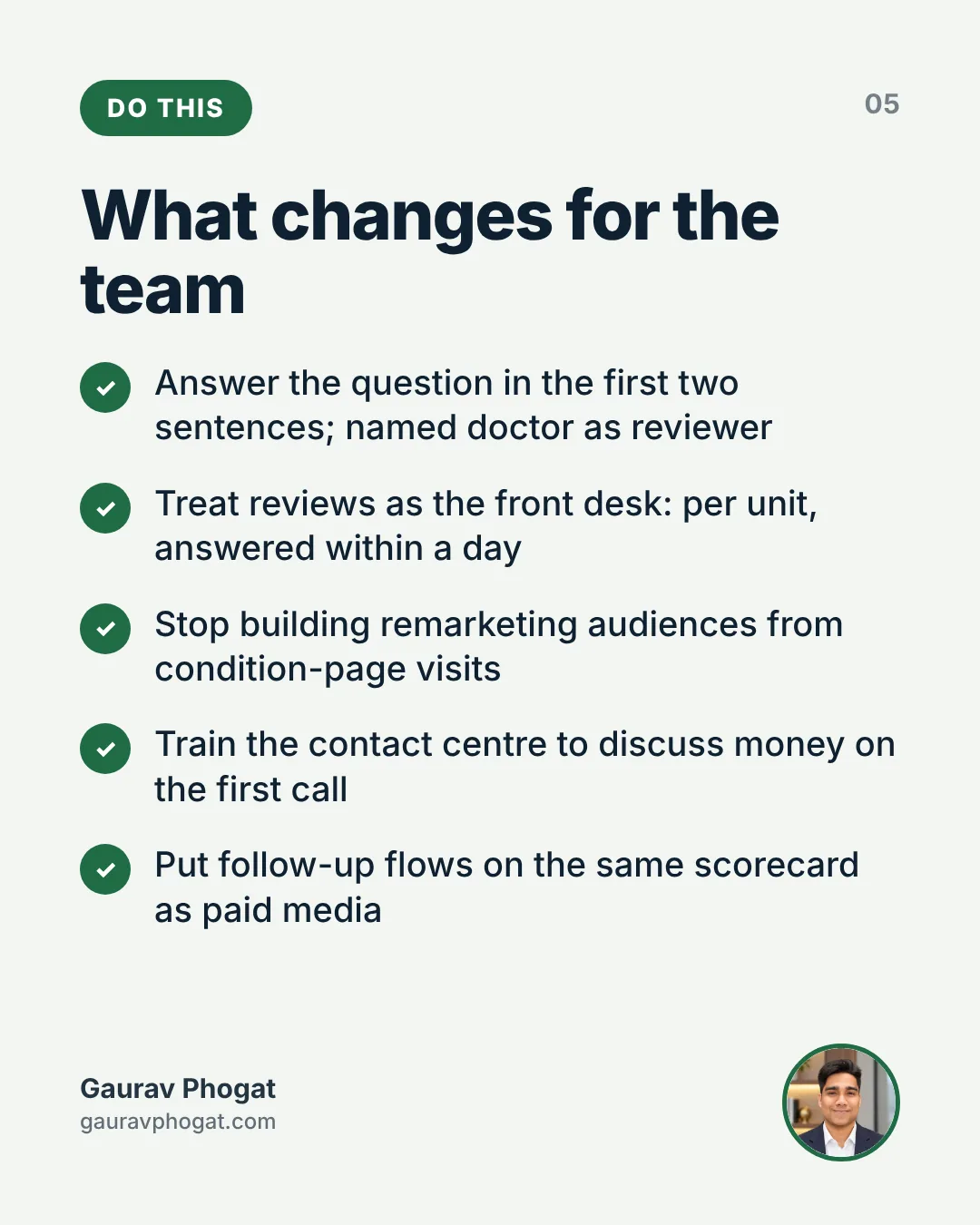
What changes for the team: the content job moves from ranking a page to being the source an answer is built from. In practice, what gets a hospital cited is unglamorous. Pages that answer the question in the first two sentences rather than after a paragraph about excellence. A named, qualified doctor as author or reviewer on every clinical page. FAQs that are structured and specific. Listing data (name, address, phone, specialties, timings) that is identical everywhere it appears. Inconsistency is the silent killer. If three directories carry three phone numbers for the same unit, no system will confidently recommend any of them.
Reviews sit inside the same machinery. Their volume, recency and substance feed what these answers say about you, and they are the first human voice a patient hears from your hospital. I now treat reviews as the front desk: owned per unit, answered within a day, escalated when a reply needs a clinician or the patient-relations team, and not as a reputation dashboard someone opens once a month.
What to ignore: anyone selling guaranteed placement in AI answers, and any tool that promises to optimise for them by generating hundreds of thin pages. A pile of weak content makes you less citable, not more.
Why is messaging the new front door for hospitals?
Patients have decided how they want to talk to a hospital, and it is in a chat thread, not on a form and often not on a call. They send a photo of a prescription, a voice note in their own language, a question about fees at eleven at night. Hospitals that still treat messaging as a broadcast channel for health-day offers are missing what it has become: the place enquiries start, appointments are confirmed, reports are shared and follow-ups happen.
What changes this year: messaging belongs inside the CRM and the contact centre, with the same queue ownership, response standards and booking authority as the phone line. Every thread should resolve to a patient record, carry its history, and be answerable by someone who can book a real slot. Automation earns its place here (confirmations, reminders, directions, report-ready notices, simple rescheduling), provided every automated flow has a visible, fast route to a person. The test: can a frightened caregiver who types “please call me” at midnight get a call within the hour? If not, the automation is deflecting, not serving.
What to ignore: blasting the whole database because the per-message cost looks trivial. The cost that matters is the patient who mutes your hospital and then misses the one notification that actually mattered to them.
Shift three: consent becomes a design constraint
Data protection under the DPDP framework has turned consent from a checkbox legal asked for into something that shapes how follow-up and remarketing are built. Your legal team owns the calendar; the direction matters more. The direction is clear: consent tied to a specific purpose, the ability to withdraw it, and an expectation that you can show what a patient agreed to.
For a marketing team the consequences are specific. Building remarketing audiences from visits to condition pages is the first thing I would stop, if you still do it. A list of people who read your oncology pages is exactly the kind of processing that is hard to defend to a patient, never mind a regulator. Follow-up journeys need consent captured at the point of enquiry, in plain language, separately for care communication and for promotion. The CRM has to record it, and every downstream tool has to respect it without someone remembering to filter a list before a send.
The upside is underrated. Consent-led, first-party follow-up (reminders, preparation instructions, post-discharge check-ins, a nudge for the review visit) usually does more for completed appointments than buying the same person back through paid media. The teams that treat this as a design brief rather than a compliance cost will end the year with a cleaner database and a cheaper funnel.
What to ignore: vendors offering “consented” data lists, and the belief that a longer privacy policy solves anything.
Shift four: the doctor’s own face is the unit of trust
Patients increasingly choose a doctor before they choose a hospital, and they choose from short video: a consultant explaining a condition plainly, in their own voice, in their own clinic. A phone camera and a doctor who explains well now beat polished hospital content. I have stopped fighting this.
What changes: the team’s job becomes running a programme, not producing assets. Choose which doctors to invest in by demand and capacity, not by seniority or by who asks loudest. Give them a simple kit and a producer who handles everything except the talking. Then build the governance most teams skip: what doctors can and cannot claim, who reviews clinical content before it goes out, how comments and direct messages are handled so nobody gives medical advice in a reply thread, and what happens to the channel if the doctor leaves. The hospital’s brand has to sit visibly behind every doctor, or you are funding someone else’s private practice.
What to ignore: follower counts as a goal. A consultant with a modest, local, engaged audience who fills their OPD is worth more than one with a national following and a next slot three weeks away.
Why is regional language where Tier 2 healthcare demand is decided?
For years regional-language content was a translation job done at the end, usually badly. In Tier 2 and Tier 3 catchments it is now where the decision gets made. The search, the video, the chat and the call happen in the patient’s language, and the hospital that answers in English first has already lost part of the family.
What changes: plan content in the language, do not translate into it. Doctors who explain well in the local language become your most valuable voices in those cities. Contact centre and messaging rosters need to match each catchment’s language mix. Listings, forms and confirmation messages should arrive in the language the patient chose, because a reminder the patient cannot read is not a reminder.
What to ignore: machine translation of clinical pages without a native-speaking clinician reviewing them. It saves a week and produces something nobody trusts.
Shift six: cost and cashless clarity convert
The question that decides many enquiries is not about the doctor. It is: what will this cost, and will my insurance cover it here? Patients now expect a direct answer, and the hospital that gives a clear consultation fee, an honest range for common procedures and a readable list of empanelled insurers and TPAs is the one they call back.
What changes: this is content and data work, not pricing policy. Publish consultation fees. Publish package ranges with what is included and what is not. Keep empanelment information current per unit, because an outdated list that sends a patient to a desk that says “not cashless here” does more damage than no list at all. Train the contact centre to discuss money on the first call instead of deflecting to billing.
What to ignore: discount-led creative for serious procedures. Clarity converts. A price cut dressed as a retail offer tells the patient something about your hospital you did not mean to say.
Shift seven: measurement moves to completed appointments
This is the shift that makes the others fundable. Lead counts are losing credibility with CFOs, and they should. The number that holds up is booked appointments (better still, completed ones) reconciled against the hospital information system, by unit and service line.
What changes: tie every channel’s reporting to the appointment, accept that part of it is estimated, and say so in the deck. Put first-party follow-up on the same scorecard as paid media. You will often find that a reminder flow or a tighter callback cadence produces more completed visits than the next increment of spend. And be clear-eyed about what attribution can honestly tell you in a business where a patient searches on one phone, asks a relative, calls from another number and walks in a week later.
What to ignore: multi-touch dashboards that hand out fractional credit to two decimal places. The precision is invented, and the CFO knows it.
The 2026 healthcare marketing trends I am not acting on
Several hospital marketing trends arrived this year with heavy promotion behind them. These are the ones I am leaving out of the budget.
- Chatbots that only deflect. A bot measured on how many conversations it closes without a human is optimising against the patient. If it cannot book, route or escalate, it is a wall with a friendly font.
- Influencer campaigns for serious conditions. Defensible for a preventive health check; wrong for oncology, cardiac or fertility, where the patient needs a qualified voice and the ethical exposure is real.
- Generic brand films. Beautiful, expensive and interchangeable with every other hospital’s. The same money spent on doctors explaining things and a booking journey that works buys more trust.
- Unreviewed AI content at volume. A liability the day a clinician reads it.
- Every new ad format. Most healthcare advertising trends are platform roadmaps, and the platform’s incentive is for you to test all of them. Test one a year, properly, against appointments.
Scepticism is not the same as ignoring. I will keep watching each of these. But in a hospital, an experiment that fails in front of patients costs more than one that fails in a retail app.
The order of operations for the next budget cycle
Taken together, the 2026 healthcare marketing trends worth acting on favour plumbing over production. If I were sequencing this for a group heading into planning, or for a single hospital with a smaller team, this is the order.
- Fix listings and entity data across every unit, directory and map, with a named owner per unit. It is the cheapest move on the list and the prerequisite for being cited.
- Bring reviews and messaging inside the contact centre, with queue ownership, response standards and a human escalation path at every hour.
- Rebuild consent capture at the point of enquiry, and stop building audiences from condition-page visits.
- Rewrite the top service-line pages answer-first, with named doctor reviewers and structured FAQs.
- Publish fees, package ranges and empanelment per unit, and train agents to talk about money on the first call.
- Choose a small number of doctors, by demand and capacity, for a governed video programme, in the local language where the catchment needs it.
- Move reporting to booked and completed appointments, with follow-up flows on the same scorecard as paid media.
- Only then ask for more paid reach, armed with a higher yield per enquiry.
None of this replaces a hospital marketing strategy. It is how I would stress-test one against what has changed this year, and most of the list will still be right when the next planning round comes around in early 2027.
The trends worth acting on are mostly about answering patients faster, more honestly and in their own language. That was always the job. The machines have simply started checking.




The future of healthcare marketing in India: 2027 and beyond
The seven shifts above are what I am funding in this budget cycle. This section looks further out. These are predictions, not certainties, so each one comes with the signal it is based on and the cheapest thing a hospital marketing team can do now to be ready. If a signal weakens, I will change the prediction at the next review of this page.
| Prediction for 2027 and beyond | Signal it is based on | What to do now |
|---|---|---|
| AI answers become the default front door, in Indian languages | Google AI Mode in India and seven more Indian languages in 2025; my AI recommendations study | Answer-first specialty pages in your top two languages |
| Booking moves into conversations and agents | Search Live in India; friction found in my OPD booking flow study | Make every chat channel able to see and book real slots |
| Consent becomes the growth engine | DPDP Rules notified 14 November 2025 with 18-month phased compliance | Capture purpose-specific consent at enquiry, recorded in the CRM |
| Portable records move loyalty from data to experience | Over 90 crore ABHA accounts and over 100 crore linked records by May 2026 | Accept ABHA in registration; make follow-up the reason to return |
| “Inform, do not promote” rewrites hospital creative | NMC guidelines in force since 6 October 2026 | Build a claims library and a doctor education programme |
| Bharat sets the volume, not the metros | 886 million internet users in 2024, 55% rural, 98% using Indic content | Plan content and contact-centre rosters by language |
| Older, insured patients and their children change the journey | PM-JAY extended to everyone aged 70 and above, irrespective of income | Publish empanelment per unit; design for the caregiver who books |
1. AI answers become the default front door, in Indian languages
The signal. Google launched AI Mode in India in June 2025, added Hindi that September and seven more Indian languages in October, alongside Search Live, according to TechCrunch. My own study of what AI assistants recommend for hospitals in India found that 86% of the sources the assistants linked were hospitals’ own websites, so your own pages are what the answer is built from.
What to do now. Rewrite the top service-line pages answer-first, starting with the two languages your catchment uses most, with a named doctor reviewer on each. Check every month what the main assistants say about your units, and fix the source page rather than the symptom. How hospitals get cited by AI search has the method.
2. Booking moves into conversations and agents
The signal. Voice and camera search are now live in India, and assistants are moving from answering to acting. Meanwhile my OPD booking flow study found that only 10 of 56 hospital websites showed a bookable slot before asking for personal details; almost half ended in a callback form.
What to do now. Expose real appointment availability to your own WhatsApp, chat and contact-centre tools through one source of truth, so any channel (and later any assistant you choose to allow) can book, reschedule and confirm. A journey that only works on the website will feel dated by 2027.
3. Consent becomes the growth engine
The signal. The Digital Personal Data Protection Rules were notified on 14 November 2025 with an 18-month period for phased compliance, according to the Press Information Bureau, which brings full obligations into effect around mid-2027.
What to do now. Capture consent at the point of enquiry, separately for care communication and promotion, and record it in the CRM so every tool honours it. The hospitals that grow fastest after 2027 will be the ones whose patients are glad to hear from them, not the ones with the biggest lists. My notes on hospital CRM implementation cover the plumbing.
4. Portable records move loyalty from data to experience
The signal. A July 2026 government release on the Ayushman Bharat Digital Mission reported that over 100 crore health records were linked to more than 90 crore ABHA accounts by May 2026. When records travel with the patient, holding the file stops being a reason to come back.
What to do now. Accept ABHA at registration and booking, make it easy for patients to share reports with you before a visit, and invest in the follow-up experience (reminders, review visits, report explanations) that becomes the real reason to return.
5. “Inform, do not promote” rewrites hospital creative
The signal. The NMC Guidelines on Ethical Advertising and Public Communication have been in force since 6 October 2026, barring testimonials, superlatives, offers and celebrity patient stories for doctors and hospitals. My NMC 2026 compliance hub sets out the detail.
What to do now. Build a claims library of approved factual statements per specialty, retrain agencies, and move budget from brand films to doctor-led education. Run every live asset through the NMC ad compliance checker. The healthcare marketing examples from India that still work under these rules are the educational ones.
6. Bharat sets the volume, not the metros
The signal. The IAMAI and Kantar Internet in India Report 2024 counted about 886 million active internet users, 55% of them rural, with 98% accessing content in Indic languages, as reported by PTI.
What to do now. Plan content in the language rather than translating into it, roster the contact centre and messaging queues by language, and send confirmations in the language the patient chose. In my benchmark of 100 hospital websites, only 14% offered a genuine Indian-language version.
7. Older, insured patients and their children change the journey
The signal. The Union Cabinet extended PM-JAY to all citizens aged 70 and above irrespective of income on 11 September 2024, and the Ayushman Vay Vandana card rolled out on 29 October 2024, according to the Press Information Bureau. More older patients will arrive with cover, often booked by a son or daughter in another city.
What to do now. Publish empanelment and cashless information per unit, train agents to explain scheme eligibility on the first call, and design journeys for the caregiver: booking on behalf of a parent, sharing updates with family, and readable reminders for the patient.
What I am less sure about: how quickly AI assistants will be allowed to book on a patient’s behalf, and whether regulators will treat assistant recommendations as advertising. Both could move faster or slower than I expect. The moves above are worth making either way, because each one also improves the experience for the patient who never uses an assistant at all.
Further reading from primary sources
- Google Search Central: AI features and your website: how pages appear in AI Overviews and AI Mode.
- DPDP Rules, 2025 (Press Information Bureau): India’s notified data protection rules and timeline.
- IBEF: Healthcare industry in India: sector overview and growth drivers.
Questions people ask
The biggest shift is that an AI-generated answer is often the first thing a patient reads, before any search results page. That rewards hospitals with answer-first pages, named doctor reviewers, structured FAQs and identical listing data everywhere. It is not a new channel to buy. It is a standard of clarity and consistency that most hospital sites and directory listings do not yet meet, and fixing it is mostly unglamorous data work.
The ones I am acting on: AI answers as the first touch, messaging as the front door and CRM channel, consent under DPDP shaping follow-up, doctors’ own video as the unit of trust, regional-language content deciding Tier 2 demand, cost and cashless clarity as a conversion lever, and measurement moving to completed appointments. Everything else on most trend lists is a platform feature looking for a budget.
Fund the plumbing before the production: clean listings, messaging inside the contact centre, consent capture, answer-first service-line pages, published fees and empanelment, and reporting against completed appointments. These are mostly operational and content costs, not media. Ask for more paid reach last, once the yield per enquiry has improved, because the same spend then produces more appointments. A CFO should be wary of any trend pitched without an appointment-level measure attached.
Paid media is becoming less about new formats and more about what happens after the click. Remarketing built on condition-page visits is getting hard to defend under consent obligations, lead counts are losing credibility, and the yield of each enquiry matters more than reach. I test one new format a year, properly, against booked appointments. Most new formats are platform roadmaps, and the platform benefits whether or not you do.
Treat DPDP as a design constraint rather than a legal footnote. Capture consent at the point of enquiry, in plain language, separately for care communication and for promotion, and record it in the CRM so every tool respects it automatically. Stop building audiences from visits to condition pages. Your legal team should own the timelines; marketing should own making sure follow-up journeys are built around what the patient actually agreed to.
Some move within weeks: bringing messaging into the contact centre with booking authority, fixing listing inconsistencies and publishing fees usually show up in the first ninety days. Answer-first content, regional-language programmes and doctor video take two or three quarters to compound. Measurement changes are immediate but uncomfortable, because the first honest appointment number is usually lower than the one circulating. Plan the budget cycle around that sequence rather than expecting everything at once.
Yes, for the doctors chosen by demand and capacity, not seniority. Short, plain explanations from a consultant now build more trust than polished hospital content. Marketing should run it as a programme: a producer, a simple kit, and written governance covering what can be claimed, clinical review before publishing, how comments and messages are handled, and what happens to the channel if the doctor leaves. The medical director should sign that governance.
Yes, and some matter more for it than for a metro group. Regional-language content, messaging in the patient’s language and clear cost and cashless information decide Tier 2 demand. A single hospital does not need a large team: clean listings, answered reviews, a staffed messaging queue and two or three doctors explaining conditions locally will do more than any campaign. The order of operations is the same, just smaller.
Answer the question in the first two sentences of each page, put a named and qualified doctor on every clinical page as author or reviewer, write structured and specific FAQs, and keep name, address, phone, specialties and timings identical across every directory. Recent, substantive reviews help too. Avoid anyone promising guaranteed placement or generating hundreds of thin pages; weak content at volume makes a hospital less citable, not more.
Only if they can book, route or escalate to a person quickly. A chatbot measured on how many conversations it closes without a human is optimising against the patient. The useful automation is narrower than the pitch: confirmations, reminders, directions, report-ready notices and simple rescheduling, each with a visible route to someone who can help. If a worried caregiver cannot get a call within the hour, the bot is a wall.
The team that owns the contact centre and CRM, not a social media agency. Messaging, reviews and follow-up are front-desk work that needs queue ownership, response standards and booking authority. In a group, give each unit a named owner for its listings and reviews, and keep the standards, tooling and reporting central. The skills you need are closer to patient service and operations than to content creation.
Ask for reporting against booked and completed appointments instead of leads, with brand and non-brand separated. Ask them to stop remarketing on condition-page visits, to route every enquiry into your CRM rather than a platform dashboard, and to put new formats through a single structured test a year. Give them visibility of contact centre outcomes in return. Agencies that cannot work to appointments will become obvious within a quarter.
Completed appointments by unit and service line, reconciled against the hospital information system, alongside marketing and contact centre cost. It is not a perfect attribution number and should not be presented as one. What matters is that it moves with the work that is changing this year (follow-up, messaging, cost clarity, answer-first content), and that it cannot be improved by counting something cheaper.
Listings and entity data. Make every unit’s name, address, phone, specialties and timings identical across every directory and map, and name an owner for each unit. It costs time rather than money, it is the prerequisite for being cited in AI answers, and it stops patients reaching wrong numbers. Next cheapest: publish consultation fees and empanelment lists, and answer every review within a day.
From 2027, I expect AI answers in Indian languages to become the first touch, booking to move into chat and assistants, consent under the DPDP Rules to decide who can follow up, portable ABHA-linked records to shift loyalty towards experience, the NMC 2026 rules to make hospital creative educational, rural and Indic-language users to set the volume, and older insured patients booked by their children to reshape journeys.
AI will decide which hospitals are named in answers and, increasingly, which slots get booked through assistants. That rewards hospitals with answer-first pages in local languages, identical listing data everywhere, named doctor reviewers and a booking system that any channel can read. It does not reward volume of AI-written content, which makes a hospital less citable, not more.
Fund the foundations that every prediction depends on: one source of truth for appointment slots, consent recorded in the CRM, ABHA-ready registration, language-first content and a claims library that meets the NMC 2026 rules. These are platform and data investments rather than media, and they compound whichever way the market moves.
Read my takes first in Google Search