
Local SEO vs Google Ads for clinics: where to spend first
For most clinics, local SEO comes first and Google Ads second. A complete, accurate Google Business Profile and a strong doctor page win the free map and organic results that drive most nearby bookings. Use Google Ads to fill specific gaps: a new service, a new location, or slots that stay empty. Judge both on cost per honoured appointment.
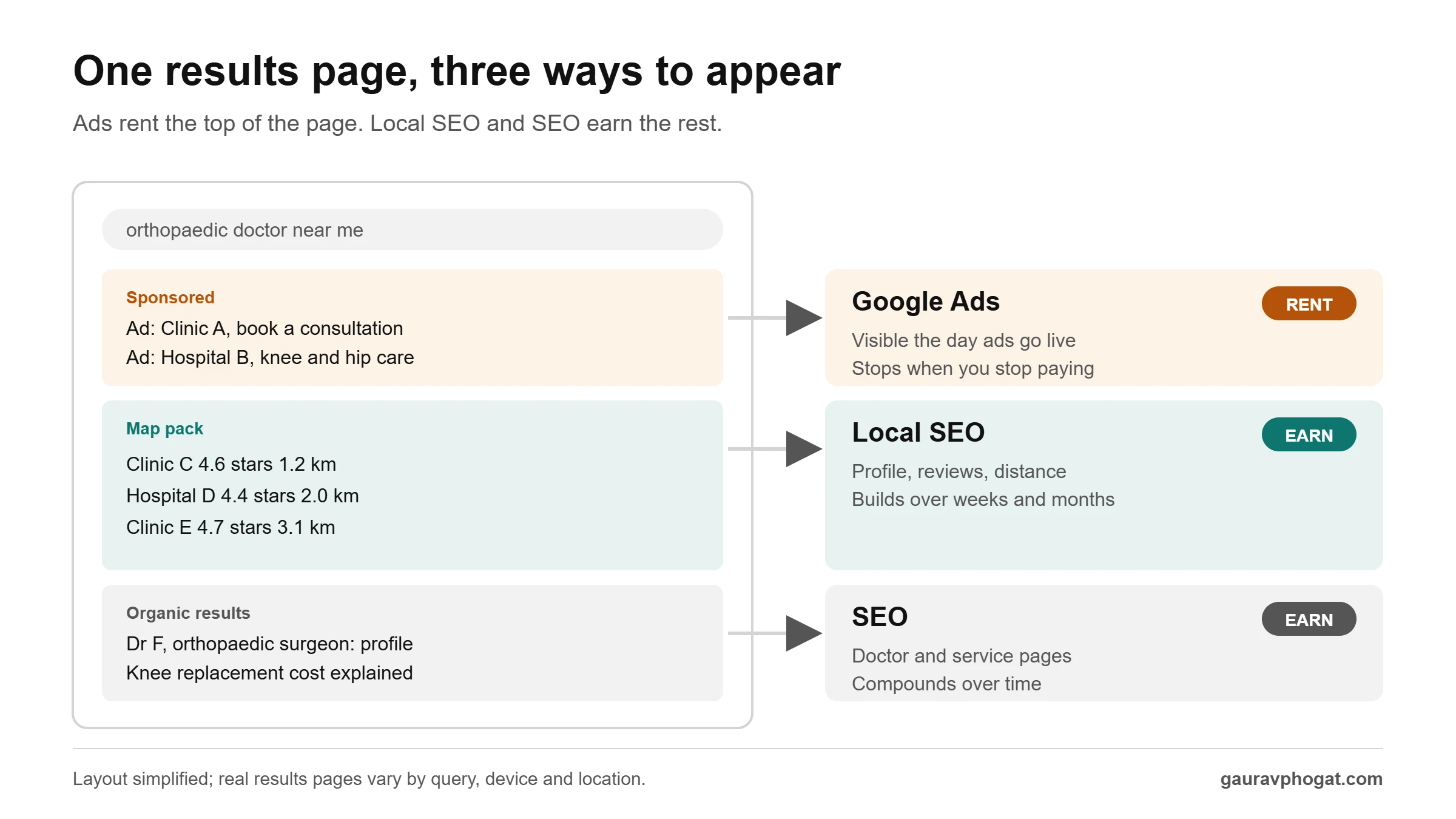
Clinic owners often ask which one to start with, as if local SEO and Google Ads were rival products. They are better seen as two layers of the same search results page. Local SEO earns the map pack and organic listings for free, slowly. Google Ads rents the top of the page immediately, for as long as you pay. The question is not which is better but which gap you are trying to close, and how fast.
Local SEO vs Google Ads: at a glance
| Local SEO | Google Ads | |
|---|---|---|
| What you get | Map pack and organic listings for nearby searches | Paid positions above or beside results, plus call and location assets |
| Speed | Weeks to months to build | Same day once ads are approved |
| Ongoing cost | Time and content; no fee per click | Pay per click, every click |
| When you stop | Visibility decays slowly | Visibility stops at once |
| Best for | Steady demand for core specialties and doctors near you | New services, new locations, empty slots, competitive or seasonal demand |
| Main risk | Neglected or inaccurate profile, slow reviews | Wasted spend on research and job queries, healthcare policy limits |
| Who should own it | The clinic, with front-desk input on hours and services | The clinic owns the account; an agency or staff member can run it |
| Judge it on | Calls, direction requests and bookings from the profile and site | Cost per honoured appointment, brand and non-brand reported separately |
Why local SEO usually comes first
Most patients looking for a clinic search with a place in mind: a specialty near them, a doctor’s name, a hospital in their area. Those searches are dominated by the map pack, which is driven by your Google Business Profile, its accuracy, its reviews and how relevant your website is. Google’s own guidance says local ranking depends mainly on relevance, distance and prominence. Ads cannot buy distance, and they do not fix an outdated phone number or a profile with no recent reviews.
Local SEO is also the foundation ads stand on. An ad that sends a patient to a slow page with the wrong OPD timings wastes the click. Fixing the profile, the doctor pages and the landing pages first makes every later rupee of paid search work harder. My comparison of Google Business Profile vs website covers which of those to fix first.
When Google Ads should come first
- A new location or service. A new clinic has no reviews, no history and no rankings. Ads buy visibility while the profile matures.
- Empty slots you need to fill now. Paid search can be turned up for a specialty with spare capacity and down when it is full.
- High-value procedures with competitive search. Where a few bookings justify the cost, paid positions are worth testing alongside organic work.
- Seasonal or campaign demand. Health check-ups and awareness months create short windows that organic work cannot catch in time.
Healthcare ads face stricter review. Some services, such as prescription medicines and certain procedures, are restricted, and landing pages are checked. Read Google’s healthcare and medicines policy before you build campaigns, and see what gets disapproved and why.
How to split the budget
I will not give a percentage, because it depends on competition, capacity and how mature your profile is. A practical sequence works better than a ratio:
- First month: fix the Google Business Profile, doctor pages and landing pages. Set up call and booking tracking.
- Months two and three: start a small brand campaign and one or two non-brand campaigns for the services with spare capacity. Add negatives for jobs, courses and free-treatment queries.
- From month four: compare cost per honoured appointment from paid search with bookings from the profile. Move money towards what books, and keep investing in reviews and content that compound.
If you run several locations, do this per location. One unit may be organically strong and need almost no ads, while a newer unit leans on paid search for a year.
What to measure for each
For local SEO, track calls, direction requests, website clicks and bookings from the profile, plus the number and recency of reviews. For Google Ads, track conversions that reach the front desk: booked and honoured appointments, reconciled with the CRM, with brand and non-brand reported separately so your own name does not flatter the account. The single number that lets you compare them is cost per honoured appointment.
The common mistake
Running ads to cover for a weak profile. Ads can hide the problem for a while, but every month the clinic pays for clicks that a well-kept profile would have earned free. Fix the foundation, then rent the extra reach.
Questions people ask
Usually, over time. Local SEO has no fee per click, but it needs steady time for profile updates, reviews and content. Google Ads costs money for every click but delivers visibility immediately. For most clinics with steady local demand, local SEO gives a lower cost per appointment once established, and ads fill specific gaps.
Expect weeks for the profile to appear reliably and several months to compete in the map pack, depending on competition and how quickly genuine reviews build. Use a small Google Ads budget during that period so the clinic is visible from day one.
No. Paid ads do not change organic or map rankings. They can show your location in ad slots, but your map pack position depends on relevance, distance and prominence, which come from your profile, reviews and website.
Only if there is spare capacity to fill or a specific service to promote. Many single-doctor clinics fill their slots through a well-kept profile, reviews and referrals. If you do run ads, keep the account in your name, start small and track booked appointments, not clicks.
Further reading from primary sources
- Google Business Profile Help: Tips to improve your local ranking
- Google Advertising Policies Help: Healthcare and medicines
Read my takes first in Google Search