World Polio Day: How Pulse Polio’s Do Boond Zindagi Ki Helped India Beat Polio
Published · By Gaurav Phogat
World Polio Day is marked on 24 October. India’s Pulse Polio programme, with its line “Do Boond Zindagi Ki” (two drops of life) and Amitabh Bachchan as its best known voice, is one of the clearest cases of health communication working alongside a huge field operation. The lesson: one short, repeatable ask works only when trusted messengers and people on the ground carry it to the families who doubt it.
About World Polio Day
World Polio Day falls on 24 October. It was established by Rotary International and marks the birthday of Jonas Salk, who led the first team to develop a polio vaccine (Wikipedia: World Polio Day). It sits within a larger effort: the Global Polio Eradication Initiative (GPEI), founded in 1988 by Rotary and its partners when polio affected 350,000 children a year (Rotary). On the day, Rotary asks clubs and supporters to host or promote events, attend one locally and share their own polio stories, and public health groups use it to review progress towards ending the disease for good (Rotary).
This article is part of the healthcare PR and communications series, best read in order from the pillar.
Pulse Polio, “Do Boond Zindagi Ki”: two drops, every round
| Campaign | Pulse Polio, “Do Boond Zindagi Ki” |
| Organisation | Ministry of Health and Family Welfare, with WHO, UNICEF and Rotary |
| Agency | Ogilvy and Mather (mass communication from around 2002) |
| Year and country | Delhi pilot 2 October 1994, national from 1995, India |
| Linked health day | World Polio Day, 24 October |
| Timed to the day? | No, it ran on national immunisation days |
| Channels | Radio, TV, print, posters, celebrities, booths, house-to-house teams, religious and community leaders |
| Headline result | Last wild polio case 13 January 2011; India certified polio-free 27 March 2014 |
| Recognition | No specific awards verified |
The problem it had to solve
Ending polio meant giving oral vaccine to every child under five, again and again, across a country of India’s size. The communication problem had three layers. First, scale: each national round aimed at nearly 172 million children (Al Jazeera). Second, fatigue and confusion: parents did not understand why a child who had already had drops needed them again (Wikipedia: Pulse Polio). Third, resistance: rumours that the drops caused infertility or contained animal products, and distrust of health workers in some communities (Wikipedia). In the 2002 outbreak, Uttar Pradesh and Bihar accounted for more than 95% of cases (Social Samosa). As late as 2009, India had 741 cases, more than half of the world’s total (UNICEF India).
The idea in one line
Two drops of life, for every child, in every round.
How it worked
Launch and scale-up. Pulse Polio began on 2 October 1994 as a Delhi Government campaign led by Dr Harsh Vardhan, targeting about 1 million children up to age three at booths, with the “Do Boond Zindagi Ki” line. In 1995 it went national with a door-to-door strategy (Social Samosa).
Mass media. Radio was the main medium until 2003, after which the focus moved to TV spots and films. Around 2002, at the request of the Health Ministry and UNICEF, Ogilvy and Mather took on mass communication, and filmmaker Santosh Sivan directed several of the ads (Social Samosa). Amitabh Bachchan became the face of the campaign in 2002 and was appointed a UNICEF Goodwill Ambassador in April 2005. His core message was that parents must give their children two drops in every round (UNICEF India). Shah Rukh Khan, AR Rahman, Sachin Tendulkar and others also appeared (Social Samosa). As cases fell, the tone moved towards hope, with posters telling parents the finish line was close.
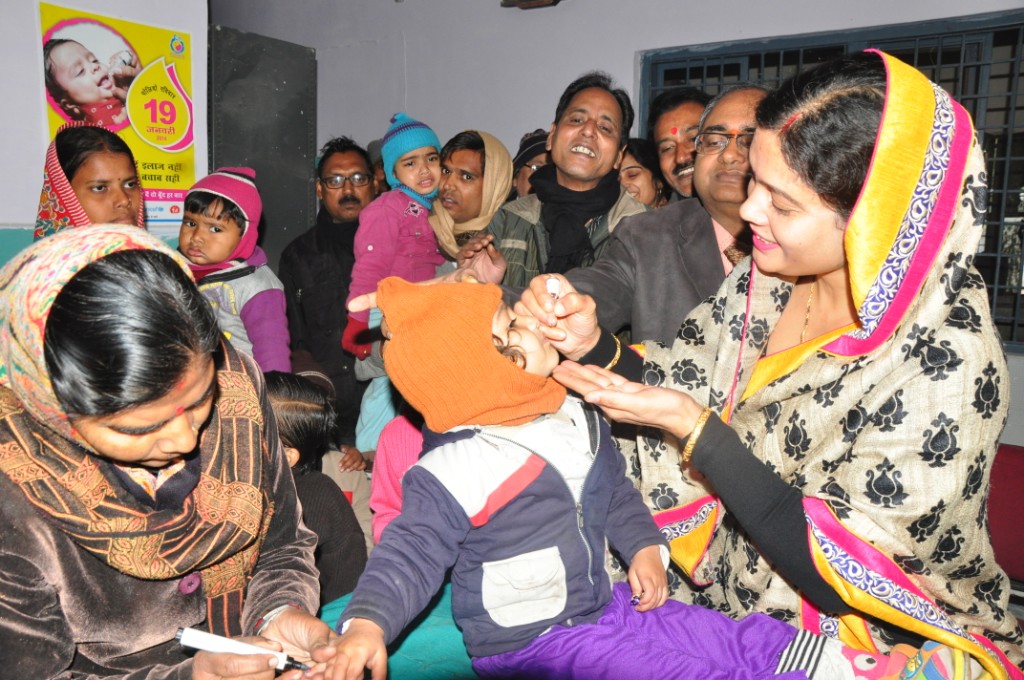
The ground game. Each national round involved about 2.4 million vaccinators and 150,000 supervisors visiting over 200 million households (Al Jazeera). Teams vaccinated children in transit at bus stations, construction sites and on trains. A 107-block plan focused on the highest-risk areas of Uttar Pradesh and Bihar, sewage sampling gave early warning, and clerics and madrasa teachers encouraged vaccination in Muslim communities (GPEI factsheet). Ulema committees played a critical role in Uttar Pradesh and Bihar, and field workers spent hours winning over individual families (Al Jazeera).
Results
- Cases fell from 741 in 2009 to 42 in 2010 (GPEI factsheet).
- The last wild polio case was reported on 13 January 2011 (Wikipedia), an 18-month-old girl in Howrah district, West Bengal (GPEI factsheet).
- WHO removed India from the list of polio-endemic countries on 25 February 2012 (Social Samosa) and declared India polio-free on 27 March 2014 (Wikipedia).
These are programme outcomes, and communication was one part of a much larger operation that included vaccine supply, cold chain, surveillance and millions of health workers. No study I found isolates the effect of the advertising alone, so it is fair to say the campaign helped, not that it did it.
What makes it stand out
- A line that is also the instruction. “Do Boond Zindagi Ki” says what to do (two drops) and why (life) in three words.
- A messenger with authority. Bachchan’s voice reached rural parents who would not listen to a ministry announcement, and his message tackled the repeat-dose confusion directly.
- Local trust where it mattered. Religious leaders, teachers and community mobilisers carried the message into homes that mass media could not persuade.
- Consistency over years. The same line ran for more than a decade, so it became part of everyday language.
- Tone that changed with the data. As the end came closer, messaging moved to hope and the final push.
Criticism and limits
- Opportunity cost. Some public health activists argued the polio focus came at a high cost while other needs were neglected, pointing to tens of thousands of non-polio paralysis cases and the way polio infrastructure crowded out other care (Al Jazeera).
- Rumours took years to counter. Resistance in some communities persisted well into the 2000s and needed intensive local work, which mass media alone could not fix (Wikipedia).
- Vaccine-derived polio. Cases of vaccine-derived poliovirus were still being detected after the last wild case, including one in Navi Mumbai in 2013 (Wikipedia), which the simple “two drops” story did not explain.
- Fatigue. Repeated rounds wore down both parents and health workers, and the programme reported weak community support and campaign fatigue in some areas (Wikipedia).
- “Polio-free” is not “done”. Rotary’s India polio chief called the label slightly misplaced, warning that immunity must stay high while the virus exists elsewhere (Al Jazeera).
Would it pass in India today?
As a government public health campaign, it is outside the NMC guidelines, which govern practitioners and their promotion. For a hospital echoing it, the useful line is clear. Supporting a national immunisation day with reminders, booth information and doctor talks is health education under clause 8.2 of the NMC 2026 guidelines. A celebrity teaching a public health message is fine, but a celebrity presented as the hospital’s patient or recommending it is not (clauses 8.1(ii) and 8.1(v)). If a hospital creates a lookalike or AI version of a famous voice, clause 7.2 applies. Under ASCI’s guidelines, no hospital should imply that it ended polio; the credit belongs to the national programme.
Watch or see the campaign: UNICEF India on Amitabh Bachchan and the polio campaign
What an Indian hospital can borrow for World Polio Day
What I take from Pulse Polio is that a slogan is only as good as the people who repeat it at the doorstep.
1. A routine immunisation reminder service (Low: under Rs 1 lakh)
Channel: an opt-in WhatsApp or SMS reminder for vaccine due dates, offered at your paediatric OPD and maternity discharge, launched around 24 October with a short explainer reel. Compliance: explicit consent and a clear purpose under the DPDP Act, reminders written as health information (clause 8.2), and no “best paediatrician” claims (clause 8.1(iii)).
2. Support the national immunisation days locally (Low to Mid)
Channel: Google Business Profile posts, website banners and posters announcing if your hospital is a vaccination booth on immunisation days, with timings and what to bring. Compliance: factual information about services and facilities (clauses 8.3 and 9.1), credited to the government programme.
3. Trusted messengers for vaccine doubts (Mid: Rs 1 to 10 lakh)
Channel: a short video series where your paediatricians, in their own names, answer the common vaccine doubts parents raise, plus sessions with schools, anganwadi workers and community or faith leaders. Compliance: talks in the doctor’s own name are allowed (clause 8.2), parents who take part are not used as endorsers (clause 8.1(ii)), and any AI-generated explainer must be labelled (clause 7.2).
Related reading
- Iconic Health Campaigns: the full series
- Health awareness days calendar for India
- Healthcare PR in India: getting announcements picked up
Sources
- Wikipedia: World Polio Day
- Rotary: World Polio Day reviews the bold steps taken to end polio
- Wikipedia: Pulse Polio
- Social Samosa: Brand Saga, Pulse Polio Do Boond and Balbir Pasha
- UNICEF India: Amitabh Bachchan
- Al Jazeera: How India won over polio drop by drop
- GPEI: Polio in India factsheet
Questions people ask
Rotary International chose 24 October to mark the birthday of Jonas Salk, who led the first team to develop a polio vaccine.
It began on 2 October 1994 as a Delhi Government campaign led by Dr Harsh Vardhan and went national in 1995 under the Ministry of Health and Family Welfare, with WHO, UNICEF and Rotary as partners.
It paired one simple, repeated ask, “two drops in every round”, with trusted messengers such as Amitabh Bachchan and local religious and community leaders, and with a field operation of about 2.4 million vaccinators per round. India’s last wild polio case was in January 2011, and it was certified polio-free in March 2014.
Share clear information on routine immunisation schedules, answer common vaccine doubts through doctor-led videos, and promote local immunisation days with factual details. Credit the national programme and avoid patient endorsements or “best” claims under the NMC 2026 guidelines.
Read my takes first in Google Search