Global ALS/MND Awareness Day: What the Ice Bucket Challenge Teaches Health Marketers
Published · By Gaurav Phogat
Global ALS/MND Awareness Day falls on 21 June. The most famous ALS campaign, the Ice Bucket Challenge, had nothing to do with that date: it spread in July and August 2014 and raised $115 million for the ALS Association. The lesson: a simple, filmable act with a built-in nomination can spread on its own, but it rarely happens twice.
About Global ALS/MND Awareness Day
Global ALS/MND Awareness Day is marked every year on 21 June. It began in 1997, led by the International Alliance of ALS/MND Associations, and the date is the summer solstice, which the UK’s MND Association says symbolises light, strength and the resilience of the MND community (MND Association, International Alliance of ALS/MND Associations). The day asks people to raise awareness, share the stories of people living with the disease, join the conversation online and support research and care charities. In India, 21 June is also the International Day of Yoga, proclaimed by the UN in 2014 (UN), so any ALS message that day competes for attention.
See every healthcare PR and communications guide in one place.
ALS Ice Bucket Challenge: the nomination that went global
| Campaign | ALS Ice Bucket Challenge |
|---|---|
| Organisation | Grassroots, popularised by Pat Quinn and Pete Frates; main beneficiary the ALS Association |
| Agency | None: user-generated |
| Year and country | July to August 2014, United States, then worldwide |
| Linked health day | Global ALS/MND Awareness Day (21 June) |
| Timed to the day? | No |
| Channels | Social video, then news coverage |
| Headline result | $115 million to the ALS Association in 2014; more than $220 million worldwide |
| Recognition | No award verified for this article |
The problem it had to solve
ALS was a disease most people had never thought about, and awareness alone does not pay for research. No one planned a campaign to fix this. The challenge was an existing cold-water dare that got attached to ALS.
The idea in one line
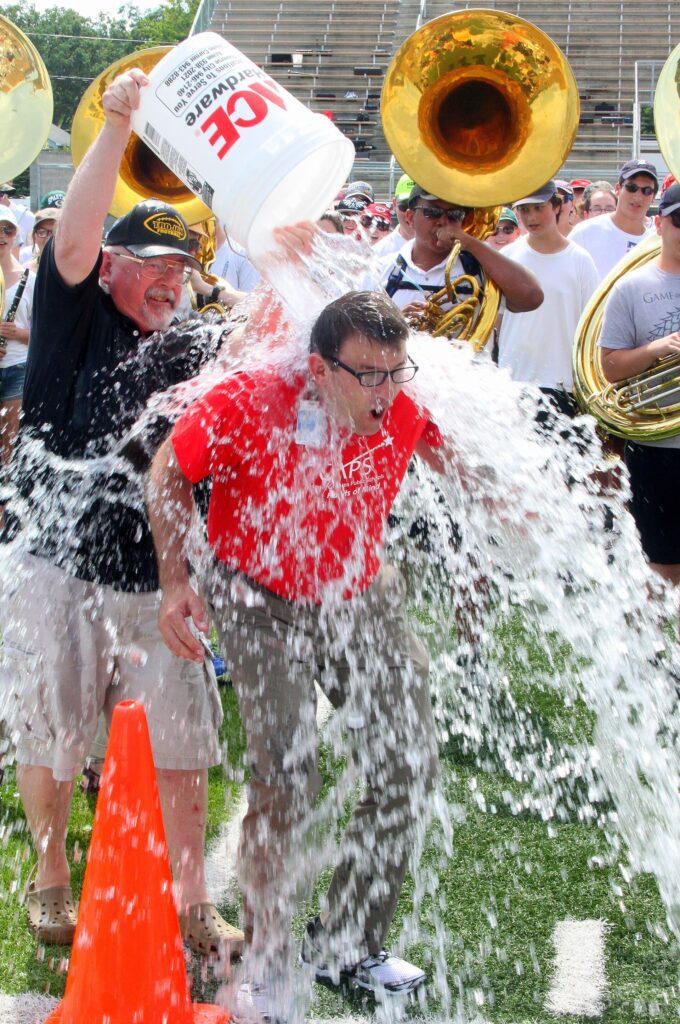
Film yourself taking a bucket of ice water, donate, and nominate three people to do the same.
How it worked
The challenge grew out of an earlier cold-water dare. Golfer Chris Kennedy’s video on 30 June 2014 is the first documented link to ALS, and Pat Quinn and Pete Frates, a former minor league baseball player diagnosed with ALS in 2012, pushed it into a movement, with Frates’s Boston network making the city its strongest hub (Wikipedia). The rules were simple: nominated people had about 24 hours to film the challenge or donate, and doing both was encouraged. Every participant could nominate at least three others, so the reach grew with each post. Celebrities, politicians and athletes joined, and news coverage followed the social spread.
Results
The ALS Association says the challenge united 17 million people and raised $115 million (ALS Association). Between 29 July and 21 August 2014 alone it received $41.8 million from more than 739,000 new donors, against $19.4 million in the same period a year earlier. More than $220 million was raised worldwide (Wikipedia). The ALS Association’s 2015 report put 67% of the money (about $77 million) into research, and in July 2016 the ALS Association announced that a team at UMass Medical School had identified a new ALS-linked gene, NEK1, with help from challenge funds (Wikipedia). The association also reports that multidisciplinary ALS clinics more than doubled after 2014 (ALS Association), though that is the charity’s own figure and has many causes.
What makes it stand out
- Insight: people will do something slightly uncomfortable if it is public, fun and done by their friends.
- The nomination is the distribution plan: every participant recruits three more.
- A 24-hour deadline creates urgency without any media spend.
- The act is visual, short and instantly understood in any language.
- Real people with ALS at the centre gave it credibility beyond a stunt.
Criticism and limits
Critics called it slacktivism: the fun could replace the giving. In the UK, the Charities Aid Foundation found that about one in six people took part but only about 10% of participants donated. The philosopher William MacAskill argued that around half of the money might have gone to charity anyway, just elsewhere. In the US, about 5 million gallons of water were estimated to have been used at the peak, during a drought in California. The ALS Association also applied to trademark “ice bucket challenge” and withdrew a day later after criticism (Wikipedia).
Most importantly for planners: it did not repeat. The 2015 relaunch raised a tiny fraction of the 2014 total, and one survey found only 14% of 2014 donors gave again (Wikipedia). Viral moments are found, not scheduled.
Would it pass in India today?
A public fundraising challenge is fine. A hospital using it for promotion needs care. Doctors taking part in their own name, with health education about the disease, fits clause 8.2 of the NMC 2026 guidelines. Featuring identifiable patients or celebrity patients to promote the hospital runs into clauses 8.1(ii) and 8.1(v), and clause 6.2 says consent does not make that acceptable. If a hospital edits or generates challenge videos with AI, clause 7.2 requires labelling. In the Indian summer, water waste would also invite criticism, so a water-free version is wiser.
Watch or see the campaign: ALS Association: the Ice Bucket Challenge
What I take from this
Planners often ask for “our own Ice Bucket Challenge”. That is the wrong brief. Nobody designed this one, and its own owners could not repeat it a year later. What can be designed are the parts that made it spread: a small public act, a social nudge to pass it on, a short deadline and a clear place to give. Even then, the honest goal for a hospital is not virality. It is that, on 21 June, families affected by ALS find clear information and a route to care and support, and that more people know the disease exists.
What an Indian hospital can borrow for Global ALS/MND Awareness Day
- Neurologist explainer series (Low: under Rs 1 lakh). Channel: YouTube Shorts, Instagram and LinkedIn in the week of 21 June. Your neurologists explain early signs, how diagnosis works and where families find support, in their own names. Compliance: health education in the doctor’s name is allowed under clause 8.2 of the NMC 2026 guidelines; describe services and facilities factually (8.3, 9.1); no “best neurologist” claims (8.1(iii)).
- A water-free nomination challenge (Mid: Rs 1 to 10 lakh). Channel: Instagram Reels and WhatsApp, seeded with staff and local influencers. Pick one simple, filmable action that hints at living with weakness in the hands or voice, ask people to nominate three friends and point them to a patient support group or research charity. Compliance: no patient faces or stories used to promote the hospital (8.1(ii), 8.1(v)); label any AI filters or edits (7.2); influencers must disclose the partnership (ASCI).
- Caregiver support hub (High: above Rs 10 lakh). Channel: a dedicated web hub with guides, a helpline callback form and recorded talks, promoted through search and social. ALS is a long journey for families, so content for caregivers has a longer life than a one-day stunt. Compliance: callback forms need explicit, purpose-specific consent under the DPDP Act; keep claims about outcomes factual and sourced (ASCI).
Related reading
- Health awareness days in India: the full calendar
- Iconic Health Campaigns: the series hub
- Hospital social media marketing
- NMC advertising guidelines 2026, explained
Sources
- MND Association: Global MND Awareness Day
- International Alliance of ALS/MND Associations: Global Day
- UN: International Day of Yoga
- Wikipedia: Ice Bucket Challenge
- ALS Association: Ice Bucket Challenge
Questions people ask
It is observed every year on 21 June, the summer solstice. It began in 1997, led by the International Alliance of ALS/MND Associations.
The cold-water dare existed before 2014. Pat Quinn and Pete Frates (diagnosed with ALS in 2012) turned it into an ALS movement in summer 2014, and the ALS Association became its main beneficiary.
It was simple, visual and social, and every video nominated three more people within a deadline. That turned each participant into the campaign’s media. It raised $115 million for the ALS Association in 2014.
Share doctor-led education on early signs and care, point families to support groups, and if you run a challenge, keep patients out of promotional content as India’s NMC 2026 guidelines require.
Read my takes first in Google Search